
Behind the Meter (BTM): what it is and how it works in energy
Behind the Meter (BTM) is a term used in the electricity sector to describe equipment, resources and loads located on the user’s side of the electricity meter. In other words, these are assets installed within the consumer’s premises whose operation first affects their consumption, demand or bill before interacting with the public grid.
A BTM system can be as simple as a rooftop solar installation on a home or as complex as a factory with photovoltaics, BESS, electric vehicle chargers, flexible loads and an EMS responsible for optimising when to consume, store or export energy.
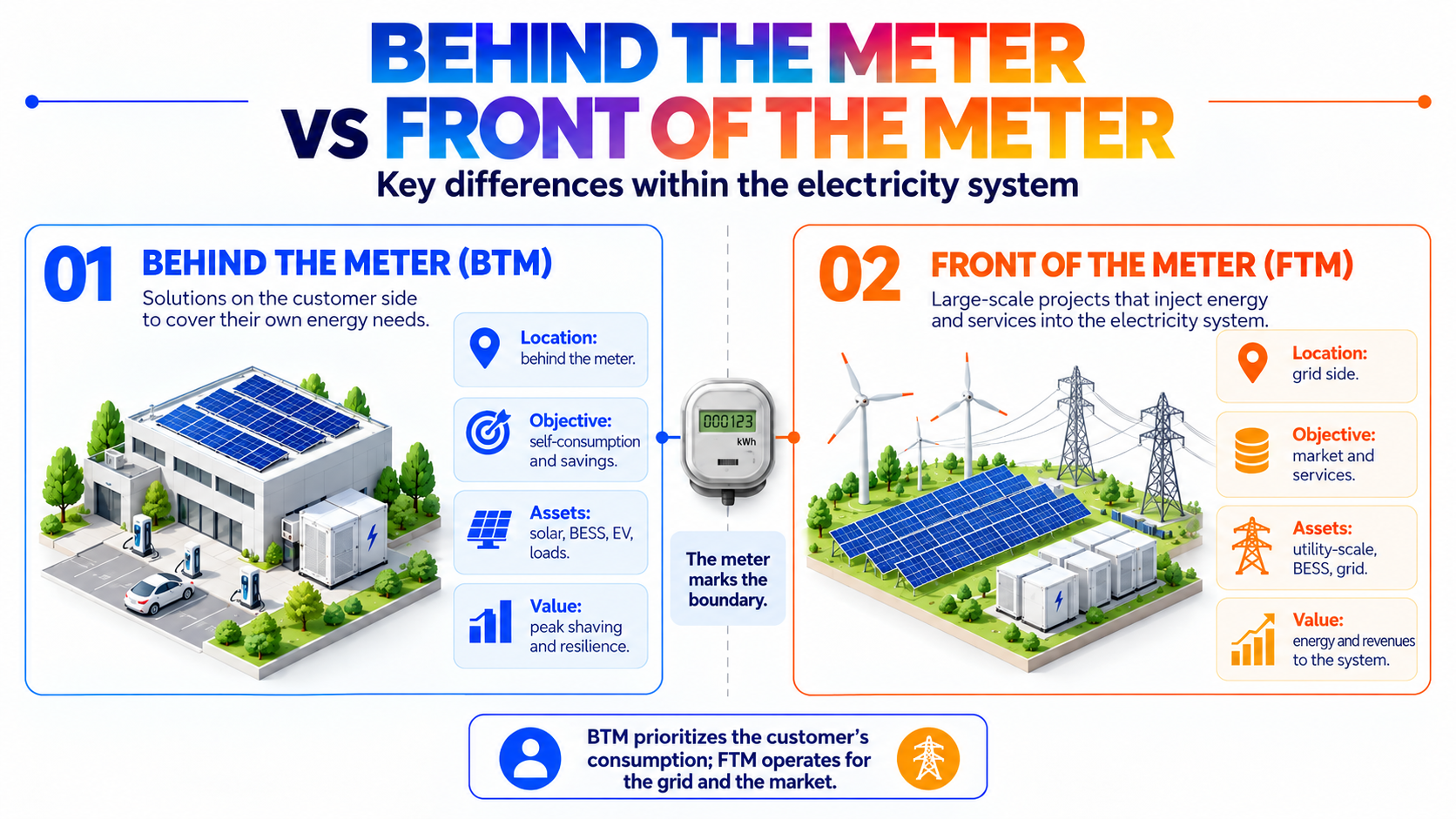
The key idea is the position relative to the metering point. If the asset is behind the customer’s meter, it is Behind the Meter; if it is connected directly to the electricity grid on the utility’s or operator’s side, it is usually called Front of the Meter (FTM).
BTM is not synonymous with self-consumption either. The practice of self-consumption is one of its most common applications, but behind the meter there can also be grid-charged batteries, demand response systems, heat pumps, electric vehicles or controllable industrial equipment.
How does a Behind the Meter system work?
To understand Behind the Meter, it helps to imagine the meter as the boundary between two worlds. On one side are the distribution grid, the electricity retailer and the power system; on the other are the consumer’s internal installation and the resources they can control.
Electricity grid → Meter → Consumption + Solar + BESS + EV + Flexible loads
If a factory consumes 1 MW and its photovoltaic plant produces 400 kW, the meter will record approximately 600 kW imported from the grid, ignoring losses and other effects. If it also has a battery discharging at 200 kW, imports can fall to around 400 kW. BTM value arises precisely because these resources change what the consumer exchanges with the grid.
The European Commission uses the concept of behind-the-meter self-consumption to describe self-consumption arrangements in which renewable electricity is consumed locally before passing through the metering point. Its latest documentation on self-consumption also considers the role of storage, smart heating and bidirectional electric vehicle charging as tools for optimising local consumption. European Commission.
Which assets can be Behind the Meter?
Behind the Meter defines a position within the electrical architecture rather than a specific technology. It can therefore include generation, storage and flexible consumption within the same installation.
The most common examples are solar photovoltaic installations, BESS batteries, cogeneration systems, electric vehicle chargers, heat pumps, backup generators, HVAC equipment, controllable industrial processes and energy automation systems. When several of these resources work together in a coordinated way, they are usually considered part of the ecosystem of Distributed Energy Resources (DER).
A BTM system can operate almost passively—for example, a small solar installation—or be highly dynamic. In an industrial facility, an EMS can decide in real time whether to consume solar energy, charge the battery, reduce a non-critical load, shift a production process or export surplus energy. The ability to coordinate these assets makes modern BTM more than local generation: it can act as a source of flexibility behind the meter.
Behind the Meter vs Front of the Meter
The difference between BTM and FTM does not depend solely on the size of the asset. It depends mainly on where it is connected relative to the consumer’s meter and on its primary economic function.
| Feature | Behind the Meter (BTM) | Front of the Meter (FTM) |
|---|---|---|
| Location | Consumer side | Grid side |
| Usual objective | Cost reduction, self-consumption, resilience, flexibility | Providing services directly to the system or the market |
| Solar example | PV on a factory roof | Solar plant connected directly to the grid |
| BESS example | Industrial battery for Peak Shaving | Utility-scale BESS for arbitrage and grid services |
| Economic measure | Bill savings + additional revenue | Market revenue or contracts |
A BTM asset can nevertheless provide external services. A battery installed in a factory can participate in flexibility markets through an aggregator or form part of a Virtual Power Plant (VPP). In that case, it remains physically behind the meter even though part of its economic value comes from the power system.
What is Behind the Meter used for?
The most obvious application is reducing the amount of electricity purchased from the grid. A BTM solar plant produces energy that can be consumed immediately, increasing self-consumption and reducing imports. Adding storage expands the possibilities. A BESS can store surplus solar energy, charge during lower-price hours and discharge when electricity is more expensive. It can also reduce maximum power demand through Peak Shaving, a strategy that is particularly attractive when the tariff structure penalises power peaks.
The IEA specifically identifies increased solar self-consumption, responses to dynamic tariffs, peak demand reduction, backup during outages and aggregated participation in electricity services among the applications of Behind the Meter batteries. In buildings or industrial facilities with flexible loads, BTM can go beyond the battery. An EMS can delay electric vehicle charging, adjust heating and cooling setpoints or schedule certain processes to coincide with lower-cost hours or greater renewable generation.
Practical example: solar + BESS behind the meter
Imagine an industrial facility whose demand reaches 800 kW during certain hours. The company has 500 kWp of photovoltaics and a 500 kW / 1 MWh BESS installed behind the meter.
At midday, if the factory consumes 650 kW and the solar plant produces 400 kW, it only needs to import approximately 250 kW from the grid. If there is a renewable energy surplus at another time, some can be stored in the BESS. Later, when demand rises to 800 kW, the battery can discharge at 300 kW and limit imports to around 500 kW. From the meter’s perspective, the grid “sees” a facility with a much more stable profile and lower peak demand. For the consumer, savings can come from purchasing less energy, reducing power-related charges, using surplus energy and, where regulation permits, earning additional revenue from flexibility.
This example shows why BTM design must use hourly or even sub-hourly data. Looking only at annual consumption does not reveal whether solar generation, storage and demand coincide in time.
What does a Behind the Meter project need?
A BTM project must start with the consumer’s actual electrical profile. Consumption, peaks, operating hours, load curves, tariffs, existing renewable generation and operational constraints must be understood. Without these data, it is difficult to size a battery correctly or determine how much additional self-consumption can be achieved.
The internal connection point, protection systems, contracted power capacity, power quality, switchboard and transformer capacity, metering system and requirements for operation in parallel with the grid must also be studied. If exports are possible, additional connection, metering and permitting requirements may apply depending on the jurisdiction.
In systems with several assets, control becomes critical. An EMS can coordinate setpoints across solar generation, the battery, vehicle chargers and industrial loads, while a SCADA provides supervision and operational traceability. Digitalisation also adds requirements for communications, cybersecurity and data quality. A poorly monitored BTM system may be technically operational yet lose much of its economic value because the battery charges at the wrong times or the EMS lacks reliable signals.
When is a BTM system worthwhile?
Behind the Meter is usually particularly attractive when there is a clear difference between the cost of buying electricity and the value of generating or storing it locally. It is also attractive where there are costly demand peaks, time-varying tariffs, high solar generation coinciding with consumption or requirements for continuity of supply. In simplified terms, its economic logic can be expressed as follows:
BTM value = energy savings + peak reduction + flexibility revenue + resilience value − CAPEX − OPEX − degradation
Not all these components can be monetised in every project. The value of resilience, for example, can be enormous for a data centre or a factory where an interruption causes major losses, but much lower for a consumer without critical processes. Installing storage is not always worthwhile either. If consumption almost perfectly matches solar generation and there are no significant demand charges, a battery may provide little additional saving. Similarly, if price differences between hours are small, tariff arbitrage may not justify the cost and degradation of the BESS.
Behind the Meter, flexibility and aggregation
A BTM resource is usually small compared with a plant at Utility Scale, but thousands of coordinated resources can reach considerable power capacity. This is where aggregators and VPPs come in, combining batteries, electric vehicles, distributed generation and flexible loads to operate as a larger virtual resource.
ACER considers Behind the Meter storage and other flexible resources an important part of Europe’s demand response potential. Its report on barriers to flexibility highlights that effective participation depends on appropriate economic signals, aggregator access, metering and market rules. ACER.
This changes the consumer’s traditional role. A building or industrial facility can move from being simply a demand point to becoming a prosumer capable of producing, storing, shifting and managing energy. Behind the Meter is, to a large extent, the physical boundary where this transformation takes place.