
EMS (Energy Management System): what it is and how it manages energy
An EMS (Energy Management System) is the energy management system responsible for monitoring, coordinating and optimising the operation of one or more energy assets.
The EMS does not store energy or replace the battery's protection systems. Its role is to turn technical data, forecasts, market signals and external setpoints into operational decisions. To do this, it exchanges information with systems such as the BMS, PCS and SCADA, electricity meters, inverters, weather stations and, depending on the project, market platforms or control centres.
In complex systems, the EMS can simultaneously manage storage, solar or wind generation, electrical loads and the grid connection. For this reason, it is particularly used in Utility Scale projects, hybrid installations, microgrids and industrial facilities with flexible energy assets.
Its importance increases as electricity systems incorporate more renewable generation and storage: physical capacity alone is not enough; decisions must be made about how to use it to maximise performance, revenue, availability and compliance with technical constraints.
How does an EMS work?
An Energy Management System operates through a continuous cycle of data acquisition, analysis, optimisation and setpoint dispatch. The system receives information from the asset and its surroundings, calculates the most suitable operating strategy and sends commands to the equipment that physically carries out that decision. In a BESS, for example, the EMS may receive the State of Charge (SoC), the power limits provided by the BMS, PCS availability, electricity prices, photovoltaic generation forecasts and a setpoint from the grid operator. Using this data, it decides whether to charge, discharge, remain on standby or reserve capacity for a subsequent service.
Data → EMS → Optimisation → Setpoint → Assets → Measurement → EMS
This process repeats continuously and is always subject to technical constraints. The EMS can optimise operation, but it must respect the PCS's maximum power, available energy, SoC window, temperature, battery state of health, connection limits and the protections imposed by the BMS.
Which variables does an EMS analyse?
The quality of an EMS depends both on its algorithms and on the quality of the available data. Typical variables include active and reactive power, SoC, State of Health (SoH), temperature, available capacity, dynamic charging and discharging limits, renewable generation, consumption, weather forecasts, market prices, grid constraints and external setpoints.
In commercial applications, it can also incorporate economic variables such as battery degradation cost, contractual penalties, expected revenue from different markets and electricity purchase cost. A modern EMS therefore does more than determine whether a battery can discharge: it tries to establish whether it is better to discharge it now or preserve that energy for a more valuable opportunity.
EMS optimisation: when to charge and discharge
One of the EMS's most important functions is to optimise asset operation. Some systems use predefined rules, while others use optimisation algorithms capable of finding the strategy that maximises an economic or technical objective while simultaneously respecting multiple constraints.
Maximise: Revenue − Costs − Degradation − Penalties
In a BESS participating in the electricity market, if prices are low during certain hours and the system expects higher prices later, the EMS can charge the battery during the low-price period and discharge it afterwards. This strategy is known as energy arbitrage. However, maximising immediate revenue is not always optimal: the battery degrades over time and with use, so an advanced EMS can incorporate a degradation cost to avoid cycles whose economic value does not offset the associated wear.
In other applications, the objective may be to reduce demand peaks through Peak Shaving, limit exports to the grid, maximise self-consumption, meet a delivery schedule or reserve capacity for balancing services.
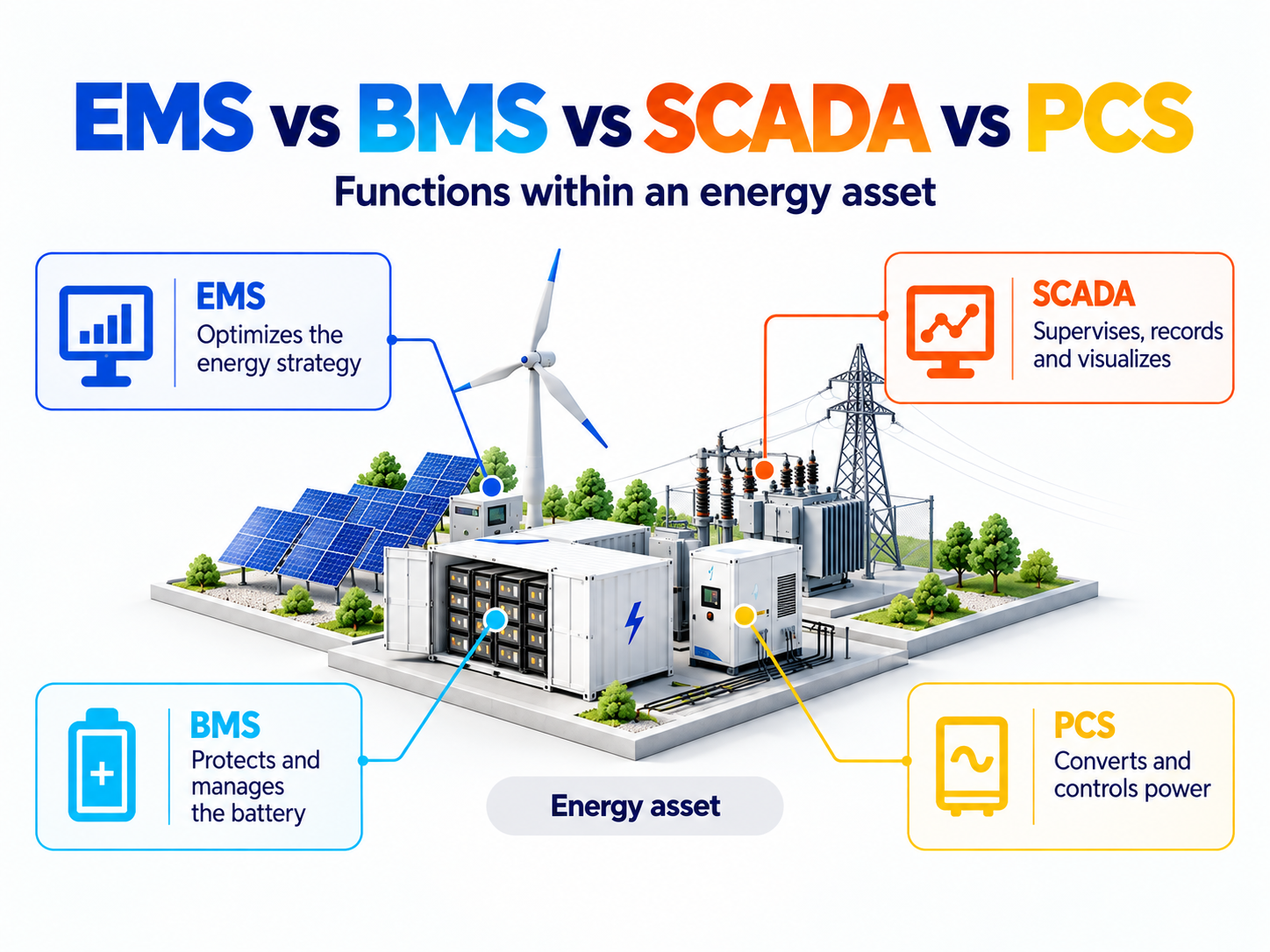
EMS vs BMS vs SCADA vs PCS: what is the difference?
EMS, BMS, SCADA and PCS are part of the control architecture of many storage projects, but they serve different functions. The BMS protects and manages the battery; the PCS converts and controls power; SCADA monitors and records what happens at the installation; and the EMS decides how the asset should operate to achieve a technical or economic objective.
| System | Main function | Question it answers |
|---|---|---|
| BMS | Battery protection and management | Can the battery operate safely? |
| PCS | Power conversion and control | How is power physically converted and delivered? |
| SCADA | Supervision and data acquisition | What is happening at the installation? |
| EMS | Energy optimisation and strategy | What should the asset do now and next? |
The boundaries are not always the same across manufacturers. Some platforms integrate EMS and SCADA functions, while others separate each level of control. It is therefore advisable to analyse the functional architecture rather than just the software's commercial name.
EMS in a BESS: control hierarchy
Within a BESS, the EMS generally sits above the systems that physically control the battery and power conversion. A simplified architecture can be represented as follows:
Market / Operator / User
↓
EMS
↓
SCADA / Plant Controller
↓
PCS + BMS
↓
Battery Racks and electrical equipment
If the EMS requests that a BESS discharge at 20 MW for one hour, the lower levels verify that sufficient capacity is available and that operation respects the technical limits. If the BMS detects a safety condition, it can reduce the available power even if the EMS's economic strategy indicates that continued discharge would be profitable. The EMS optimises, but it must not override the protections of the lower-level systems.
In installations with numerous Battery Racks, management can become more complex as differences in SoH, capacity, temperature or availability arise between groups of batteries.
Applications of an Energy Management System
An EMS is not used exclusively with batteries. It can coordinate any set of controllable energy resources. In a Utility Scale BESS, it can optimise arbitrage, balancing services, capacity or congestion management; at a solar plant with storage, it can shift energy from the middle of the day to periods of higher demand; and at an industrial facility, it can combine generation, consumption and storage to reduce costs and power peaks.
In a microgrid, the EMS can also coordinate distributed generation, loads and storage to maintain balance in both grid-connected and islanded modes. This ability to coordinate resources makes the EMS particularly relevant in hybrid systems and assets with multiple sources of flexibility.
EMS in hybrid plants: solar, wind and storage
In a hybrid plant, the EMS must coordinate technologies with different operating characteristics. Solar and wind generation depend on the available resource, whereas a battery can decide when to absorb or deliver energy.
Consider a plant with 100 MW of solar PV and a 50 MW / 100 MWh BESS connected at a point limited to 80 MW. If the solar plant generates 95 MW, 15 MW would exceed the export capacity. Instead of immediately reducing this output through curtailment, the EMS could command the battery to charge using those 15 MW and keep exports at 80 MW. Later, when solar generation falls, it could discharge the BESS to shift some of that energy to other hours.
EMS and electricity markets: revenue stacking
A battery has economic value when its flexibility is used at the right time. A single BESS may have the technical capacity to provide several services, but not all can be performed simultaneously without reserving power or energy. The EMS must manage these incompatibilities and prioritise services according to contracts, prices, availability and technical constraints.
Combining several revenue streams is known as revenue stacking. For example, a battery can perform energy arbitrage while reserving some of its power for frequency services. If the EMS used all available energy in a merchant strategy, it could leave the asset without enough headroom to meet a later obligation.
Forecasting and control algorithms
The ability to anticipate what will happen is one of the differences between purely reactive control and an advanced strategy. Many EMS platforms therefore use forecasting models to estimate renewable generation, demand, electricity prices or future asset availability.
Techniques used may include control rules, mathematical optimisation, linear programming, mixed-integer programming and Model Predictive Control (MPC). Some developments also incorporate machine learning. Complexity, however, does not guarantee better results: the algorithm must be robust against forecast errors, communication failures and unexpected changes in the market or equipment availability.
Interoperability, communications and cybersecurity
An EMS needs to exchange information with many devices and platforms, making interoperability critical. Depending on the installation, protocols and standards such as IEC 61850, Modbus TCP, OPC UA, IEC 60870-5-104, DNP3 or other interfaces may be used. The specific architecture depends on the equipment, the operator and the control requirements.
Cybersecurity is also particularly important because the EMS can send setpoints directly to assets capable of exchanging large amounts of power with the grid. The design must address authentication, user management, network segmentation, event logging, updates, redundancy and secure remote access mechanisms. Its maintenance must also be integrated into the project's O&M strategy.
EMS and ISO 50001: they are not exactly the same
There is significant ambiguity around the term Energy Management System. In storage, microgrids and asset control, EMS usually refers to a technology platform that monitors and optimises energy operations. By contrast, ISO 50001 uses the concept of an energy management system to describe an organisational framework designed to systematically improve an organisation's energy performance.
Both concepts share a name, but they are not equivalent. A BESS EMS may be real-time control software, whereas a management system compliant with ISO 50001 incorporates policies, objectives, monitoring and continuous improvement processes at organisational level. In industrial settings, both can coexist.
- Tags: energy storages, BESS, BMS, EMS, Energy Management System, energy management, PCS, SCADA