
The Argentine energy sector is placing the grid, storage and financial predictability at the heart of the next phase
Buenos Aires, 18 September 2026. The debate on energy in Argentina is no longer centred on the availability of resources and technology. During the two-day Energyear Argentina 2026, held on 16 and 17 September at the Faena Art Centre in Buenos Aires, the more than 50 participants identified three measurable constraints for the next stage of growth: electricity transmission capacity, financeable contracts and regulations capable of reducing risk throughout the life of the projects.
AlmaSADI enters its most demanding phase: implementation
Storage was the technical focus of the first day. AlmaSADI It awarded 700.5 MW across 20 projects after receiving 235 bids totalling 8,338 MW. The volume of bids confirmed private sector interest, but also showed that the tender was only the beginning: the successful bidders must secure financing, procure equipment, arrange imports and logistics, complete engineering and grid connection work, and meet the deadlines for commissioning.
Five groups account for the awarded projects (Genneia, DQD Energy, 360 Energy, Aluar and Intermepro). The meeting examined timetables that set the first operations for 2027. Solar DQD outlined a target of approximately nine months between contract award and commissioning for its first systems; this schedule requires the simultaneous coordination of financing, permits, transport and the installation of heavy and bulky equipment.
The winning bid ranged from USD 7,632 to USD 9,705 per MW-month, with an average of USD 8,427 per MW-month. The discussion was not limited to the cost of the batteries. It covered the power conversion system, fire protection, control software, degradation, warranties, grid services and operational capability under local conditions. The impact of customs classification was also highlighted: the current treatment applies a 3 per cent statistical duty, whilst the sector is calling for the equipment to be recognised as capital goods.
“We’re not just talking about batteries. We’re talking about a complete system that must be integrated into the grid and operate safely throughout its entire service life.”
Icíar Vargas | Everyray LATAM
For Energyear, the key figure from AlmaSADI is not just the contracted capacity, but the transition from a competitive auction to a performance test. The performance of these 20 projects will determine confidence in future storage tenders and the ability to use BESS as a complement to grid infrastructure works, rather than as a permanent substitute for structural expansion.
Transmission becomes the physical limit to growth
The second day shifted the debate from generation to infrastructure. The panellists described a grid designed for unidirectional flows that must now integrate distributed generation, storage, new renewable energy parks and a more electrified demand. In this context, AMBA I was presented as the first significant test of the expansion plan: a project with a capacity of around 2,000 MW and an estimated timeframe of five years, compared with the approximately nine months it takes to deploy a BESS system.
The difference in timeframes explains why storage can alleviate immediate constraints, but does not replace high-voltage corridors, transformer stations and robust nodes. The panel identified Rodríguez, Ezeiza, Abasto and Plomer as critical points; furthermore, it highlighted the need to consider very high-capacity corridors and planning horizons of up to 50 years.
Neuquén provided a concrete perspective on the problem. Agustina Barahona, executive director of the Neuquén Provincial Energy Authority (EPEN), stated that the province had welcomed more than 26,000 new residents over the past year and that approximately 5,000 of them were of school age. This population growth comes on top of industrial expansion and a vast, sparsely populated territory subject to harsh climatic conditions. EPEN also provides a service to some 2,100 isolated users via solar kits.
“Having the resource is not enough. We need the networks to receive, transmit and distribute the energy.” Agustina Barahona | EPEN
The province generated 7,700 GWh of hydroelectric power in 2025 (25 per cent of the national total, according to the figures presented), compared with provincial consumption of around 2,200 GWh. This gap illustrates a recurring paradox: having an energy resource does not guarantee transmission capacity or the quality of the local supply. At the same time, EPEN is planning investments in excess of USD 500 million over the next 10 to 15 years, including new connections to the SADI, 132 kV power lines, transformer stations and equipment refurbishment.
Wind power needs the grid before it can be a viable resource
Argentina operates 72 wind farms, with a total capacity of 4,558 MW and 1,249 wind turbines, with capacity factors reported at the event as ranging between 40 per cent and 50 per cent, according to the Argentine Chamber of Renewable Energy. The wind energy panel agreed that the resource and the technology do not constitute the main barrier. The constraint lies in grid connection capacity, particularly in Patagonia and along the corridors that must carry electricity to consumption centres.
Among the projects mentioned were Puerto Madryn–Choele Choel–Bahía Blanca and Vivoratá–Plomer. Participants pointed out that these projects could take between five and ten years to complete, whilst a wind farm can be built in around 18 months. This disparity could leave capital and projects on hold, even when there is corporate demand for renewable energy to reduce costs and emissions.
Examples of private investment linked to transport expansion were also presented. PCR Energy reported 440 MW of dispatch priority linked to capacitor projects (including a 210 MW development in Olavarría) and a further 350 MW in the NOA. Aluar outlined the integration of 582 MW of wind power into its industrial operations, combined with thermal and hydroelectric generation to manage variability and ensure continuity of supply.
USD 10,000 million: the question is the risk, not the resource
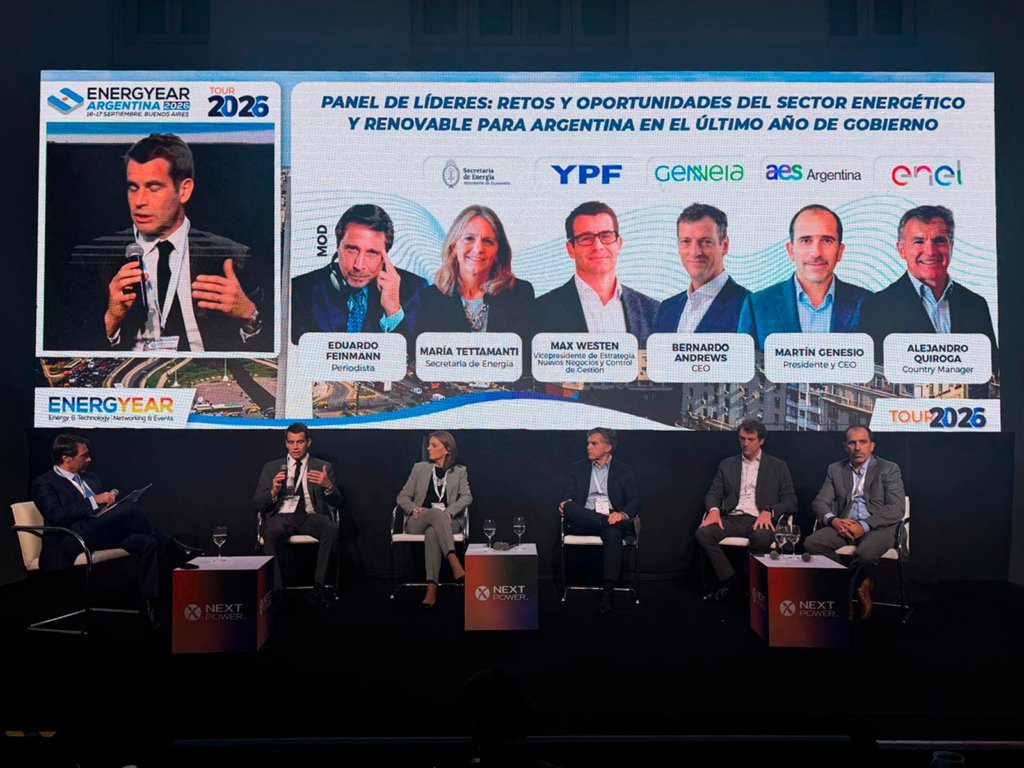
The panel of leaders addressed a direct question: what is currently the main obstacle to attracting a further US$10 billion into the Argentine energy sector? The response from the Secretary of Energy, María Tettamanti, encapsulated the view shared by developers and generators: regulatory predictability, policy continuity and a reduction in uncertainty throughout the life of the investments.
“Clear rules are needed to provide predictability for investment, certainty for projects and a reduction in uncertainty for businesses.”
María Tettamanti | Secretary of Energy
Tettamanti advocated for a market with price signals that reflect costs, targeted residential subsidies and greater competition in the wholesale segments. He also pointed out that funding for high-voltage expansion must be linked to the beneficiaries of each project and to verifiable milestones for progress. Among the priorities are the Vivoratá–Abasto, Puerto Madryn–Choele Choel–Bahía Blanca lines and the extensions northwards from Mendoza.
Martín Genesio, Bernardo Andrews and Alejandro Quiroga linked capital inflows to a reduction in country risk, regulatory stability and the ability to sustain frameworks such as the RIGI beyond a single political cycle. The consensus was not to call for a lack of regulation, but rather for clear rules, enforceable contracts and adjustment mechanisms that enable the calculation of revenue, costs and foreign exchange exposure.
Financing requires contracts, guarantees and a precise allocation of risk
The financing panel highlighted a recurring tension: developers point to a lack of credit, whilst financial institutions respond that there is a shortage of bankable projects. This discrepancy is resolved through the contractual structure. Prior to the project becoming operational, lenders require corporate backing, liquid collateral or commitments from the sponsors; thereafter, repayment can be supported by the project’s cash flows, insurance assignments, shares in the special purpose vehicle and guarantees on equipment.
Banco Galicia explained that it assesses both the asset and the sponsor’s capacity, and that delays tend to arise when the project lacks a dedicated team, changes partners, or has not resolved issues relating to import rules, currency and regulation. During the panel discussion, it was noted that thermal power contracts tend to have terms of around one year, whilst renewable energy contracts are usually between three and five years. For assets with lifespans of 20 years or more, this difference in duration increases the refinancing risk and limits leverage.
The Inter-American Development Bank (IDB) has announced that it is preparing a guarantee programme for transmission projects, with AMBA I as the first application. The scheme would combine liquidity support against assigned public risks with technical assistance for tendering, economic and financial modelling, regulatory review and dialogue with the market. Its aim is to reduce the cost of capital without replacing technical, social and environmental due diligence.
In addition to bank loans, the analysis covered negotiable debt instruments, bridge loans, capital markets and leasing for distributed generation. All these instruments are subject to the same condition: a contract capable of sustaining predictable cash flows and clearly allocating the risks associated with construction, operation, currency, counterparty and regulatory changes.
Energyear Argentina 2026 set out a clear technical sequence. Renewable capacity and storage can be contracted and built quickly; the grid requires much longer lead times; and funding only materialises once contracts turn expected revenue into viable cash flows. For this reason, coordination between generation and BESS tenders, transmission plans, permits, imports and financial guarantees must take place before contracts are awarded, not afterwards.
The sector already has projects, manufacturers, developers and interested investors. The next phase requires quantified network priorities, public timetables, stable regulations and assigned responsibilities. If these elements are brought together, AlmaSADI could become a benchmark for implementation and AMBA I a replicable model. If they proceed separately, the gap between the time taken to build the assets and that required for the infrastructure will continue to translate into costs, congestion and energy that cannot reach consumers.
About Energyear Argentina
Energyear Argentina It is a leading event in the field of renewable energy, bringing together business leaders, investors, institutions and experts to discuss the present and future of the sector, driving the transition towards a more sustainable energy model in Argentina and Latin America.
Press contact:
Luis Montaño – Mkt & Coms | luis@energyear.com +34 618 56 12 11

LinkedIn
Facebook
X
WhatsApp
Email