
Energy yield: what it is, how it is calculated and what an Energy Yield Assessment is
In energy, the term yield refers to the amount of energy an asset produces or delivers over a given period. In general terms, it can be expressed in MWh or GWh, but in photovoltaics it is particularly common to use specific yield or specific energy yield, which relates the energy generated to the installed capacity and is usually expressed in kWh/kWp.
Yield allows us to compare how much an asset is actually producing relative to its size, its available resource and the project’s expectations. In a solar plant, it does not depend solely on irradiation: temperature, orientation, albedo, electrical losses, availability, degradation, soiling, clipping, shading and operating strategy.
That is why, before building a plant, developers, investors and lenders carry out an Energy Yield Assessment (EYA): a technical study that estimates how much energy the project should produce over the long term and with what level of uncertainty.
In photovoltaics, understanding yield is essential because it connects engineering with economics: it determines the MWh that can be sold, affects LCOE, shapes the financial model and is one of the most important variables for bankability.
What is yield and how is it measured?
The exact meaning depends on the context. When we talk about energy yield in a broad sense, it may simply mean the energy produced over a period: for example, 180 GWh per year. However, in solar photovoltaics, it is often useful to normalise that output by the installed capacity to compare plants of different sizes.
Specific Yield = AC energy generated (kWh) / Installed photovoltaic capacity (kWp)
A 10 MWp plant generating 17,000 MWh per year would have a specific yield of approximately 1,700 kWh/kWp-year. This metric allows us to compare the energy productivity of different designs or sites, although it must always be interpreted in light of the solar resource, climate, orientation and technology. IEA PVPS considers Pxx Energy Yield to be one of the main technical KPIs in photovoltaics and uses it to express expected generation together with its probability of exceedance.
Yield is not the same as Performance Ratio
Yield measures how much energy the plant produces, while the Performance Ratio (PR) assesses what proportion of the available solar resource is ultimately converted into useful energy after system losses. The standard IEC 61724-1 sets out terminology and methods for monitoring and analysing the performance of photovoltaic systems. In this framework, PR relates the final yield to the reference resource.
Two plants can have the same PR but different yields if they receive different irradiation. Likewise, a plant in a very sunny area may have a high yield even if its operating efficiency is lower than that of another installation.
Which factors determine photovoltaic yield
Final yield is the result of a chain of conversions and losses. The most important factors are:
- Solar resource: global, direct and diffuse irradiation available at the site.
- Orientation and tilt: azimuth, tilt, backtracking and row geometry.
- Temperature: high temperatures reduce the instantaneous power of the modules; parameters such as NOCT/TONC help model their thermal behaviour.
- Shading and mismatch: losses between modules, strings or areas receiving different irradiation.
- Soiling and snow: reduce the effective irradiation reaching the module.
- DC and AC losses: cabling, inverters, transformers and auxiliary consumption.
- Clipping: energy that cannot be converted because the inverter reaches its maximum power.
- Availability and curtailment: technical outages or grid restrictions reduce the energy actually exported.
- Degradation: module performance gradually declines over the asset’s lifetime.
Components such as a tracker solar can increase yield by changing the orientation of the modules during the day, while a high level of curtailment can reduce the energy sold even when the plant is technically capable of producing more.
Yield by type of energy asset
The concept of yield extends beyond photovoltaics, although it is not always expressed in the same way.
Solar PV
This is where the term is most standardised. Annual generation in MWh or GWh, specific yield in kWh/kWp and P50, P75, P90 or P99 probabilities are used to express different generation scenarios.
Wind
In wind power, energy yield commonly refers to expected annual generation, usually in MWh or GWh. The assessment is based on the wind resource, power curve, wake losses, availability, electrical losses and other adjustments. The result can also be expressed through P50 and P90 scenarios.
Hydropower
Yield depends on the water resource, flow rates, head, turbine efficiency, environmental restrictions and availability. Hydrological variability can lead to significant differences between dry, average and wet years.
Thermal generation
In thermal power plants, generation, capacity factor, heat rate or efficiency are discussed more often than specific yield. Even so, the economic concept is similar: estimating how much useful energy the asset can produce given its technical constraints, availability and fuel.
BESS and storage
In storage, “yield” is not usually the main KPI on its own. Discharged energy, throughput, equivalent cycles, round-trip efficiency and availability are used instead. The asset’s value depends both on how many MWh it handles and on when it charges and discharges them.
What is an Energy Yield Assessment (EYA)?
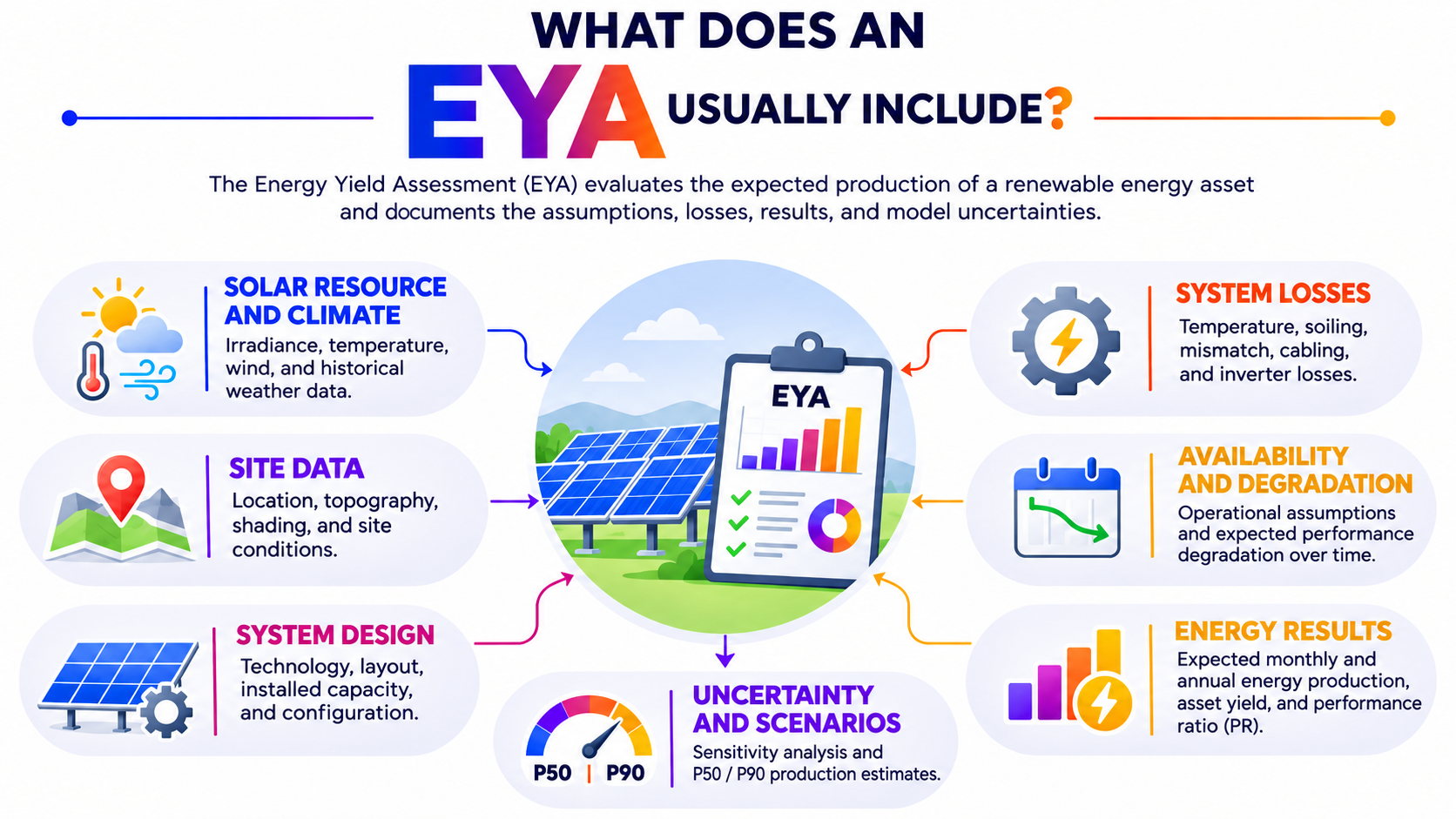
An Energy Yield Assessment is a technical study that estimates a project’s future energy generation and quantifies the associated uncertainty. It is particularly important for solar and wind plants before construction, financing, acquisition or refinancing. A photovoltaic EYA usually includes:
- Solar resource analysis: satellite databases, weather stations and historical time series.
- Design modelling: modules, inverters, orientation, trackers, strings and electrical configuration.
- Loss modelling: temperature, soiling, shading, mismatch, cabling, clipping, transformers, availability and curtailment.
- Long-term correction: adjusting the resource to obtain an expectation representative of the project’s lifetime.
- Degradation: progressive loss of generation over the years of operation.
- Uncertainty analysis: resource, modelling, measurement, losses and interannual variability.
- Probabilistic scenarios: calculation of P50, P75, P90 or other exceedance levels.
The DNV highlights that lenders usually require an independent energy assessment because a plant’s ability to produce energy directly determines its financial viability.
P50, P90 and probability of exceedance
P50 represents the generation level with a 50% probability of being exceeded and is usually used as the central or expected scenario. P90 is more conservative: it represents a generation level with a 90% probability of being exceeded under the study’s assumptions. That is why P90 is usually lower than P50. The greater the project’s uncertainty, the larger the gap between the two values will normally be.
Greater uncertainty → larger P50–P90 gap → higher perceived risk
IEA PVPS notes that interannual variability in irradiation is one of the main factors explaining the difference between P50 and P90, alongside uncertainties in modelling, operation and degradation.
Why yield is key to profitability and financing
Yield directly connects physical generation with the financial model. If a plant generates fewer MWh than expected, revenue falls while many costs remain virtually constant. A higher yield can reduce the effective cost per MWh and improve indicators such as NPV, IRR and DSCR. Conversely, an overestimated yield can cause the project to fall short of revenue expectations or struggle to service its debt.
That is why an Energy Yield Assessment does more than provide a generation figure. Its purpose is to answer three questions: how much the asset will produce, what losses are expected and how confidently that estimate can be used in a financial model. In utility-scale projects, reducing uncertainty can be worth as much as a small increase in generation: it improves P90, reduces perceived risk and can help secure financing on better terms.