
Albedo in the photovoltaic sector: what it is and how it affects performance
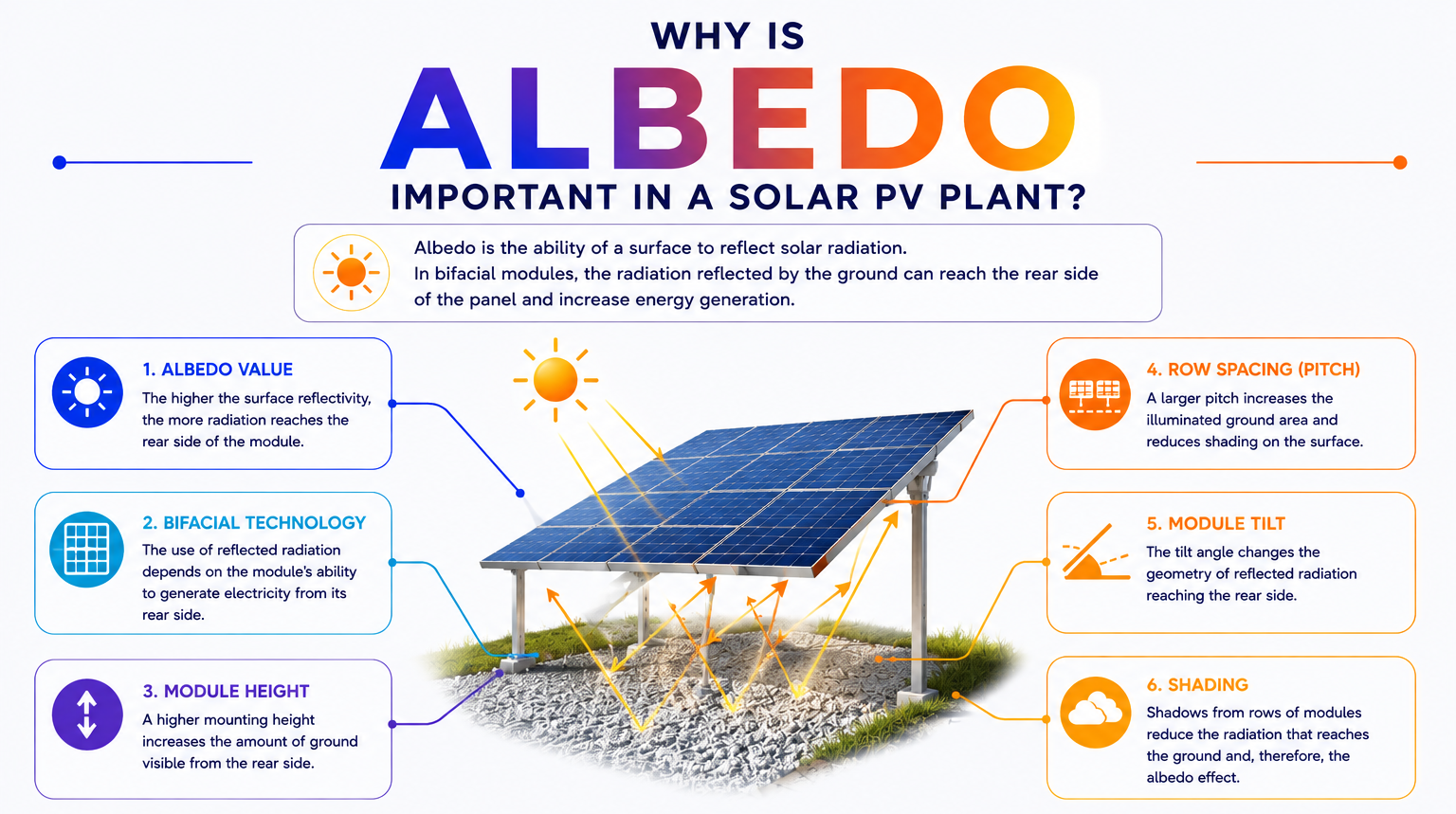
Albedo is the proportion of solar radiation that a surface reflects back into the environment, relative to the radiation it receives. In the photovoltaic sector, albedo is a particularly important parameter in installations that use bifacial modules, as the radiation reflected by the ground can reach the rear of the modules and help to increase electricity generation.
The albedo value is normally expressed as a number between 0 and 1. A low value indicates that the surface absorbs a greater proportion of the incident radiation, whilst a high value indicates a greater ability to reflect it. For example, dark surfaces usually have lower albedo values than light surfaces.
In a photovoltaic installation, albedo is not a characteristic of the module, but a property of the environment and, primarily, of the surface situated beneath and around the panels.
Why is albedo important in a photovoltaic plant?
The importance of albedo is particularly significant in photovoltaic plants fitted with bifacial modules. These modules can harness both the irradiance reaching their front face and part of the radiation reaching their rear face.
When the ground surface has a high albedo, a greater amount of solar radiation may be reflected towards the rear of the module. This additional irradiance may increase energy output compared with an equivalent installation situated on a surface with a lower reflectance. The final effect depends on various design variables and site conditions:
- Albedo value: determines the proportion of incident radiation that can be reflected by the surface.
- Bifacial technology: the ability to harness reflected radiation depends on the module’s capacity to generate electricity via its rear side.
- Module height: adjusts the amount of surface area visible from the rear of the module.
- Distance between rows: the pitch determines the illuminated area and the distribution of shadows on the ground.
- Module tilt: this affects the geometry by which the reflected radiation reaches the rear.
- Shading: the rows of modules themselves can reduce the radiation reaching the ground and alter the albedo effect.
The National Renewable Energy Laboratory (NREL) considers albedo to be one of the factors influencing the capacity factor of photovoltaic plants, alongside bifaciality, shading, the type of tracking system and system losses.
Albedo and bifacial photovoltaic modules
The relationship between albedo and bifacial modules is particularly important when designing a solar power plant and estimating its output. In a monofacial module, the radiation reflected by the ground has a relatively limited influence on power generation. In contrast, in a bifacial module, the rear side is designed to capture some of that irradiance. For this reason, accurately determining the site’s albedo is essential for making a reliable energy estimate.
According to figures published by the National Renewable Energy Laboratory (NREL) of US, the radiation reflected by the ground accounts for a much larger proportion of the output for bifacial modules than for monofacial modules, as the additional output from bifacial technology depends on the irradiance reaching the rear face of the modules. Albedo can vary considerably depending on the surface. Natural ground, vegetation, gravel, concrete and snow all exhibit different reflective behaviours. Furthermore, the value does not necessarily remain constant throughout the year.
Rainfall, soil moisture, vegetation growth, the presence of snow or certain changes in surface conditions can alter reflectivity and, consequently, the albedo used in production models.
How is albedo measured and taken into account in a photovoltaic installation?
To correctly estimate the albedo of a photovoltaic project, it is necessary to characterise the actual surface of the site and take into account its potential temporal variability. It is not always appropriate to use a single fixed value throughout the entire lifetime of a plant. The albedo can be calculated from the ratio of the irradiance reflected by a surface to the incident irradiance. In specific measurement campaigns, instruments such as oriented pyrheliometers and piranometers can be used to record incident and reflected radiation. In bifacial photovoltaic projects, albedo is incorporated into energy simulation models alongside parameters such as row geometry, module height, pitch, tilt, shading and the module’s bifacial characteristics.
NREL has developed albedo-specific datasets to facilitate the planning and modelling of bifacial photovoltaic systems. These datasets include time-series data and aggregated values for different sites and surface types. In addition, modelling tools such as bifacial_radiance, developed by NREL, enable the analysis of the rear irradiance of the modules, taking into account variables such as albedo, tilt, row spacing, module height and shading.
How does albedo affect photovoltaic performance?
A higher albedo can increase the irradiance received by the rear side of a bifacial module and, under certain conditions, improve the energy output of the installation. However, the increase in energy generation does not depend solely on the albedo value.
Bifacial power output is determined by a combination of the module’s characteristics, the installation geometry and the surface conditions. The height of the modules, the distance between rows, the tilt angle, solar tracking and shading determine how much reflected radiation can actually reach the rear face. For this reason, increasing the albedo of a surface does not automatically mean that output will increase by the same proportion. The effect must be analysed using irradiance and output models that reflect the specific characteristics of the project.
In its technical scenarios for utility-scale photovoltaic plants, albedo improvements are specifically identified as one of the factors that can help to increase a plant’s capacity factor, particularly when combined with greater use of bifacial modules. The importance of albedo in the design of bifacial systems is also reflected in technical regulations. The IEC 62548-1:2023+AMD1:2025 It incorporates requirements relating to the design of photovoltaic arrays and addresses specific aspects of systems that use bifacial modules.