
Curtailment: what it is, why it occurs and how it affects the electricity system
The curtailment is the deliberate reduction of an energy asset's output or consumption relative to what it could technically be supplying or demanding at that moment. In electricity, the term is usually used to describe a temporary limit on generation when the system, grid or market cannot absorb all the available energy.
Although often associated with solar and wind plants, the concept is broader. It can affect renewable generation, conventional power stations, storage, flexible loads and even industrial consumers when a temporary demand reduction is requested. The key point is that available capacity is not fully used because of a technical, economic, regulatory or contractual constraint.
At a photovoltaic plant, for example, there may be enough irradiation to produce 100 MW, yet the operator may instruct the facility to limit its power output to 70 MW. The remaining 30 MW represents potential generation that is not injected into the grid during that period.
Curtailment is a necessary tool for maintaining system security in certain situations, but when it occurs repeatedly it can also indicate insufficient grid capacity, a lack of flexibility or a mismatch between the locations of generation and demand.
Why does curtailment occur?
Curtailment can have very different causes. It does not always mean that the plant has a fault or that the operator is 'wasting' energy without reason. In many cases, it is the fastest or most economical option for keeping the system within its limits.
Grid congestion
One of the most common causes arises when a line, substation or transmission corridor reaches its maximum capacity. Even if demand exists elsewhere, the energy cannot physically be transported there without exceeding thermal or security limits. ACER notes that physical grid congestion can translate directly into renewable generation curtailment, and that this problem is increasing in some European markets as renewable penetration grows and the grid does not expand at the same pace.
Excess generation relative to demand
Available generation may exceed consumption and export capacity. If interconnections, storage and flexible demand are insufficient, some output must be temporarily reduced. In its adequacy analyses, ENTSO-E defines the curtailment ratio by comparing the energy that must be curtailed with the sum of actual generation and curtailed energy. In scenarios with high solar or wind generation, these situations can occur during hours of low demand and high renewable output.
Stability and security constraints
The grid is not managed solely in terms of MW. Voltage, frequency, reserves, short-circuit capacity, dynamic stability and other technical parameters must also be respected. In certain areas, the operator may need to limit generation even without obvious thermal congestion.
Negative prices or economic signals
Negative prices can arise in wholesale markets with high output and low demand. Some producers then choose to reduce generation voluntarily because continuing to produce may be economically unfavourable, particularly if no incentives offset those prices.
Contractual or connection constraints
An access agreement, PPA or connection agreement may set a maximum export capacity or allow the operator to limit injection temporarily. In hybrid assets, generation and storage may also share constraints.
Types of curtailment
A useful way to classify it is by the cause of the reduction.
| Type | What causes it | Example |
|---|---|---|
| Technical curtailment | Physical or security limits of the grid | Congestion on a generation export line |
| System-wide curtailment | Excess generation and insufficient flexibility | High solar output with low demand |
| Economic curtailment | Price or marginal cost signals | Voluntary shutdown during negative prices |
| Contractual curtailment | PPA, connection or contractual limits | Maximum export constraint |
| Demand curtailment | Temporary reduction in consumption | Industrial facility reducing load at the system's request |
This classification matters because the economic impact and potential compensation vary according to the cause. A reduction ordered by the grid operator is not necessarily treated in the same way as a voluntary reduction prompted by negative prices.
How curtailment is measured
The basic metric compares the energy that could have been generated with the energy actually produced.
Curtailment (MWh) = potential generation − actual generation
It can also be expressed as a percentage:
Curtailment (%) = curtailed energy / potential energy × 100
If a plant could have produced 1,000 MWh during a period but delivers only 950 MWh because of a limiting instruction, curtailment would be 50 MWh, equivalent to approximately 5% of potential generation. In practice, estimating potential generation is not always straightforward. Solar calculations use irradiance, temperature, module and inverter availability and performance models; wind calculations combine power curves, wind speed and availability. It is therefore important to distinguish losses from curtailment from losses caused by faults, maintenance, soiling or low availability.
Curtailment by asset type
Solar PV
In solar, curtailment is usually implemented by reducing the inverter's power setpoint or limiting exports at the connection point. It is particularly common in areas with high generation around midday and limited grid capacity.
Wind
Wind turbines can reduce power through pitch control, torque limitation or other strategies. At wind farms, curtailment may be applied because of congestion, environmental restrictions, noise, wildlife protection or system needs.
Thermal and hydropower generation
Output from conventional power stations can also be limited. The difference is that some technologies have technical minimum operating levels, start-up times or shutdown costs that determine how far and how quickly they can reduce output.
BESS and storage
In a BESS, the term can refer to a limit on charging or discharging. Storage can also reduce curtailment at other assets by absorbing surplus energy when the grid cannot accept all generation and returning it later.
Flexible demand
In some markets, curtailment is used to describe a temporary reduction in consumption. An industrial facility, data centre or aggregated portfolio can reduce load as a flexibility resource, helping to balance the system.
Curtailment vs redispatch: they are not exactly the same
Both concepts relate to managing constraints, but they are not identical. The redispatch process involves changing the planned dispatch of one or more units to resolve congestion or maintain grid security. It may involve reducing generation in one area and increasing it in another.
Curtailment is the part of that management in which a facility reduces its output or consumption relative to what it could have delivered. A redispatch process may therefore include curtailment, but not all curtailment necessarily involves coordinated redispatch across multiple assets. This distinction also matters economically: redispatch, technical constraints and curtailment may have different compensation mechanisms depending on the country, market and reason for intervention.
Economic impact of curtailment on a project
Each curtailed MWh may represent energy that is no longer sold. Curtailment therefore directly affects a project's expected revenue and must be modelled from the development stage. The impact depends on the commercial structure. In a merchant project, the loss is linked to the price that energy would have earned. Under a PPA, the contract must define who bears curtailment risk and whether compensation exists for undelivered energy.
A high level can also affect LCOE: much of CAPEX and OPEX remains unchanged while the MWh actually sold decrease. As a result, the economic cost per unit of energy marketed increases. For lenders and investors, curtailment risk is part of the assessment of bankability. Historical congestion, generation export capacity, forecasts of new generation, grid reinforcements and contractual compensation clauses are reviewed.
Who pays for or bears curtailment?
There is no universal answer. It depends on the regulatory framework, the type of curtailment and the project's contracts. In some cases, an operator's instruction may create a right to compensation. In others, the producer bears the loss of revenue. Private contracts can transfer that risk between the producer, offtaker, owner, operator or optimisation provider.
It is therefore important to define concepts such as compensated curtailment, uncompensated curtailment, grid events, force majeure, availability and energy treated as deemed generation. Two physically identical projects can have very different economic exposures depending on how the contract is drafted.
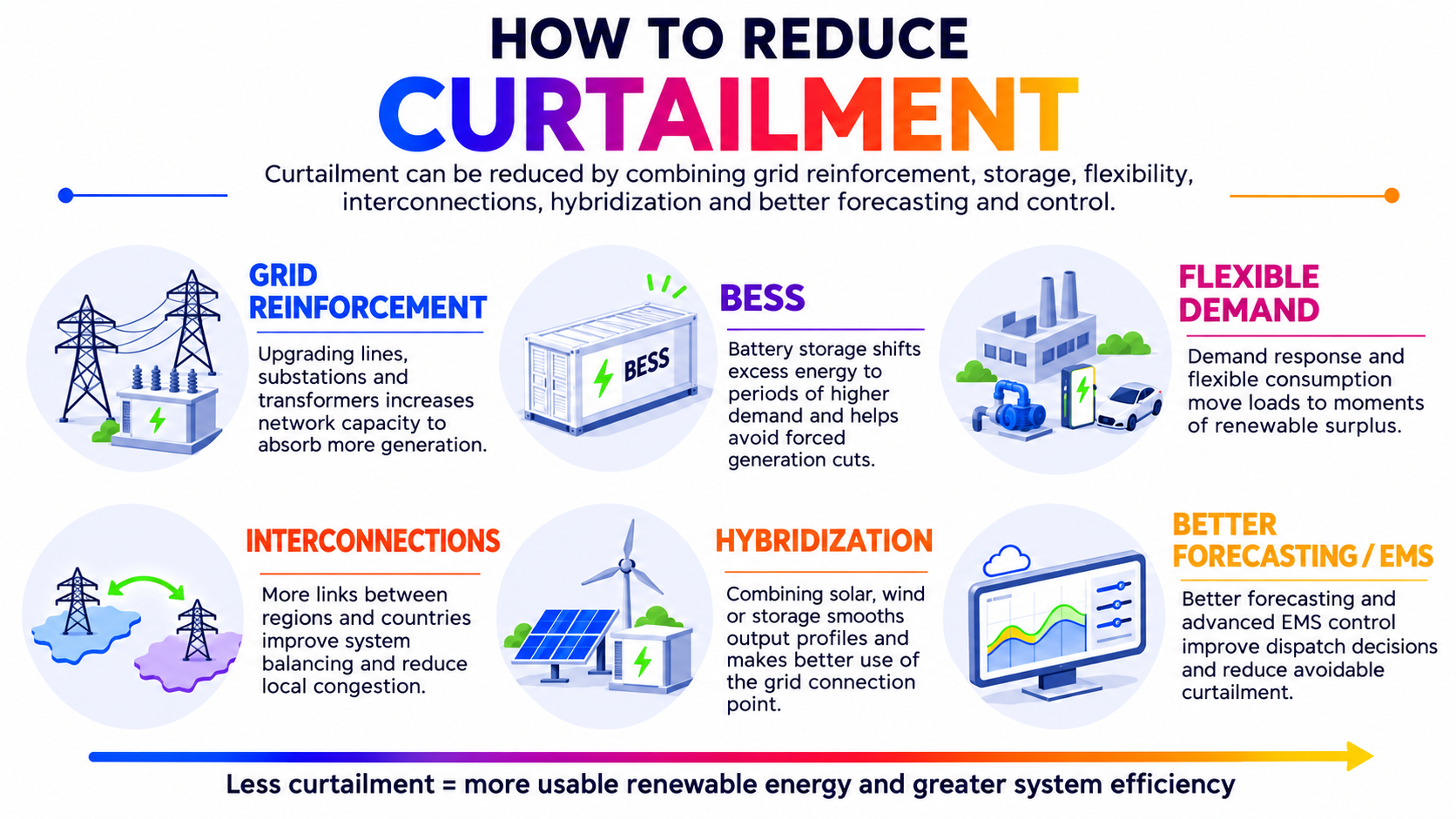
How to reduce curtailment
The aim is not always to eliminate it completely. In certain systems, accepting a small percentage of curtailment may be more economically efficient than building oversized infrastructure that would be used for only a few hours a year. However, when curtailment becomes structural, several solutions are available:
- Grid reinforcement and expansion: new lines, substations, transformers and interconnections increase transmission capacity.
- Energy storage: BESS absorb surplus energy and shift it to hours of greater demand.
- Flexible demand: consumers able to increase load during periods of excess generation help use energy that would otherwise be lost.
- Hybridisation: combining technologies and sharing a connection point can improve the use of available capacity.
- Locational and market signals: prices and mechanisms that encourage generation, consumption or storage where they add most value to the system.
- Better forecasting and operation: forecasts, EMS and optimisation algorithms help anticipate constraints and adapt the asset's strategy.
ACER estimated that more than 12 TWh of renewable generation was curtailed in the EU in 2023 because of grid congestion, illustrating that the problem already has a significant scale in the European market. ACER.
Why curtailment will become an increasingly important variable
The addition of more renewables, electrification and distributed generation is increasing demands on grids designed for more predictable flows. ENTSO-E notes that congestion is growing in frequency, variability and complexity, requiring infrastructure development to be combined with more efficient management tools. ENTSO-E.
For developers and asset owners, analysing only solar resources, wind or market prices is therefore no longer enough. It is also necessary to understand how much energy can actually be exported, when constraints may arise and which mechanisms can capture value from that energy before it has to be curtailed.