

Redispatch: what it is and how it works in the electricity system
Redispatch is an operational mechanism within the electricity system that allows for the controlled adjustment of generation or consumption at specific facilities in order to prevent grid congestion and maintain safe and stable operation. The aim is to adapt the operation of generation units to actual grid conditions when the initial planning is insufficient to ensure that all power lines and electrical components operate within their technical limits.
In an increasingly decentralised electricity system, with a high penetration of renewable energy and greater variability in generation, redispatch is becoming increasingly important. The location of generation plants does not always coincide with areas of highest demand, which means that situations may arise where there is sufficient generation capacity at national level, but not enough transmission capacity at certain points in the grid.
Redispatch enables these situations to be rectified by adjusting generation or, in certain markets, demand. In this way, the system operator can maintain a balance between generation and consumption and prevent overloading of the electricity infrastructure.
How does redispatch work?
The redispatch mechanism comes into play when the planned generation schedule could cause congestion at one or more points in the grid. The system operator then identifies the power stations that can adjust their output to resolve this constraint. Put simply, the mechanism may involve reducing generation at a power station located in an area where congestion exists, whilst simultaneously increasing generation at another power station situated in a different area where capacity is available.
For example, a solar or wind power plant located in an area with high renewable energy output may have to temporarily reduce its generation because a nearby transmission line is reaching its capacity limit. At the same time, another plant situated in an area with available capacity could increase its output to maintain the balance of the system. Therefore, redispatch does not necessarily imply that there is a shortfall in electricity. The restriction may relate solely to the physical capacity of the grid to transmit that energy.
The process can be represented in simplified form as follows:
Scheduled generation → congestion detection → adjustment of generation → elimination of congestion → safe operation of the grid.
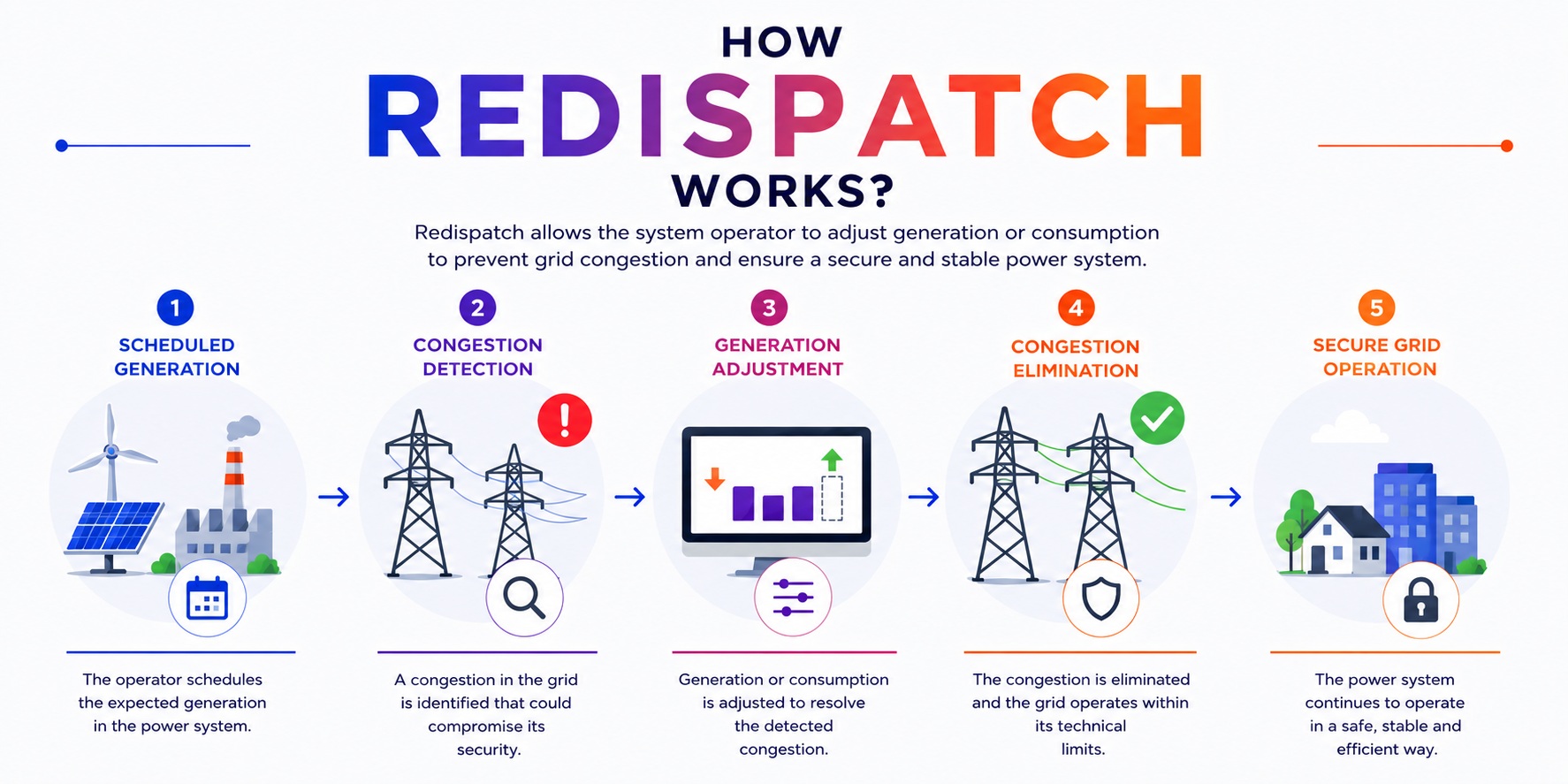
Depending on the design of the electricity market and the applicable regulations, changes may be made prior to real-time operation or whilst the system is in operation.
Redispatch and renewable energy
The growth of wind and solar power has increased the importance of redispatch in European electricity systems. Renewable energy plants are often located in areas with excellent solar or wind resources, which do not always coincide with the main centres of consumption. This situation can lead to congestion when renewable generation is high and the available transmission capacity is insufficient to transmit all the electricity generated.
In such cases, the system operator may use redispatch to temporarily adjust the output of certain facilities. When a renewable power plant has to reduce its generation due to a grid constraint, this action may be related to the concept of curtailment, although the two terms are not exactly equivalent. Redispatch describes the mechanism for adjusting generation or demand schedules to resolve a system constraint, whilst the curtailment refers, in more general terms, to the reduction in the output that a facility might generate.
The need to use redispatch mechanisms may increase when the expansion of renewable generation outpaces the development of transmission and distribution infrastructure. For this reason, grid planning, interconnections and new flexibility technologies are becoming increasingly important in reducing constraints.
How is redispatch linked to energy storage?
Energy storage systems, particularly those BESS, they can provide an additional tool for managing grid congestion and reducing the need for certain redispatch measures. A battery can store electricity during periods of high generation and discharge it later when the grid has greater capacity or when demand is higher. This ability to adjust the timing of when electricity is fed into or consumed makes storage a flexibility resource for the electricity system.
The use of BESS for this type of application depends on its location, power output, energy capacity, response time and the rules governing access to grid services. A battery strategically located in a congested area can help alleviate certain constraints by modifying power flows. In addition to storage, other sources of flexibility can play a part in mechanisms related to congestion management, such as distributed generation, demand response or certain active grid management resources. In this way, redispatch forms part of a broader set of tools designed to ensure that the growing electrification and penetration of renewable energy can be integrated whilst maintaining the security and stability of the electricity system.
Why is redispatch important?
Redispatch is a vital tool for the safe operation of electricity systems when physical constraints prevent the planned generation schedule from being implemented directly. Its importance increases as the share of variable renewable technologies grows, particularly solar photovoltaic and wind power. These technologies can concentrate large volumes of generation in specific areas and at specific times, increasing the need to manage electricity flows between regions.
An efficient redispatch system enables the operator to address these constraints without compromising grid security. At the same time, its frequent use can reveal the existence of structural bottlenecks that require investment in new lines, substations, interconnections or flexibility solutions. From an economic perspective, redispatch actions also have implications for electricity markets, as adjusting generation from the initial schedule can generate operational costs and compensation for the affected facilities. The way in which these costs are calculated and allocated depends on the regulatory design of each market.
The coordinated management of redispatch and countertrading forms part of the mechanisms used by system operators to manage network congestion in European electricity markets. ACER – Redispatching and countertrading. In an electricity system with a high level of renewable energy penetration, redispatch thus becomes an essential balancing mechanism for aligning available generation with the physical constraints of the grid, whilst facilitating greater integration of new renewable energy installations.