
Photovoltaic string: what it is and how it works in a solar installation
A photovoltaic string is a set of one or more photovoltaic modules connected electrically in series to form a direct current (DC) circuit. This configuration allows the electrical voltage of the set to be increased whilst keeping the current at approximately the same level as that of the connected modules. The photovoltaic string is one of the fundamental electrical configurations of any solar photovoltaic installation.
In a photovoltaic plant, the modules do not necessarily operate individually. To transmit the energy generated to the power conversion equipment, the modules are grouped into electrical strings. Each photovoltaic string provides a specific voltage and current depending on the characteristics of the modules it comprises and the operating conditions.
The IEC standard defines a PV string as a circuit comprising one or more modules connected in series. This configuration forms part of the electrical architecture of photovoltaic systems and must be designed taking into account parameters such as the maximum system voltage, the open-circuit voltage, the inverter’s MPPT range and the environmental conditions at the site.
In a conventional installation, several strings can be connected in parallel to increase the available current and achieve the required DC power. Consequently, the electrical design of a photovoltaic plant is usually structured across different levels: module, photovoltaic string, sub-array or sub-array y campo fotovoltaico.
How does a photovoltaic string work?
The operation of a photovoltaic string is based primarily on the series connection of solar modules. When several modules are connected in this way, the voltage of each module is added together, whilst the circuit current remains determined primarily by the current of the module that limits the whole string. For example, if ten modules with an operating voltage of 40 V are connected in series, the nominal operating voltage of the photovoltaic string will be approximately 400 V. The current will, in simple terms, be that corresponding to each module connected in the string.
This configuration is particularly useful because it allows for the use of high DC voltages and reduces the current required to transmit a given amount of power. By reducing the current, resistive losses in the conductors can also be reduced, provided that the system design complies with the relevant electrical and thermal limits. Each photovoltaic string has two particularly important parameters: the voltage at the point of maximum power (Vmp) and the open-circuit voltage (Voc). The Voc value is particularly important for ensuring that the maximum voltage of the system does not exceed the DC voltage rating of the inverter or the rest of the electrical equipment.
The National Renewable Energy Laboratory (NREL) uses precisely these parameters for the design of photovoltaic systems. Its System Advisor Model tool calculates the open-circuit voltage of the string based on the module’s Voc voltage and the number of modules connected in series.
How many panels can a photovoltaic string have?
The number of modules that can be included in a photovoltaic string is not a fixed value. It depends on the electrical characteristics of the module, the inverter, the minimum and maximum temperatures at the installation site, and the available MPPT voltage range. One of the main design criteria is to ensure that the open-circuit voltage of the photovoltaic string under the most unfavourable temperature conditions remains below the maximum DC voltage that the inverter can handle.
At the same time, the operating voltage of the string must fall within the inverter’s MPPT range under normal operating conditions. The aim is to ensure that the modules’ maximum power point can be utilised correctly by the maximum power point tracking system. For this reason, indiscriminately increasing the number of modules in a photovoltaic string does not always improve performance. A string that is too long may exceed the maximum voltage permitted by the inverter, whilst a string that is too short may operate outside the optimum MPPT tracking range.
The system must be sized taking into account the actual conditions of the project. Temperature has a particularly significant influence because the voltage of photovoltaic modules varies with it. Generally speaking, low temperatures cause an increase in open-circuit voltage, whilst high temperatures reduce the operating voltage.
Voltage and current of a photovoltaic string
The relationship between voltage and current is one of the key aspects for understanding the behaviour of a photovoltaic string. When the modules are connected in series:
- The voltage of the modules is added together.
- The circuit current remains approximately at the same level as the module current.
- The resulting power depends on the voltage and current available under each operating condition.
If, for example, ten modules have a maximum power voltage of 40 V and a maximum power current of 13 A, the array will have approximately 400 V and 13 A under nominal conditions, before taking into account losses and environmental variations.
The approximate electrical power of the photovoltaic string would therefore be the result of multiplying the voltage by the current. This configuration allows photovoltaic fields to be designed with different voltage and power levels, tailored to the characteristics of the inverters used. In the actual design of a solar power plant, parameters such as Voc, Isc, Vmp, Imp, temperature coefficients, manufacturing tolerances and module degradation must also be taken into account.
Photovoltaic string and MPPT
The relationship between a photovoltaic string and the inverter’s MPPT system is particularly important for the performance of a solar installation. MPPT stands for Maximum Power Point Tracking. This is the system by which the inverter identifies and maintains the operating point that allows the maximum available power to be obtained from the photovoltaic array at any given time.
Each photovoltaic string has a characteristic voltage-current curve that varies depending on irradiance, temperature and operating conditions. The inverter’s MPPT algorithm analyses these variables to identify the point at which electricity generation is maximised. Inverters may be equipped with one or more MPPT trackers. When different groups of modules have different orientations, tilt angles or shading conditions, it is advisable to use independent MPPT inputs to prevent the electrical characteristics of one group from adversely affecting the performance of another.
The design must ensure that the operating voltage of each photovoltaic string falls within the MPPT range specified by the inverter manufacturer. NREL recommends selecting the number of modules per string so that the open-circuit voltage remains below the inverter’s maximum DC voltage and the operating voltage falls within the MPPT range.
Photovoltaic string and inverter
The inverter is the device responsible for converting the direct current generated by the modules into alternating current. The configuration of the photovoltaic string must be directly aligned with the electrical characteristics of the inverter’s DC input. The main parameters to be checked are the maximum DC voltage, the MPPT voltage range, the maximum current per input and the permissible DC power.
An incorrect design may cause the photovoltaic string to operate outside the inverter’s optimal range or, in more critical situations, to exceed the electrical limits set by the manufacturer. In modern installations, it is common to use distributed string inverters, particularly in photovoltaic plants of a certain size. In this type of configuration, several strings are connected directly to inverters installed close to the module fields, thereby reducing the need for certain DC grouping and distribution arrangements.
NREL has studied the differences between architectures based on string inverters and solutions using central inverters in multi-megawatt photovoltaic installations, analysing aspects relating to costs, power conversion and electrical configuration.
Photovoltaic strings in large-scale solar power stations
In a utility-scale photovoltaic plant, there may be thousands of modules distributed across numerous strings. The electrical configuration depends on the plant’s capacity, the module technology, the type of inverters, the system voltage and the layout of the solar field.
At these facilities, the correct grouping of each photovoltaic string is essential to ensure uniform operation and maximise energy production. The strings can be organised into sub-fields with similar electrical characteristics. These groups are then connected to the inverters and to the various stages of energy conversion and transmission.
The architecture can vary considerably between a system with central inverters and one based on string inverters. In both cases, the design of the photovoltaic string must ensure that the electrical parameters are compatible with the connected equipment. Furthermore, in large-scale projects, it is common to use monitoring systems that enable the performance of different groups of strings to be analysed and any deviations from expected values to be detected.
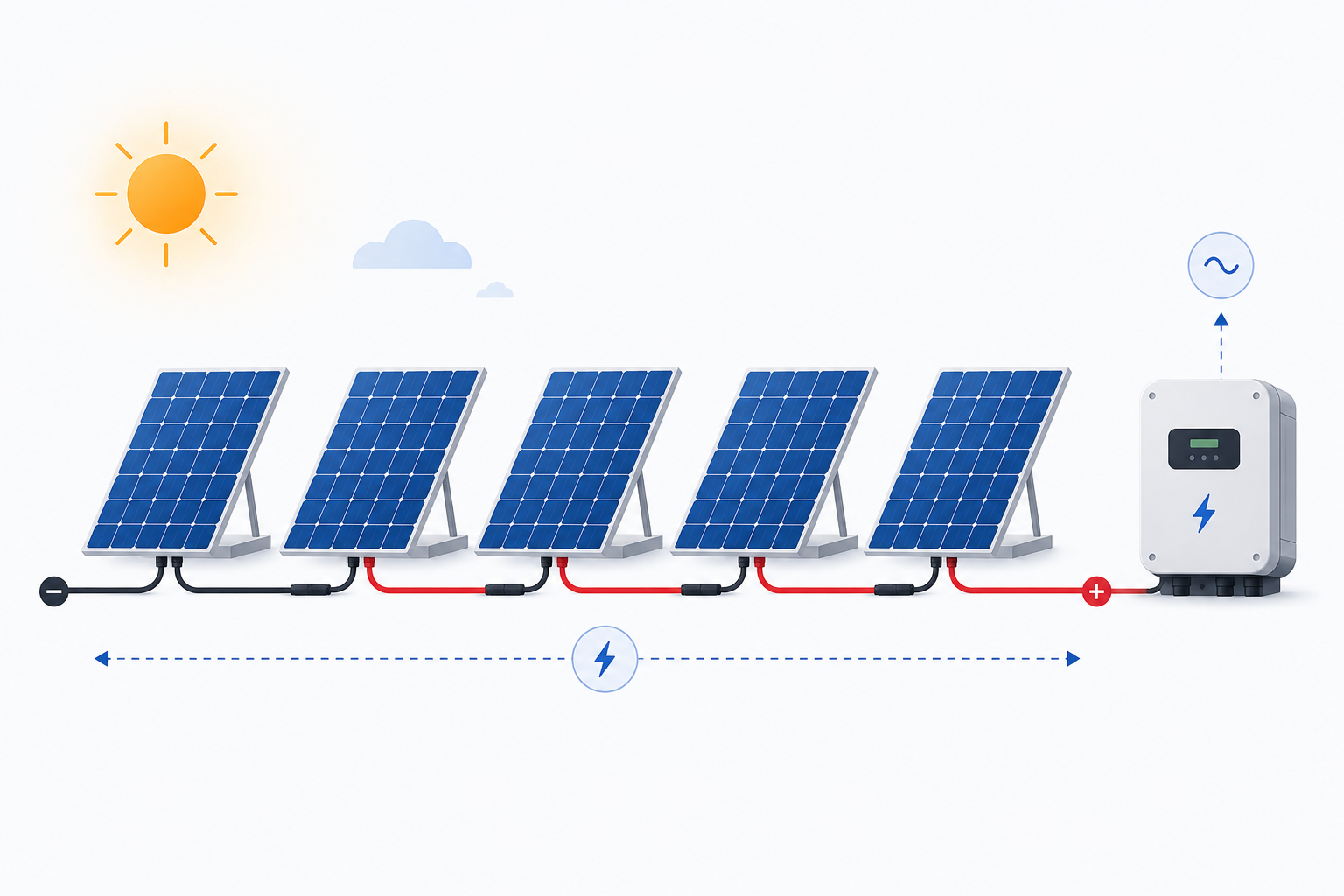
The difference between a photovoltaic string and a photovoltaic module
A photovoltaic module is an individual unit consisting of interconnected solar cells encapsulated within a structure designed to withstand environmental conditions. A photovoltaic string, on the other hand, consists of one or more modules connected electrically in series. The module is therefore a physical generation unit, whilst the string represents an electrical configuration.
This distinction is key to understanding the architecture of a solar installation. A photovoltaic field may consist of hundreds or thousands of modules grouped into numerous strings, which are then connected to one another and to the conversion equipment.
The difference between a photovoltaic string and a photovoltaic array
The term ‘array’ or ‘photovoltaic field’ refers to a grouping of modules and strings that make up a specific part of the installation. A photovoltaic string therefore constitutes a smaller electrical unit within the overall architecture. When several strings are connected in parallel, they can form a sub-array, and several sub-arrays can subsequently make up the complete photovoltaic field.
The terminology may vary slightly depending on the architecture of the installation, but the hierarchical structure helps to explain how a plant is organised electrically: modules, strings, sub-arrays and the photovoltaic array. This structure is particularly important during the engineering, construction, commissioning, and operation and maintenance phases, as it makes it easier to identify circuits and pinpoint any faults.
The importance of photovoltaic string design
The correct design of a photovoltaic string has a direct impact on the performance, safety, availability and service life of a solar installation. It is not simply a matter of connecting a specific number of modules, but of ensuring that the entire electrical circuit operates within the limits set by the manufacturers and by the applicable regulations. Selecting the correct number of modules ensures that the voltage remains within the inverter’s operating range, allows for optimal use of MPPT and reduces losses resulting from an inappropriate electrical configuration.
It is also important to maintain a consistent configuration across strings that share the same MPPT input. Significant differences in orientation, tilt or irradiance conditions can lead to losses in power output. In large-scale projects, the analysis of photovoltaic strings is an essential part of electrical engineering and the design of the DC field. The final configuration must be coordinated with the selection of modules, inverters, cabling, protection devices and monitoring systems.
International regulations set out specific requirements for the safe design of photovoltaic fields, including DC cabling, overcurrent protection, insulation, earthing and means of disconnection. The IEC 62548-1:2023, together with its 2025 amendment, is an important international benchmark for the design of photovoltaic arrays.