
PPA: what is a Power Purchase Agreement and what types exist in the renewable energy sector?
A PPA (Power Purchase Agreement) is a contract for the sale and purchase of electricity, usually of medium or long-term duration, entered into between an energy producer and a buyer or off-taker. In the renewable energy sector, PPAs are mainly used to set out the financial and operational terms under which the electricity generated by a solar photovoltaic plant, a wind farm or another generation facility will be sold.
The PPA sets out key aspects such as the price of electricity, the duration of the agreement, the contracted volume, the supply profile, the responsibilities of the parties and the treatment of certain market risks. Depending on its structure, it may also govern the transfer of Guarantees of Origin associated with renewable electricity.
In Europe, Power Purchase Agreements have become an important tool for both generators and corporate consumers. For the generator, a PPA can provide greater visibility over future revenues and help to improve the project’s bankability. For the buyer, it enables the establishment of a long-term electricity procurement strategy and partially reduces exposure to fluctuations in the wholesale market.
It is important to note that there is no single type of PPA. Contracts can be classified according to the method of electricity delivery, the payment terms, the location of the renewable asset or the relationship between the producer and the consumer. For this reason, terms such as physical PPA, virtual PPA, financial PPA, on-site PPA and off-site PPA describe different characteristics of the contractual structure and may be combined with one another.
What is a PPA and how does it work?
In its most basic form, a PPA establishes a contractual relationship between two main parties: the electricity producer and the buyer. The producer undertakes to sell a specified amount of electricity over a set period, whilst the buyer agrees to purchase it in accordance with the financial terms set out in the contract. The European Union defines a Power Purchase Agreement as a contract whereby a natural or legal person agrees to purchase electricity from a producer on market terms. In the specific case of renewable energy, European legislation also recognises renewable electricity purchase agreements entered into directly between producers and buyers. The definition and the European framework can be found at the European Commission on Power Purchase Agreements.The duration of a PPA depends on the needs of the parties and the characteristics of the project. Multi-year contracts are common for new renewable energy installations, as greater stability in revenue can facilitate the financing of construction. The main elements typically defined in a PPA include:- Duration: the period for which the agreement will remain in force.
- Price: the methodology used to determine the price of electricity.
- Volume: the amount of energy agreed between the producer and the buyer.
- Supply profile: sets out how the plant’s actual output relates to the contracted energy.
- Delivery point: the physical or commercial location at which the electricity is deemed to have been delivered.
- Guarantees of Origin: determine, where applicable, who receives the renewable attributes associated with the electricity generated.
- Risks and liabilities: covers situations such as unavailability, production deviations, regulatory changes, force majeure or breach of contract.
Types of PPA: physical, virtual, on-site, off-site and by generation profile
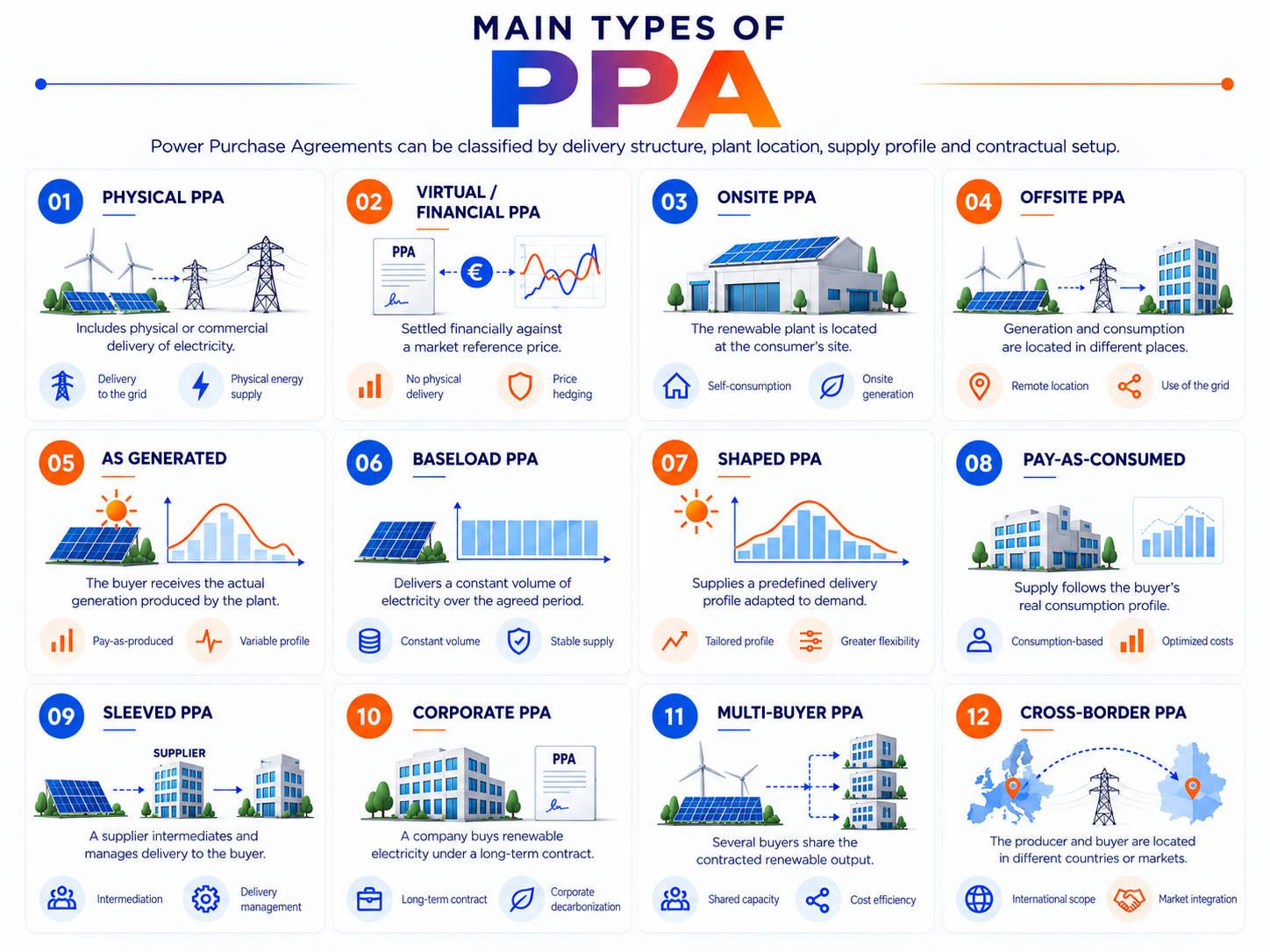
There are different types of PPA (Power Purchase Agreement), but not all fall under the same classification. A PPA can be defined according to how the electricity is supplied or settled, according to the location of the renewable energy plant, according to the contracted energy profile, or according to the roles played by producers, buyers and suppliers. For this reason, terms such as physical PPA, virtual PPA, on-site PPA, off-site PPA, ‘as generated’ PPA or baseload PPA are not necessarily mutually exclusive. A single contract may, for example, be a physical, off-site, sleeved and baseload PPA, whilst another may be structured as a virtual, off-site and ‘pay-as-produced’ PPA.Types of PPAs based on energy delivery and settlement
Physical PPA
In a physical PPA, there is a physical or commercial delivery of electricity from the producer to the buyer. When the generator and the consumer are located in different places, the energy is transmitted via the electricity grid and issues such as scheduling, balancing, deviations and supplementary supply must be managed. The buyer purchases the renewable energy in accordance with the terms set out in the contract, although this does not mean that the electrons generated by a particular plant are physically delivered exclusively to their premises. The delivery takes place as part of the overall operation of the electricity system.Virtual PPA or Financial PPA (Virtual PPA / Financial PPA)
A virtual PPA or financial PPA does not require a direct physical delivery of electricity between the generator and the buyer. The renewable energy facility normally sells its output to the electricity market, whilst the buyer continues to purchase the electricity they consume through their usual supplier. At the same time, both parties carry out a financial settlement, generally based on the difference between a PPA price or strike price and a market reference price.Types of PPA based on the plant’s location
PPA Onsite
In an on-site PPA, the renewable energy generation facility is located on the consumer’s own site or is directly associated with their premises. The most common example is a solar photovoltaic plant installed on the roof, car park or grounds of a factory, logistics centre, office or industrial facility. A third party may finance, build, operate and maintain the plant, whilst the consumer undertakes to purchase the electricity generated under the PPA for a specified period. The electricity is mainly consumed at the point of generation itself, reducing the amount of energy that needs to be imported from the grid.PPA Offsite
In an offsite PPA, the renewable energy plant and the buyer’s premises are located in different places. The consumer may, for example, contract the output of a solar power plant or wind farm situated hundreds of kilometres away from their consumption centres. An offsite PPA can be either physical or financial. If there is a commercial supply of electricity via the grid, it is an Offsite Physical PPA. If there is only a financial settlement linked to the plant’s output and at a market price, it can be structured as a Virtual Offsite PPA.Types of PPA based on the generation profile provided
Another of the most important classifications of Power Purchase Agreements is based on the energy profile that the seller undertakes to supply. This feature is particularly important in determining who bears the risks associated with the variability of renewable generation.PPA As Generated o Pay-as-Produced
Under a PPA ‘as generated’, also known as a ‘pay-as-produced’ PPA, the buyer purchases the actual electricity generated by the renewable energy facility or the percentage of generation specified in the contract. The amount of electricity supplied therefore varies depending on the availability of the renewable resource. A solar power plant will generate more during the middle of the day and none at night, whilst the output of a wind farm will depend on wind conditions.PPA Baseload
En un PPA baseload, el productor se compromete a entregar una cantidad constante de electricidad durante determinados intervalos, independientemente de la producción instantánea de la planta renovable. Por ejemplo, el contrato puede establecer la entrega de una potencia equivalente de 20 MW durante todas las horas del periodo acordado. Si la planta produce más electricidad en determinadas horas, el excedente puede venderse al mercado. Si produce menos, el vendedor deberá adquirir la energía necesaria para completar el volumen comprometido.Esto significa que, a diferencia del modelo as generated, en un PPA baseload el riesgo asociado a transformar una generación renovable variable en un suministro constante recae principalmente sobre el productor, comercializador o intermediario encargado de realizar el shaping. El PPA baseload ofrece al comprador un perfil de suministro más predecible, pero implica una mayor complejidad y riesgo para la parte responsable de garantizar la entrega.Shaped PPA or profiled PPA
A Shaped PPA represents an evolution of the fixed-volume model. Rather than supplying exactly the same amount of electricity at all times, a supply profile is established in advance that can be better tailored to the buyer’s consumption patterns. For example, a contract may stipulate a higher supply during working hours and a lower supply at night or at weekends.Pay-as-Consumed PPA
In a Pay-as-Consumed PPA, the volume supplied is tailored to the buyer’s actual consumption or to a pre-agreed percentage of their demand. Rather than receiving the entire output from a renewable energy facility, the buyer receives a volume that matches their own consumption pattern. This structure can be particularly attractive to consumers who wish to minimise the risk of purchasing more or less electricity than they actually need.Other PPA structures
Sleeved PPA
The Sleeved PPA is a physical structure in which an energy trader or supplier acts as an intermediary between the renewable energy plant and the buyer. The so-called sleeving may include services such as market representation, balancing, deviation management, the supply of supplementary energy, billing and the alignment of the generation profile with the customer’s consumption. This model is particularly useful in off-site PPAs because it enables the variable output of a renewable energy plant to be transformed into an energy product that is easier for a company to use.Corporate PPA
A Corporate PPA is a Power Purchase Agreement in which the buyer or offtaker is a company that purchases electricity to meet all or part of its energy requirements. The term ‘Corporate PPA’ does not specify how the electricity is supplied. A Corporate PPA may be onsite, offsite, physical, virtual, ‘as generated’, baseload or shaped. It should therefore be understood as a classification relating primarily to the identity and purpose of the purchaser.Multi-buyer PPA or aggregated PPA
In a multi-buyer PPA, several consumers jointly contract the output of a renewable energy facility. Demand aggregation allows the contracted volume to be distributed amongst different buyers and can facilitate access to PPAs for companies which, individually, do not have sufficient consumption to justify a large-scale contract. This type of structure is gaining importance in Europe as a mechanism for expanding access for small and medium-sized enterprises to long-term renewable electricity contracts.Cross-border PPA
A cross-border PPA establishes a contractual link between a generator and a buyer located in different countries or market areas. These transactions are more complex as they must take into account factors such as differences in zonal prices, interconnection capacity, national regulation, Guarantees of Origin and base risks between the various electricity markets. Cross-border PPAs do, however, enable large consumers to contract renewable generation located outside the market in which their facilities are physically situated.Summary of the main types of PPA
| Kinds | Types of PPA | Key feature |
|---|---|---|
| Delivery / settlement | Physical PPA | There is a physical or commercial supply of electricity. |
| Virtual / financial PPA | There is essentially a financial settlement based on a reference price. | |
| Location | PPA onsite | The generation takes place at the consumer’s site. |
| PPA offsite | Generation and consumption take place in different locations. | |
| Delivery profile | As Generated / Pay-as-Produced | The buyer receives the actual output from the plant. |
| Baseload | A constant volume is supplied during the agreed periods. | |
| Shaped | A predefined profile tailored to specific consumption patterns is provided. | |
| Pay-as-Consumed | Delivery is tailored to the buyer’s actual consumption pattern. | |
| Contractual structure | Sleeved PPA | A supplier or distributor acts as an intermediary and manages the delivery. |
| Corporate PPA | A long-term electricity purchase agreement (ranging from 3 to 20 years) entered into directly between a consumer company and a renewable energy producer. | |
| Multi-buyer PPA | Several buyers share the contracted production. | |
| Cross-border PPA | The producer and the buyer are based in different markets or countries. |
Differences between physical, virtual, on-site and off-site PPAs
The simplest way to understand the different types of PPAs is to consider two separate questions: how is the electricity supplied or settled? and where is the renewable energy plant located? A physical PPA and an on-site PPA are not synonymous. A physical PPA can be either on-site or off-site. Similarly, an off-site PPA can be structured as a physical contract or as a virtual PPA.| Types of PPA | Key feature | Physical delivery | Location |
|---|---|---|---|
| Physical PPA | There is a physical or commercial supply of electricity to the buyer. | Yes | Onsite or offsite |
| Virtual / financial PPA | The main relationship is a financial settlement based on a reference price. | Not directly | Usually offsite |
| PPA onsite | The plant is located on the customer’s premises. | Usually, yes | At the point of consumption |
| PPA offsite | The plant is situated at a different location from the consumer. | It can be physical or financial | Away from the point of consumption |
How is the price of a PPA set?
Price is one of the key elements of any PPA. However, not all Power Purchase Agreements use a fixed tariff throughout their term. The parties may use different structures depending on their market expectations and the allocation of risks they wish to assume.- Fixed price: a specific price per MWh is set for the whole or part of the contract, providing a high degree of predictability regarding associated revenue and costs.
- Indexed price: the PPA price is wholly or partly linked to a market benchmark and may include discounts, premiums or other adjustments.
- Floor: a minimum price is set, below which the producer’s remuneration cannot fall.
- Cap: sets a maximum price, limiting the buyer’s exposure to sharp market rises.
- Collar: combines a minimum price and a maximum price within which the return may fluctuate.
What risks should a PPA contract cover?
A Power Purchase Agreement is a complex contract because it allocates risks between the producer and the buyer that may persist for many years. A properly structured PPA must clearly set out who bears each of these risks. The main elements that are usually analysed include:- Price risk: the possibility that the market price may move differently from the forecasts used to negotiate the contract.
- Volume risk: the difference between the expected energy output and the electricity actually generated by the installation.
- Profile risk: this arises when the times at which electricity is generated do not coincide with the periods when the buyer needs to consume it.
- Risk of deviations: differences between planned output and actual generation that must be managed within the electricity market.
- Counterparty risk: the possibility that a producer or off-taker may be unable to meet their contractual obligations.
- Risk of curtailment: the possibility that the plant may have to reduce its output due to grid constraints or other regulatory or operational circumstances.
- Regulatory change: legal or regulatory amendments that may affect the economic conditions of the project.
- Force majeure: defines how extraordinary events that temporarily prevent the fulfilment of contractual obligations are to be managed.