
Tolling Agreement: what it is, how it works and why it is key to BESS
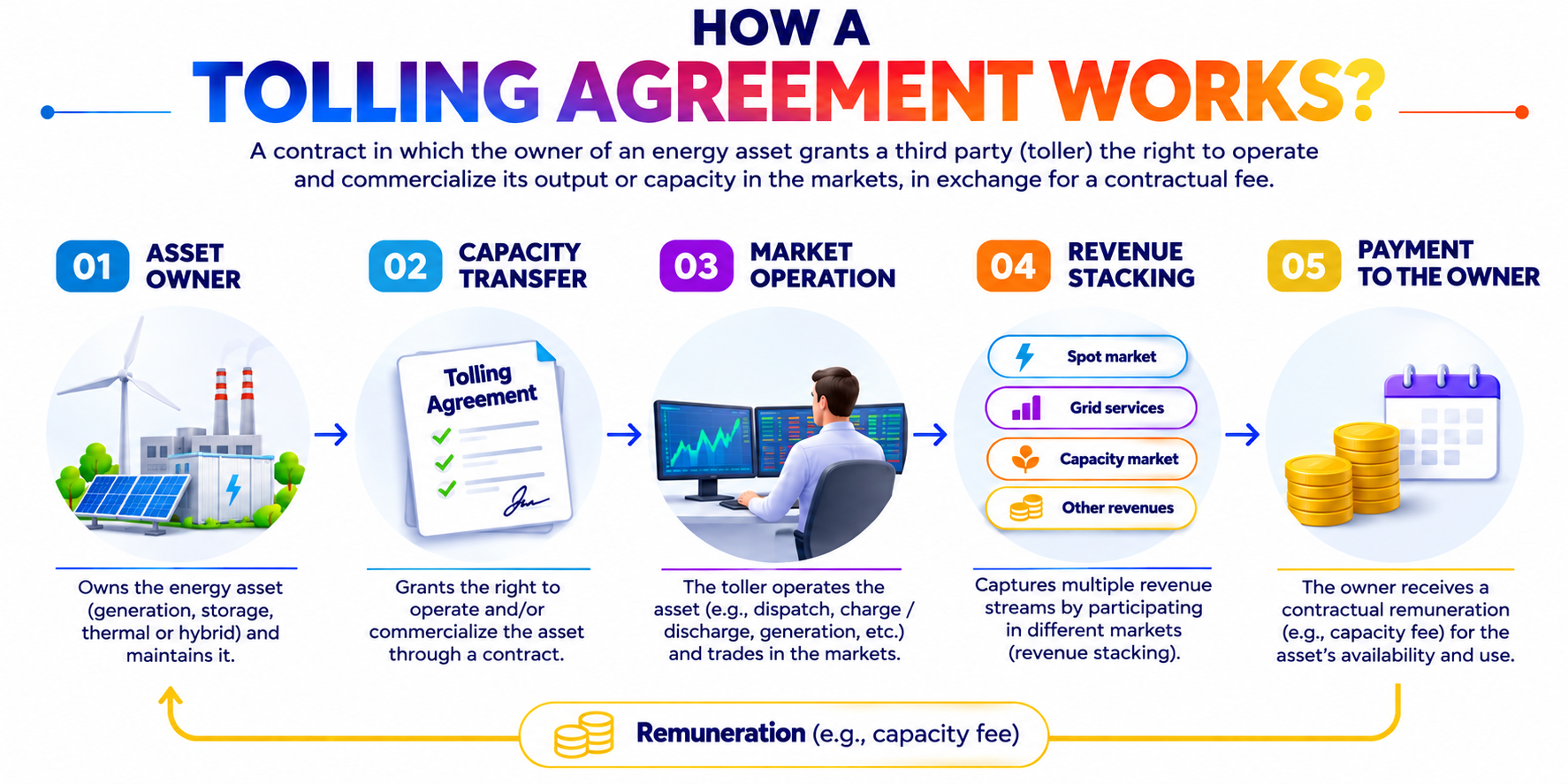
A Tolling Agreement or tolling contract is an agreement under which the owner of an energy asset makes some or all of the asset's operating capacity available to a third party (the toller or offtaker) in exchange for remuneration. In energy, the toller seeks to capture the commercial value of that flexibility without having to own the infrastructure.
The concept originated in generation assets: one party supplies the fuel, the plant converts it into electricity, and the toller receives the resulting energy while paying a fee to use the asset. ACER describes traditional tolling agreements precisely as contracts in which one party retains ownership of the fuel and the resulting electricity while another performs the conversion.
With the growth of BESS storage, the concept has evolved. There is no longer a fuel to convert: what is contracted is the ability to store energy, charge, discharge and monetise the battery within defined technical and degradation limits.
This is why tolling has become a particularly relevant structure for Front of the Meter projects. It separates two risk profiles: the owner provides the asset and seeks predictable revenue; the toller brings trading capabilities, optimisation and market access, and assumes a significant share of the commercial exposure.
What the toller actually buys
A Tolling Agreement does not necessarily involve purchasing the energy produced, as is the case with many PPA. What is contracted is the economic or operational right to the asset's flexibility. In a BESS, this may mean the right to decide when to charge, when to discharge and which markets to participate in, always within the limits set out in the contract. In return, the toller normally pays the owner a capacity fee or availability payment.
Owner → asset capacity and availability → Toller
Toller → capacity fee + commercial management → Owner
The economic logic is simple: the owner gives up some merchant upside in exchange for greater revenue certainty; the toller agrees to pay a fixed or semi-fixed fee because it believes it can extract more value from the asset through arbitrage, balancing services, imbalance management or other strategies.
In storage, value does not depend solely on the battery 'producing' energy. It depends on optionality: being able to buy electricity when it is cheap, sell it when it is expensive, reserve capacity for grid services or combine different markets. EY notes that Financial Tolling Agreements for BESS monetise precisely this optionality and the intraday spread rather than a fixed volume of output.
How a Tolling Agreement works by asset type
The term 'tolling' is used in different energy segments, and its mechanics vary by asset. It is therefore useful to distinguish between them.
Tolling in thermal generation
In the traditional model, the toller supplies or nominates the fuel (for example, gas), and the plant converts it into electricity. The owner operates the plant and receives a fee for capacity, availability or conversion. The toller retains exposure to fuel costs, electricity prices and the spark spread.
Tolling in BESS storage
A battery has no fuel, but it does have charging and discharging capabilities limited by power, energy, efficiency, cycles and degradation. The toller obtains the right to exploit that flexibility commercially, while the owner must keep the asset available within the agreed parameters.
The contract typically sets limits on power, duration, throughput, equivalent cycle count, minimum efficiency, SoC windows, availability and degradation. The EMS and BMS become important components here because they translate commercial setpoints into technically permissible operation.
Tolling in hybrid assets
In projects combining renewables and storage, the contract may cover only the BESS or the joint optimisation of the asset. This requires priorities to be defined: if solar energy is available, is it sold directly, stored, or is the battery reserved for another market? This hierarchy must be defined to avoid conflicts between renewable revenue, arbitrage, grid services and contractual obligations.
Physical tolling vs Financial Tolling Agreement
In storage, one of the most important distinctions is whether tolling involves actual operational control or only financial settlement.
| Feature | Physical tolling | Financial Tolling Agreement |
|---|---|---|
| Dispatch | The toller controls or instructs actual operation | Settlement is based on theoretical dispatch |
| Physical electricity | Charging and discharging follow the setpoints | Not required to calculate settlement |
| Market risk | Mainly borne by the toller | Linked to the financial value of the spread |
| Operational risk | Closely linked to availability and actual performance | The owner retains physical operation |
| Economic reference | Actual market revenue | Theoretical value or Optimal Dispatch Value |
In physical tolling, the toller can send charging and discharging setpoints (directly or through an optimisation platform) within the contractual constraints. The owner remains responsible for ensuring that the asset operates, but the commercial strategy largely rests with the toller.
Under a Financial Tolling Agreement (FTA), the battery may physically operate differently. The contract is cash-settled against the value that a theoretical battery would have generated when optimised using published market prices and predefined constraints. EY calls this value Optimal Dispatch Value (ODV).
How a Tolling Agreement is remunerated
The most visible element is usually the capacity fee, a periodic payment for making the asset's capacity available to the toller. However, modern contracts can combine fixed and variable components. A simplified formula for the owner would be:
Owner's revenue = capacity fee + variable component / profit sharing ± bonus-malus − penalties
The variable component may be linked to market revenue, throughput, cycles, availability or performance. It is also common to establish mechanisms for profit sharing: once a certain revenue level has been exceeded, the owner receives a share of the upside. The contract must precisely define what happens if the toller uses more cycles than expected, if the battery degrades faster, if round-trip efficiency falls or if the asset fails to achieve the committed availability. A seemingly small difference in these parameters can shift millions of euros in a large-scale BESS.
Which risks are shared between the owner and toller
Tolling does not eliminate risk: it redistributes it. The quality of the contract depends precisely on allocating each risk to the party best placed to manage it.
| Risk | Who usually bears it | What is negotiated |
|---|---|---|
| Prices and spreads | Toller | Permitted markets and commercial strategy |
| Availability | Owner | Availability guarantee and penalties |
| Degradation | Shared / contractual | Throughput, cycles, SoH and capacity augmentation |
| Efficiency | Owner, subject to qualifications | Minimum round-trip efficiency |
| Imbalances and market exposure | Usually the toller | Balance responsible party and settlement |
| Grid outages / curtailment | Negotiated | Force majeure events and availability |
| Regulatory change | Shared | Change in law and reopener clauses |
| Counterparty | Both parties | Guarantees, collateral and termination rights |
In BESS, degradation deserves particular attention. The more the toller uses the battery, the more market opportunities it gains, but each cycle consumes part of the asset's service life. The contract must therefore align commercial incentives with the OEM warranty, BMS limits and the strategy for O&M.
Benefits of a Tolling Agreement for each party
For the asset owner
The main benefit is converting part of merchant revenue into more predictable contractual cash flows. This can improve cash flow visibility, reduce price exposure and strengthen the bankability of the project. It also allows a trading and optimisation specialist to monetise the asset without requiring the owner to build a complete electricity markets team in-house.
For the toller
The toller gains access to a flexible asset without paying all the CAPEX needed to build it. It can incorporate the battery into its portfolio, hedge positions, reduce imbalances and exploit opportunities in spot, intraday or ancillary services markets.
For lenders
A long-term capacity fee with a creditworthy counterparty can reduce revenue volatility and improve metrics such as DSCR. However, lenders assess not only the fee amount, but also contract duration, the toller's credit quality, guarantees, termination payments, required availability and compatibility with the debt.
Tolling, revenue stacking and the capacity market
A battery rarely depends on a single source of revenue. It can combine arbitrage, balancing services, capacity and private contracts. This revenue stacking is one reason why tolling must precisely define which rights are granted to the toller and which the owner retains.
For example, if a BESS signs a Tolling Agreement but also wants to participate in a capacity mechanism, issues such as dispatch priority, availability obligations during system stress events and revenue sharing must be resolved. A poorly designed contract can create two incompatible obligations over the same MW. The European Commission considers storage an essential source of flexibility and is promoting its deployment to support renewable integration and energy competitiveness. European Commission. In this context, structures such as tolling, capacity contracts and merchant revenue can coexist provided that the contractual and regulatory framework is compatible.
Tolling Agreement vs PPA vs merchant operation
| Model | What is contracted | Who bears more market risk | Main objective |
|---|---|---|---|
| Tolling | Asset capacity and flexibility | Toller | Monetise availability and optionality |
| PPA | Generated energy or contractual profile | Depends on the structure | Secure price / supply |
| Merchant | No main contractual offtake | Owner | Capture market value directly |
In a solar PPA, the main product is usually the electricity generated. In a storage Tolling Agreement, the economic product is the ability to move energy between times and markets. This difference explains why availability, efficiency, degradation and dispatch rights carry so much weight in the contract.
Practical example of a Tolling Agreement for a BESS
Imagine a 100 MW / 200 MWh BESS. The owner finances, builds and maintains the asset. A toller signs a ten-year contract and pays an annual capacity fee to access the battery's capacity within agreed limits.
During the contract, the toller may decide to charge when prices are low and discharge during higher-price hours, reserve part of the power capacity for balancing services or use the asset to manage positions in its portfolio. The owner guarantees, for example, minimum availability, specified efficiency limits and a degradation profile.
If the battery is unavailable for more hours than permitted, penalties may apply. If the toller exceeds the contracted throughput, the agreement may provide for an additional payment or reduce its future usage rights. If market revenue exceeds a specified threshold, profit sharing with the owner may be triggered. The key is not the specific example but the contractual logic: the owner monetises availability and the toller monetises flexibility.
When a Tolling Agreement is worthwhile and when it may not be
Tolling makes sense when the owner places particular value on revenue stability, needs to improve project financing or does not want to assume trading risk directly. It may also be attractive when there is an experienced market counterparty capable of capturing more value than the owner alone. It may be less attractive if the offered capacity fee does not compensate for giving up the upside, if the contract places too many restrictions on other revenue streams or if the toller requires a level of utilisation incompatible with the asset's warranty and degradation.
Counterparty risk must also be assessed. A fifteen-year contract is only as strong as the toller's financial ability to meet its payments throughout that period. Corporate guarantees, collateral, ratings, termination payments and replacement rights can therefore be as important as the price itself.
For a BESS project, the final decision is usually a balance between three objectives: revenue certainty, retaining merchant upside and protecting the asset's service life.