
Ready to Build (RtB): what it means and when a project is ready for construction
Ready to Build (RtB) is a term used in the development and sale and purchase of energy projects to indicate that a project has reached a sufficient level of maturity for construction to begin once the final contractual and financial steps have been completed. In renewables, storage and energy infrastructure, reaching RtB usually means that the main development risks — land, permits, grid connection, design and authorisations — have been resolved or sufficiently addressed.
However, RtB is neither a universal legal category nor an identical certification in every market. Two projects advertised as Ready to Build may be in very different situations. One may have final permits, secured land, firm connection capacity and a finalised design; another may still have outstanding conditions, administrative appeals, connection milestones, project amendments or agreements yet to be implemented.
That is why, in a sale and purchase or financing transaction, the key question is not only whether the seller calls the project “RtB”, but which specific milestones have been reached, which rights remain valid, which obligations are outstanding and which risks could actually prevent work from starting.
Reaching Ready to Build usually significantly increases a project’s value because it reduces uncertainty and brings the asset closer to the stage at which CAPEX begins to be deployed. It also facilitates the entry of investors, banks, infrastructure funds and buyers who do not want to take on development risk from the early stages.
When is a project considered Ready to Build?
There is no single checklist applicable to every country and technology, but an RtB project should have passed most of the milestones that could legally, technically or physically prevent its construction. The exact scope is usually defined in the transaction documents, during due diligence and, where a project is being sold, in the agreement’s conditions precedent. In practical terms, the most common milestones are:
| Milestone | What should be resolved |
|---|---|
| Land rights | Ownership, leases, options, easements and access rights with sufficient duration for construction and operation. |
| Permits and authorisations | Environmental, administrative, planning and construction authorisations needed to begin work. |
| Access and connection | Valid connection rights, granted capacity, fulfilled milestones and an understanding of the necessary works. |
| Technical design | A sufficiently mature layout, defined technology and compatibility with permits, land and the grid. |
| Power export and infrastructure | Substation, line, easements and construction responsibilities sufficiently secured. |
| Critical studies | Geotechnical, topographical, resource, drainage, access, environmental impact or other relevant studies. |
| Regulatory conditions | Regulatory milestones, guarantees, deadlines and obligations that could lead to expiry or loss of rights. |
The European Commission even uses the term ready-to-build phase to describe the point at which the competent authority has issued a decision allowing the developer to begin the necessary construction work for energy infrastructure. European Commission. In private transactions, however, the standard may be more demanding than simply having an administrative authorisation.
What is usually still outstanding when a project reaches RtB
Ready to Build does not necessarily mean that all project contracts are in place or that financing has been disbursed. Depending on the transaction, a project may be considered RtB before signing its contract for EPC, before financial close or even before all supply contracts have been executed.
Typically, pure development risk has been substantially reduced, but construction, procurement and financing decisions remain. In a photovoltaic project, for example, the environmental permit, connection point and land rights may have been obtained while the buyer is still negotiating modules, inverters, mounting structures, EPC, insurance and financing. This distinction matters because RtB acts as a boundary between two types of risk: development risk dominates before RtB; execution risk increases after RtB. From that point onwards, the main challenges usually shift towards CAPEX, supply, construction, schedule compliance, commissioning and asset performance.
Ready to Build by asset type
Solar PV
In utility-scale solar, robust RtB status usually requires secured land, environmental and administrative permits, construction authorisation, access and connection rights, a defined export line and a layout compatible with the authorisations. Resource and yield studies, geotechnical assessments, topography, drainage and potential archaeological, environmental or easement constraints are also reviewed.
Wind
Wind projects tend to involve greater development complexity due to visual impact, noise, birdlife, access, easements and component transport. Having environmental authorisation does not necessarily eliminate all risks if there are appeals, wildlife conditions, height restrictions or subsequent changes to the turbine model.
BESS and storage
For a BESS, grid connection is usually one of the critical milestones. Safety, fire protection, noise and land-use permits, along with compliance with local rules, are also relevant. In markets where the regulatory framework for storage is still evolving, a project may have land and a connection but retain uncertainties over permits or its revenue model.
Hydropower
In hydropower projects, reaching RtB usually requires water-use rights, concessions and environmental authorisations, available land, hydrological and geotechnical studies, a defined dam or intake, access and grid connection. Timescales can lengthen because of complex environmental assessments, impacts on watercourses, biodiversity, easements and public participation. For brownfield assets or repowering projects, the situation may be simpler, but confirming that existing authorisations allow the planned changes remains critical.
Thermal generation
For a thermal power plant, RtB normally requires integrated environmental permits, fuel availability and logistics, process and cooling water where applicable, electrical connection, emissions management and a sufficiently advanced power block design. Industrial safety, supply contracts and regulatory conditions on emissions also matter. A project may be technically ready for construction but unfinanceable if exposure to fuel, carbon or regulation makes its economic model unviable.
Nuclear
In nuclear power, Ready to Build implies a much more demanding level of maturity than in other technologies. Site selection and characterisation, nuclear licences, environmental assessment, safety analysis, reference design, water supply, grid connection, waste management and supply chain readiness must be very advanced before major construction work begins. Construction authorisation also depends on a specific regulatory framework and extensive technical reviews, so the pre-construction phase can last many years.
Data centres
For a data centre, RtB depends on both the property and the energy supply. The site must have land rights, planning and building permits, sufficient electrical capacity, connection agreements, substation and redundancy design, water supply where needed, telecommunications and security requirements. In many European markets, power availability has become the critical factor: a permitted site may not truly be RtB if the electrical connection is not secured within the required timeframe.
Hydrogen and Power-to-X
In renewable hydrogen and Power-to-X, reaching RtB requires several infrastructures to be coordinated at once: electricity supply, electrolysers, water, storage, compression, potential derivatives such as ammonia or e-fuels, and logistics or gas connections. Industrial and environmental permits, safety, offtaker availability and energy supply contracts also matter. Complexity increases because the project may depend on an associated renewable plant and on infrastructure progressing at different regulatory speeds.
Biomethane and biogas
In biomethane and biogas, RtB requires a secured site, environmental and industrial permits, sustainable feedstock availability, supply logistics, digestion and treatment, a gas grid connection or local consumption solution, and digestate management. Unlike solar or wind, bankability depends heavily on the supply chain: a permitted project without sufficient feedstock contracts may not be considered truly mature enough for construction.
Why reaching Ready to Build increases a project’s value
The value of an energy project increases as development risks fall away. Land with a project idea has limited value; a project with an assessed resource, advanced permitting, a secured connection and final authorisations is worth more because it has a higher probability of reaching construction and operation. That is why many developers pursue a strategy of developing to RtB and then selling. The buyer acquires an asset with much of the development work completed and mainly takes on financing and construction risk. The seller monetises the value created through years of permitting, engineering, land arrangements and grid management.
The difference between an early-stage project and an RtB project may be reflected in the price per MW, milestone payments or earn-out. The more robust the package of permits and rights, the smaller the discount the buyer will usually apply for uncertainty. This effect is directly linked to bankability and WACC: lower risk can translate into better financing terms.
Risks that may remain in an RtB project
One of the most common mistakes is interpreting RtB as “zero risk”. In reality, a project may be ready for construction and still exposed to material risks. The buyer must check not only that each permit exists, but also its content, duration, conditions and compatibility with the intended design. Common risks include permits under appeal or not yet final, land rights that do not cover every plot, incomplete export easements, regulatory milestones nearing expiry, connection costs above budget, required grid reinforcements, mandatory design changes, environmental restrictions, geotechnical risk and technical conditions that reduce capacity or generation.
Commercial risk may also arise. A project can be RtB without a PPA, leaving market exposure open. Likewise, it may have a connection but be located in an area with severe congestion and a risk of curtailment. That is why due diligence must analyse the asset as a whole, rather than as a simple permit checklist.
Common issues and disputes in an RtB sale and purchase
The most common debate between seller and buyer is exactly when RtB is deemed to have been reached. The seller may consider obtaining the main authorisations sufficient, while the buyer may require them to be final, free from appeals and compatible with a specific design. Disagreements over who bears the risk of subsequent modifications are also common. If the buyer changes modules, inverters, capacity, layout or technology, permit amendments may be needed. In that case, it is necessary to distinguish whether the change addresses a shortcoming in the original development or reflects a commercial decision by the new owner.
Other common issues include sharing connection costs, liability for export infrastructure cost overruns, guarantees on permit validity, milestone compliance, compensation if connection capacity is lost, and the handling of claims from landowners, authorities or third parties. That is why many transactions use a milestone-based price. One portion may be paid at signing and another when the RtB condition is met, the Notice to Proceedis issued, financial close is reached or COD is achieved. This structure aligns the price with the actual reduction in risk.
Ready to Build, FID, NTP and COD: different milestones
These concepts belong to different stages. RtB indicates sufficient maturity for construction. The Final Investment Decision (FID) is the investor’s decision to commit capital definitively. The Notice to Proceed (NTP) is the contractual instruction for the EPC contractor or other contractor to begin work. The Commercial Operation Date (COD) marks the start of commercial operation. In some projects, the four milestones occur close together; in others, months may pass between RtB and FID while financing, EPC, supply or PPA negotiations continue. That is why RtB should not be used as a synonym for “financed” or “construction started”.
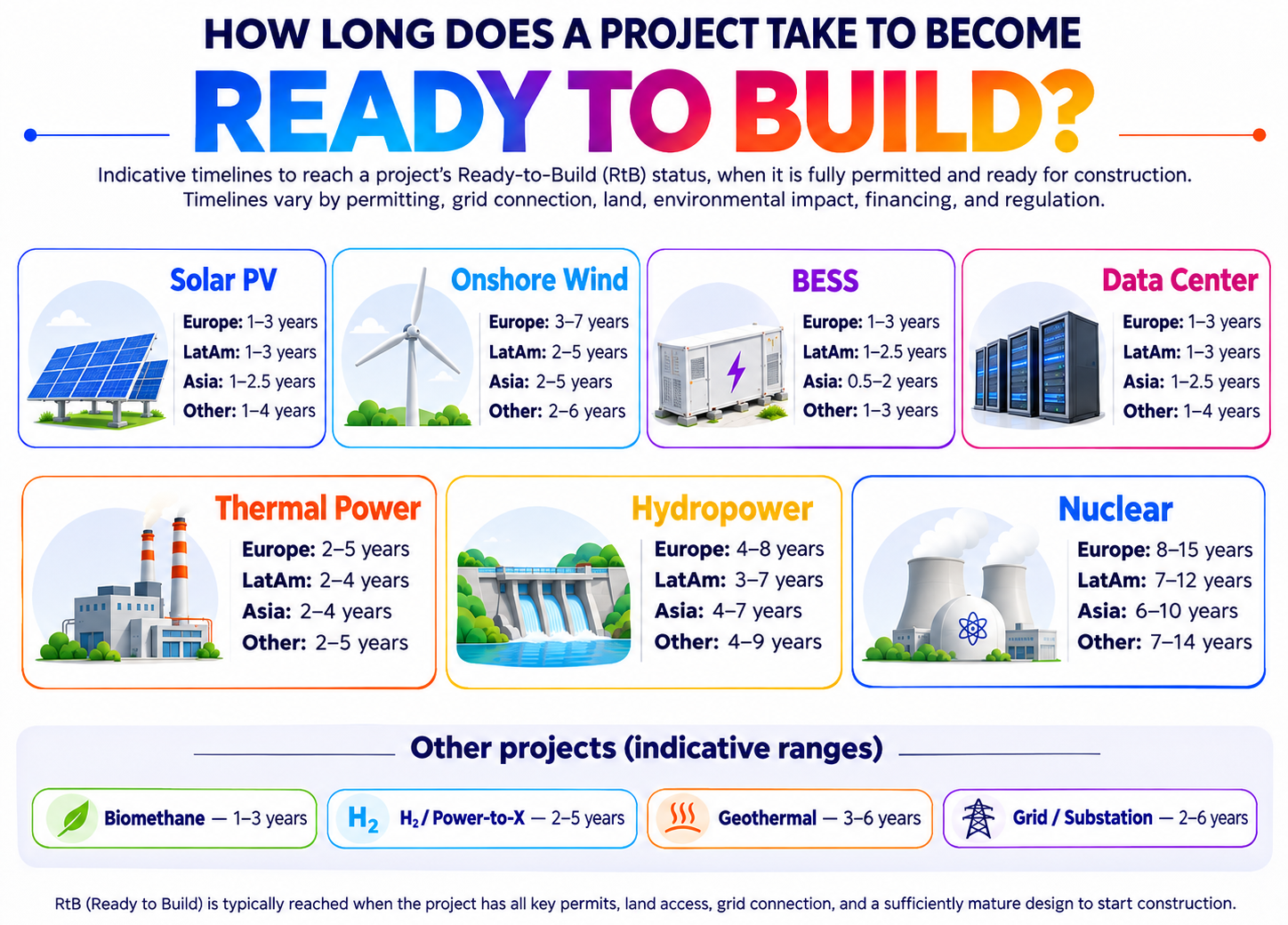
How long does it take a project to reach Ready to Build?
There is no standard timeframe because it depends on technology, country, environmental complexity, grid availability and administrative readiness. As a reference, the IEA notes that permitting processes can take approximately 1–5 years for utility-scale solar PV, 2–9 years for onshore wind and around 9 years on average for offshore wind. IEA. These timescales do not exactly equal the total time to RtB, because land development, studies, connection, engineering and contractual negotiations can progress in parallel. For relatively straightforward projects, a solar plant may reach RtB in a few years; for wind projects, major infrastructure or sites with a saturated grid, the process can take much longer.
Connection is becoming one of the biggest bottlenecks. The IEA currently estimates that more than 2,500 GW of renewable, storage and large-load projects remain stuck in connection queues worldwide, while in the EU waiting times for some connections can stretch for years. This means a technically straightforward project may take longer to reach RtB because of the grid than because of plant construction.
What a buyer should review before accepting that a project is RtB
The best way to assess Ready to Build status is to try to answer a simple question: “If the capital and contractor were available today, what could prevent construction from starting?”. Anything capable of blocking, significantly delaying or changing the project should be identified in due diligence.
Beyond checking permits, land and connection, it is important to review whether the authorised design matches the financial model, whether connection costs are finalised, whether there are expiry milestones, whether guarantees remain valid and whether contracts allow a change of control. Resource, generation and LCOE, curtailment risks and potential conditions that could increase CAPEX or OPEX must also be analysed. Ready to Build should therefore be understood as a demonstrable level of maturity rather than just a label. The more clearly its milestones are defined, the less likely it is that seller, buyer and lender are using the same term to describe very different projects.