
Power-to-X (PtX): what it is, how it works and its different types
Power-to-X (PtX or P2X) is a concept covering technologies capable of converting electricity into another energy carrier, fuel, heat or feedstock. The “X” represents the final product: hydrogen, synthetic gas, methanol, ammonia, liquid fuels, heat or other compounds that can subsequently be used in industry, transport, heating or energy storage.
Put simply, Power-to-X transforms electrons into molecules or heat. This is particularly useful when renewable electricity is abundant and the end use cannot be electrified directly, requires energy storage over long periods or needs a molecule as an industrial feedstock. IRENA uses the term for products such as hydrogen and its derivatives—for example ammonia, methanol or synthetic fuels—obtained from renewable electricity.
Power-to-X is closely linked to energy system integration. The European Commission highlights that certain hard-to-electrify end uses can be decarbonised through indirect electrification, converting electricity into fuels such as hydrogen.
But PtX is not a universal solution. Each conversion introduces losses, infrastructure and CAPEX. Where an application can be electrified directly and efficiently, using electricity without converting it is usually more favourable in energy terms. Power-to-X makes particular sense when it provides something that direct electricity use cannot easily offer: long-duration storage, high energy density, transport of molecules or feedstocks for industrial processes.
How does Power-to-X work?
The Power-to-X chain starts with electricity, ideally from renewable sources. This electricity powers a conversion process that produces a different energy carrier. The best-known example is electrolysis: an electrolyser uses electricity to split water and produce hydrogen and oxygen.
From there, hydrogen can be used directly or converted into downstream products. Through chemical synthesis, it can be combined with nitrogen to produce ammonia or with CO₂ to make methanol, synthetic methane or liquid hydrocarbons. A PtX facility can therefore be much more than an electrolyser: it may incorporate compression, storage, water treatment, gas separation, CO₂ capture or supply, reactors, thermal systems and product conditioning equipment.
Renewable electricity → Conversion → H₂ / heat / gas / liquids / chemicals → End use or storage
Operation can be continuous or flexible. In projects linked to solar and wind power, the system can increase production when generation is abundant and reduce it when electricity is scarce or expensive. This flexibility makes some PtX assets consumers capable of adapting to power system conditions, although feasibility depends on the technology and how much cycling the industrial process can withstand.
Types of Power-to-X
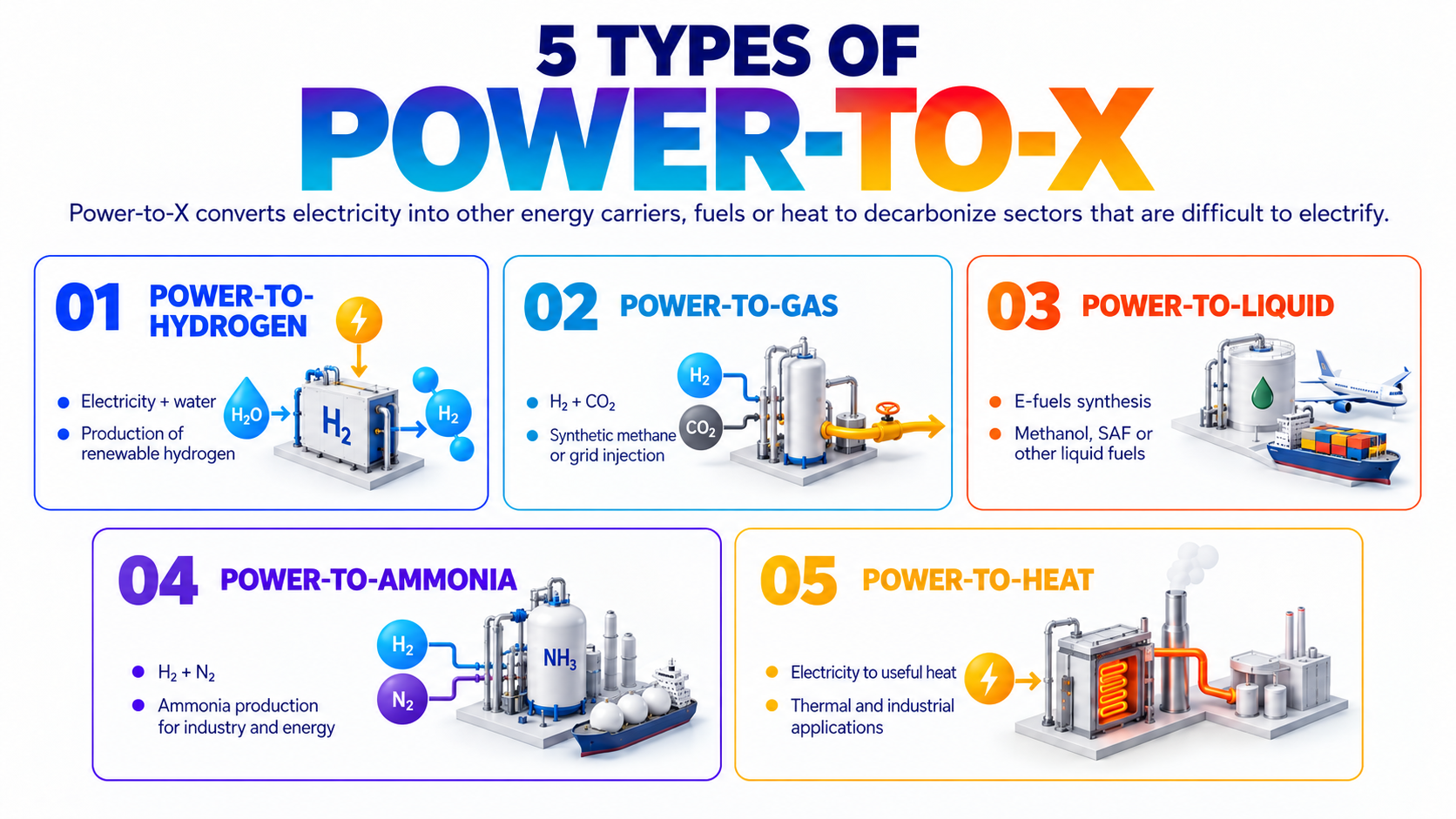
Power-to-X does not describe a single technology. It is a family of conversion pathways distinguished by their final product and the intermediate processes required.
Power-to-Hydrogen (P2H₂)
This converts electricity into hydrogen through electrolysis. It is the most basic pathway and the starting point for many other PtX processes. Hydrogen can be used in refining, ammonia production, steelmaking, heavy-duty transport, storage or as a feedstock for producing other fuels.
Power-to-Gas (P2G)
The term can refer to hydrogen production or, in a more specific definition, to the subsequent conversion of hydrogen into synthetic methane through methanation. Producing methane requires a carbon source, usually CO₂, in addition to renewable hydrogen.
Power-to-Liquid (P2L) and e-fuels
In this pathway, electricity is ultimately converted into synthetic liquid fuels. Renewable hydrogen is usually combined with a carbon source to produce molecules such as methanol or synthetic hydrocarbons. These products can be converted into e-kerosene, e-diesel or other e-fuels. The IEA includes renewable electrolytic hydrogen and e-fuels such as e-kerosene, ammonia and methanol among renewable fuels, which are particularly relevant for hard-to-electrify sectors.
Power-to-Ammonia and Power-to-Chemicals
Hydrogen obtained through electrolysis can be used to produce ammonia, methanol and other chemical feedstocks. Here, the value lies in more than storing energy: a fossil-based feedstock is replaced by one produced from renewable electricity.
Power-to-Heat (P2H)
Power-to-Heat converts electricity into heat using resistive heating elements, electric boilers, heat pumps or other technologies. It is conceptually simpler than producing fuels and can be used in district heating, industrial processes or thermal storage. In certain applications, it can achieve much higher efficiencies than electricity–hydrogen–fuel chains.
Power-to-X, green hydrogen and e-fuels: are they the same?
No. Power-to-X is the overarching concept. Renewable hydrogen is one of its possible products, and e-fuels are downstream products that can be made from that hydrogen. It is therefore helpful to think of PtX as a tree of pathways rather than a specific technology.
Power-to-X → H₂ → NH₃ / methanol / synthetic CH₄ / e-fuels / chemicals
IRENA explains that derivatives such as ammonia, methanol and synthetic fuels produced from electrolytic hydrogen are considered Power-to-X products. This distinction matters because each additional stage increases the amount of equipment, investment, energy losses and operational requirements.
What does a Power-to-X project need?
A PtX project needs much more than electricity and an electrolyser. Its configuration depends on the final product, but several recurring requirements determine technical and economic feasibility.
- The first is the electricity supply. Energy accounts for a substantial share of production costs, particularly in Power-to-Hydrogen. The project must determine whether it will use a dedicated renewable energy plant, a grid connection, a PPA, a combination of sources or a hybrid arrangement. A decision is also needed on whether to prioritise a high electrolyser utilisation factor or access to low-cost electricity for fewer hours.
- The second element is the physical resource. Electrolysis requires water of suitable quality, while derivatives may require nitrogen, CO₂ or other feedstocks. An e-methanol project, for example, does not end with producing H₂: it also needs a carbon source, gas treatment and a synthesis unit.
- Then comes infrastructure. Depending on the product, compressors, tanks, pipelines, cryogenic storage, port terminals, loading systems, rail connections or export facilities may be required. In PtX, producing the molecule and delivering it to the consumer are two parts of the same challenge.
- Finally, there are safety engineering, permits, product quality, guarantees of origin, electricity traceability and the rules applicable to the fuel. In large projects, integration through EMS and control systems enables the coordination of renewable generation, electricity consumption, storage and the chemical process.
Examples of Power-to-X
A simple example would be a solar plant powering an electrolyser to produce hydrogen for a nearby industrial facility. The final product is H₂, making this a project based on Power-to-Hydrogen.
A second case would use that hydrogen together with nitrogen to produce ammonia. Here, the product has applications in fertilisers, the chemical industry and potentially as a fuel or energy carrier. The project’s value no longer depends solely on electricity prices, but also on the synthesis plant, logistics and the ammonia market.
Another example is the production of e-methanol or e-kerosene. In these chains, renewable hydrogen is combined with carbon to make synthetic fuels intended, among other uses, for shipping or aviation. These products are particularly attractive in sectors where replacing fuel directly with electricity is difficult.
Power-to-Heat is another option: an industrial facility with surplus renewable energy can convert electricity into heat for thermal processes or store it in a thermal system for later use. There is no intermediate molecule, but electricity is still converted into another energy carrier.
When does Power-to-X make sense, and when does it not?
This is probably the most important question. Power-to-X is worthwhile when the resulting product provides value that justifies the losses and conversion costs. It can make sense when there is a need for high-energy-density fuel, a chemical feedstock, seasonal storage, energy exports in molecular form or decarbonisation of a process that cannot easily be electrified.
By contrast, if the end goal can be met directly with electricity, adding several conversions usually increases energy consumption, equipment requirements and costs. For example, to supply an electrical load for a few hours, a BESS can be much more straightforward than producing hydrogen, storing it and subsequently converting it back into electricity.
PtX should therefore not be seen as a universal competitor to direct electrification or batteries. Each technology serves different time horizons and needs: batteries are highly efficient for short- and medium-duration electricity storage, while hydrogen and certain derivatives can offer advantages when molecules, prolonged storage or the transport of large quantities of energy are required.
Power-to-X vs BESS: two different ways to use renewable electricity
A BESS stores electricity electrochemically and subsequently returns it as electricity. Power-to-X transforms that electricity into another product. This difference determines efficiency, infrastructure and the target market.
| Aspect | BESS | Power-to-X |
|---|---|---|
| Output | Stored electricity | H₂, gas, liquid, heat or chemical product |
| Typical use | Arbitrage, grid services, backup, Peak Shaving | Industry, fuels, chemicals, long-duration storage |
| Conversion chain | Relatively short | May involve several stages |
| Main advantage | High electrical efficiency and fast response | Converts electricity into useful molecules or heat |
In practice, both can coexist within the same project. A BESS can stabilise renewable generation, limit ramp rates or improve electrolyser operation while the PtX system converts large volumes of energy into a product that can be stored or marketed.
What determines the profitability of a Power-to-X project?
PtX economics depend on a combination of factors. The cost of electricity and the number of hours it is available are fundamental, but they are not the only considerations. Other important factors include the CAPEX of the electrolyser and synthesis units, efficiency, annual utilisation, water and feedstock costs, infrastructure, financing, equipment degradation, OPEX and the price of the final product.
A very cheap electrolyser operating for only a few hours can produce expensive hydrogen because its investment cost is spread over a small production volume. However, increasing operating hours by using more expensive electricity does not guarantee a better outcome either. The optimal design balances energy costs, utilisation factor and equipment size. For derivatives such as e-methanol or e-kerosene, CO₂ costs, synthesis efficiency, storage availability and logistics must also be analysed. PtX projects therefore often require more complex optimisation models than a conventional generation plant.
Power-to-X and renewable energy
Power-to-X can act as a bridge between the power system and sectors that consume molecules or heat. As solar and wind generation increase, flexible demand capable of absorbing electricity during periods of high production can become more valuable.
IRENA notes that converting electricity into hydrogen, chemical derivatives and synthetic fuels can facilitate renewable energy integration, provide long-duration storage and support the decarbonisation of hard-to-electrify industries. This does not mean that every renewable energy surplus should automatically be converted into hydrogen: the decision depends on the value of that electricity, the alternatives available and actual demand for the product.
In projects at Utility Scale, the combination of large renewable energy plants, electrolysers and synthesis facilities is creating a new category of energy infrastructure in which electricity, industry and fuels are beginning to be designed together.
Key challenges for Power-to-X
The first challenge is efficiency. Each conversion loses part of the initial energy, so longer chains require more electricity to deliver the same amount of useful energy. This makes it particularly important to reserve PtX for applications where direct electrification does not adequately solve the problem.
The second is scale. Producing large quantities of hydrogen or e-fuels requires enormous volumes of renewable electricity, grid infrastructure, water, industrial equipment and logistics infrastructure. The availability of low-cost renewable resources and a reliable offtaker is therefore often decisive in achieving bankability.
There are also regulatory, certification and demand challenges. A synthetic fuel may be technically viable but require long-term contracts, incentives or regulatory requirements to bridge the cost gap with fossil-based alternatives. The evolution of these markets will determine which Power-to-X pathways first achieve significant commercial scale.