
Offtaker: what it is, the different types and why it is key in energy
A offtaker is the party that commits to buying the energy, capacity or energy product generated by a project over a specified period. In electricity, it may be a utility, an energy supplier, an industrial company or a large consumer; in gas and LNG, it may be a long-term supply buyer; and in emerging markets such as hydrogen or e-fuels, it may be the counterparty securing the demand needed for the project to move forward.
Its importance goes far beyond 'buying energy'. In many projects, especially those using project finance, the offtaker is one of the asset's main sources of revenue. Its creditworthiness, contract duration, committed volume and pricing structure can therefore determine whether the project is bankable or not.
The term is used in both conventional and renewable energy. An offtaker may be involved in a thermal power station, solar plant, wind farm, liquefied natural gas project, hydrogen facility, biofuels plant or hybrid asset. What changes is the contracted product and how price, volume, availability and market risks are allocated.
Put simply, the producer needs to know who will buy, how much they will buy, for how long and at what price or pricing formula. The offtaker answers precisely those questions.
What exactly does an offtaker do?
The offtaker's main role is to assume a purchase obligation towards the producer or asset owner. That obligation may be physical (actually receiving electricity, gas, hydrogen or fuel) or financial, depending on the contract.
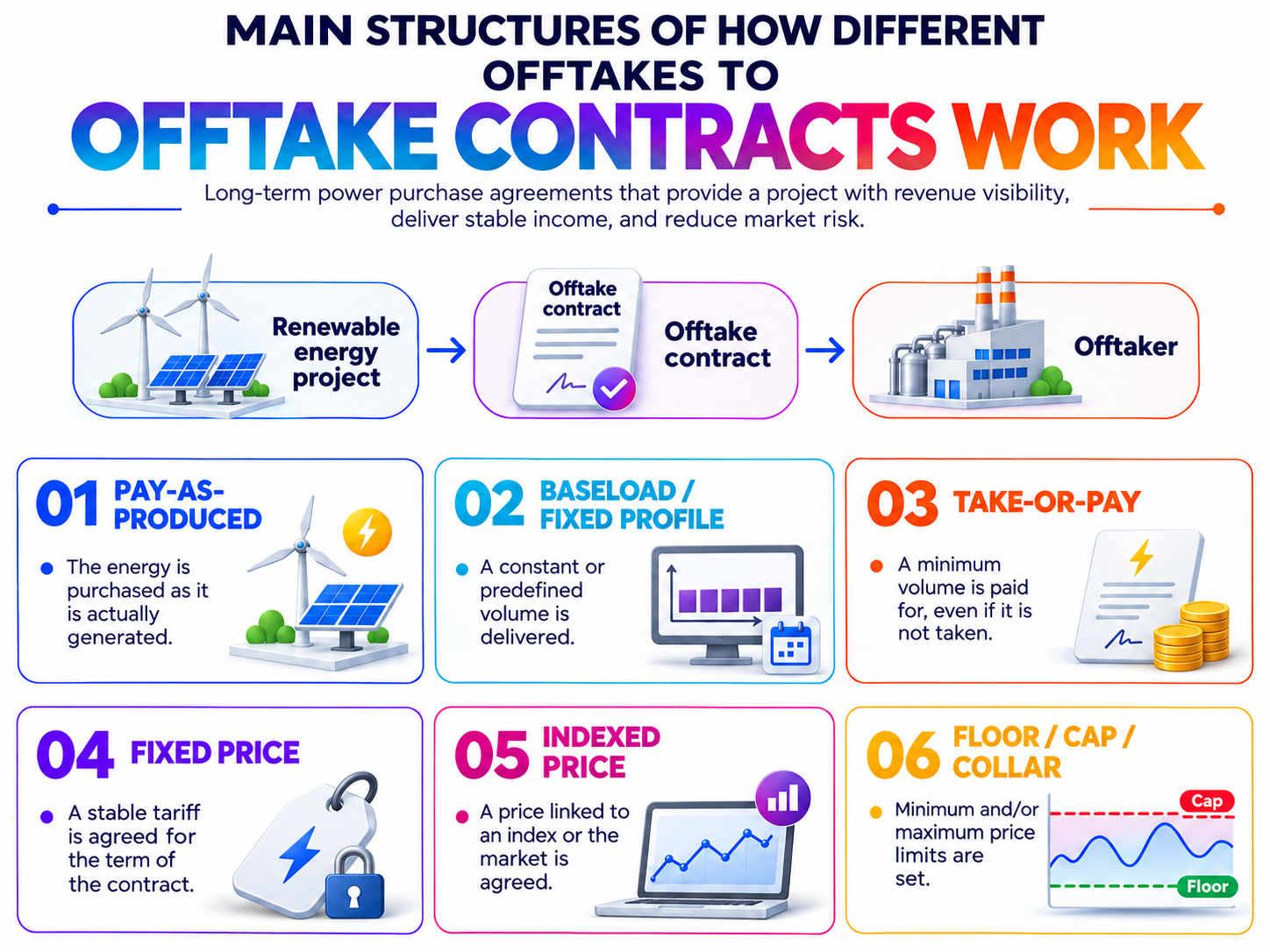
Energy project → offtake contract → Offtaker → consumption, supply or resale
In electricity, for example, an offtaker can buy a plant's output through a PPA. In LNG, the buyer may commit to purchasing specified cargoes or annual volumes. In hydrogen, an industrial company may sign a long-term contract to secure future supply while giving the producer revenue visibility. The European Commission defines PPAs as contracts under which a natural or legal person agrees to purchase electricity from a producer on a market basis. In practice, that buying party is the offtaker. European Commission.
How an offtake relationship works
An offtake relationship is built around four elements: product, volume, price and term. The contract must define what is being bought, how much the producer must deliver, how the price is calculated and how long the obligation lasts. In an electricity generation project, the offtaker may purchase all output, a fixed proportion or a specified profile. At a gas plant, it may contract a minimum annual volume. In a hydrogen project, the agreement may include specifications for purity, pressure, delivery and certification of origin.
The contract also determines who bears deviations. If actual output is lower than forecast, there may be an obligation to procure replacement supply, a penalty or simply a reduction in the billed volume. If the offtaker does not consume the committed amount, take-or-pay clauses may apply, requiring payment for some or all of the contracted volume even if it is ultimately not taken. In LNG and gas, long-term offtake contracts have historically been a tool for giving investors confidence before a final investment decision. The IEA explains that many liquefaction projects traditionally secured long-term supply contracts before reaching FID.
Types of offtaker in energy
Not all offtakers play the same role. The classification depends on the market and the ultimate use of the energy or product.
Utility or electricity company
A utility may buy energy from one or more producers to supply end customers. In regulated markets, it may also act as the principal buyer for generation projects.
Corporate or industrial offtaker
An industrial, technology, mining or services company may contract electricity or fuels directly to cover part of its consumption. In corporate PPAs, the buyer normally seeks price stability, protection against volatility and decarbonisation objectives.
Energy supplier, trader or aggregator
These entities buy energy to resell it, integrate it into their portfolios or manage it across different markets. They may assume profile, imbalance and market risks that the producer does not want to retain.
Public-sector offtaker
This may be a public company, a state entity or a publicly owned utility. In certain markets, its ability to pay and sovereign backing are central to financing.
Buyer of gas, LNG, hydrogen or fuels
In these sectors, the offtaker may be a refinery, chemical company, gas company, shipping company, fertiliser producer, infrastructure operator or distributor. Volume commitments, product specifications, logistics and take-or-pay clauses tend to be particularly important.
Main offtake contract structures
An offtake contract can take very different forms. There is no single model applicable to all energy assets.
- Pay-as-produced: the offtaker buys the energy actually generated and therefore assumes part of the profile risk.
- Baseload or fixed profile: a uniform or predefined quantity is contracted, requiring differences between actual output and contracted delivery to be managed.
- Take-or-pay: the buyer must pay for a minimum volume even if it does not physically take delivery.
- Fixed price: provides revenue visibility for the producer and cost visibility for the buyer.
- Indexed price: the tariff is linked to a market, index or formula, retaining greater exposure to prices.
- Floor, cap or collar: minimum and/or maximum limits are established to share market risk.
In electricity, many of these structures appear within a PPA. In gas or fuels, they may form part of an offtake agreement or long-term supply contract. In storage, the relationship may more closely resemble a Tolling Agreement, where the counterparty does not necessarily buy a fixed product, but rather rights to use the asset or its capacity.
Why the offtaker's creditworthiness is so important
For a bank, it is not enough for the project to produce energy. There must also be a high probability that the party committed to buying it can pay throughout the contract's life. This is why creditworthiness or the offtaker's financial soundness is one of the most important variables in project finance. A 15-year contract with a weak counterparty may provide less security than a shorter agreement with a financially sound buyer.
The World Bank notes that, if the offtaker is not sufficiently creditworthy, lenders may require additional guarantees, letters of credit, reserve accounts or sovereign backing. It also highlights that the offtaker's credit quality can become a critical factor in project bankability. World Bank PPP Resource Center.
What a lender assesses about the offtaker
The analysis is not limited to the credit rating. Lenders typically examine the counterparty's financial capacity and the quality of the contract itself.
| Element | What is assessed |
|---|---|
| Creditworthiness | Balance sheet, cash flow, debt, rating and ability to pay |
| Duration | Whether the term covers a sufficient portion of the debt |
| Price | Fixed, indexed, floor/cap and market exposure |
| Volume | Minimum quantity, profile and contractual flexibility |
| Guarantees | LC, parent guarantee, escrow, collateral or sovereign guarantee |
| Termination | Compensation, events of default and termination payment |
| Imbalances | Who bears imbalance, profile, curtailment and replacement supply risks |
This analysis explains why a good offtaker can increase a project's value even without paying the highest market price. Lower risk can reduce financing costs and improve the ability to raise debt.
Offtaker vs buyer, energy supplier and toller
The terms may overlap, but they do not mean exactly the same thing.
| Role | Function |
|---|---|
| Offtaker | Party assuming a contractual obligation to purchase the product or energy |
| Buyer | Generic term; may make one-off purchases without a long-term commitment |
| Energy supplier / trader | Buys and sells energy as part of a trading or portfolio activity |
| Toller | Obtains rights to use, convert or dispatch an asset through tolling |
| End consumer | Physically uses the energy or product; may or may not be the contractual offtaker |
An industrial company can be both an end consumer and an offtaker. An energy supplier can be an offtaker without physically consuming the energy. A toller can control an asset's operation without buying all its output through a traditional offtake contract.
Main risks in an offtake relationship
Offtake reduces uncertainty, but does not eliminate risk. It reallocates it between producer and buyer. The producer may be exposed to counterparty risk, non-payment or early termination. The offtaker may assume volume, price, profile or demand risk. Both may be exposed to regulatory changes, force majeure, congestion, curtailment, logistics or cost variations.
In long-term contracts, allocating these risks is as important as the price. An apparently attractive agreement may be difficult to finance if termination, guarantee or volume clauses leave the project too exposed.
Examples of offtakers by asset type
- Solar or wind plant: an industrial company signs a 10-year PPA and buys part of the output to cover its consumption.
- Thermal power station: a utility contracts capacity and energy to secure supply for its customers.
- LNG project: a gas company agrees to purchase several cargoes annually over a long period to secure supply and enable the facility to be financed.
- Hydrogen project: a refinery or fertiliser producer signs an offtake agreement guaranteeing minimum demand before the developer takes FID.
- BESS project: the counterparty may contract capacity or optimisation rights through a tolling structure rather than a traditional offtake arrangement.
What makes a good offtaker valuable to a project
A good offtaker is not simply the buyer offering the highest price. From the project's perspective, it adds value when it combines creditworthiness, contract duration, sufficient volume, clear guarantees and a financeable allocation of risks.
In projects with high CAPEXrequirements, securing stable demand can facilitate the final investment decision, reduce merchant exposure and improve debt terms.
During the development of an energy project, selecting the offtaker is therefore usually a financial and strategic decision, as well as a commercial one. The buyer shapes future revenue, asset risk and, in many cases, the project's very ability to be built.