
Agrivoltaics: what it is, how it works, and which crops and livestock can be integrated
Agrivoltaics is a model that combines agricultural or livestock farming with the generation of solar photovoltaic energy on the same site. It may also be referred to by terms such as agrovoltaics, agrophotovoltaics or Agri-PV.
A diferencia de una planta solar convencional instalada sobre suelo, una instalación agrivoltaica se diseña para que la producción energética conviva con el uso agrícola del terreno. Los módulos fotovoltaicos pueden instalarse a mayor altura, aumentar la distancia entre filas, utilizar estructuras verticales o incorporar sistemas de seguimiento que permitan mantener el acceso de maquinaria, trabajadores, cultivos o animales.
The The European Commission, through the Joint Research Centre (JRC), defines Agri-PV as the simultaneous use of land for solar photovoltaic generation and agricultural production. The European body regards this technology as an alternative for reducing competition between food production and renewable energy generation.
The potential impact is considerable: the JRC estimates that using just 1 per cent of the European Union’s utilised agricultural area for agrivoltaic systems could represent around 944 GW of photovoltaic capacity, although its actual development depends on technical, regulatory, agricultural and grid connection factors.
How does agrivoltaics work?
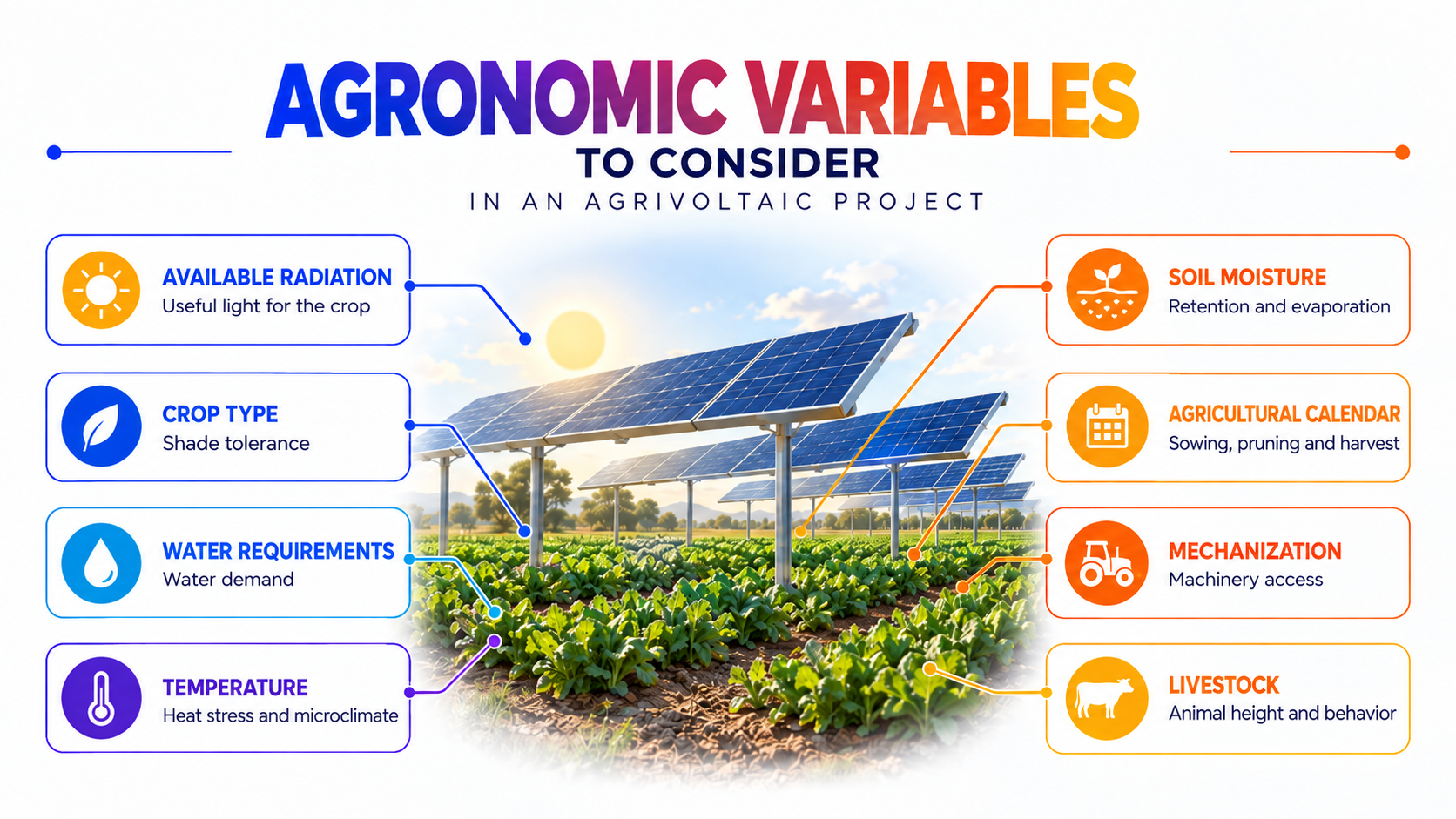
The principle of agrivoltaics involves designing a photovoltaic installation whilst taking into account both electricity generation requirements and the needs of agricultural activity. Solar panels intercept part of the sunlight to generate electricity, whilst the rest reaches the crops or areas used for livestock. The aim is not simply to install panels on agricultural land, but to achieve a dual and functional use of the land. The design must take into account variables such as:
- Height of the modules: this must allow for crop growth, the movement of animals or the passage of the necessary agricultural machinery.
- Row spacing: this determines the amount and distribution of radiation reaching the crops.
- Orientation and tilt: these affect both photovoltaic output and the distribution of light and shade across the site.
- Monitoring system: certain projects use solar trackers capable of adjusting the position of the modules and dynamically managing the balance between electricity generation and agricultural needs.
- Type of crop: each species has different requirements in terms of light, temperature and water.
- Climate and water availability: these determine whether the partial shading provided by the modules is an advantage or a limitation.
The panels also alter the microclimate beneath and around the installation. Shade can reduce direct radiation on the crop, alter soil temperature, partially reduce evaporation and provide protection against certain heatwaves. However, these effects are not always positive. Excessive shade can hinder the growth of certain species. For this reason, agrivoltaics requires the energy and agricultural components to be designed in tandem, rather than simply optimising photovoltaic output.
The IEA PVPS It emphasises, in particular, that the performance of an agrivoltaic system must be assessed in an integrated manner, taking into account photovoltaic generation, agricultural production, the microclimate and the specific characteristics of each site.
Solar panels, agriculture or livestock: which crops or animals are suitable for agrivoltaics?
A crop’s suitability for agrivoltaics depends on its tolerance to shade, its radiation requirements, the climate, the geometry of the installation and agricultural management practices. Consequently, there is no universal list of crops that will always yield better results when grown beneath solar panels. Among the most common or widely studied applications are:
- Vineyards: viticulture is one of the most promising applications of agrivoltaics in Europe. The structures can be designed to span the rows of vines and provide partial protection against extreme temperatures or certain weather conditions.
- Fruit trees: apple trees and other fruit trees can be combined with elevated photovoltaic structures. Depending on the design, the panels may also provide some protection against excessive radiation, hail or adverse weather conditions.
- Red berries: certain crops, such as raspberries, blackberries and blueberries, may thrive in partially shaded conditions provided the system is correctly sized.
- Leafy vegetables: lettuces, spinach and other crops with lower requirements for direct sunlight can be suited to certain agrivoltaic set-ups.
- Tomatoes and other vegetables: there are experimental and commercial projects investigating the balance between shading, temperature, water requirements and yield.
- Extensive crops: cereals, potatoes and other agricultural crops can also be integrated, although they require designs that ensure access for machinery and an appropriate distribution of radiation.
- Pastures and forage: the areas beneath or between the panels can be used to maintain vegetation for animal feed.
The FAO describes agrivoltaics as the combination of agricultural production and electricity generation on the same land, and highlights its potential to optimise land use, increase resilience to climate change and provide new sources of income for farms.
Agrivoltaics can also be integrated with livestock farms. In such cases, the land retains its productive function through grazing or activities related to animal husbandry whilst generating photovoltaic electricity. The most common example is sheep grazing on solar farms. Their size and behaviour make it easy for them to move between photovoltaic structures, whilst at the same time, grazing helps to control the growth of vegetation. Possible applications include:
- Sheep: these are probably the most common livestock species found on photovoltaic sites where grazing takes place. As well as making use of the land, they can reduce the need for certain forms of mechanical weed control.
- Cattle: can be accommodated in systems specifically designed with structures that are sufficiently high, sturdy and protected. Their larger size necessitates higher structural and safety requirements.
- Poultry: hens and other birds can use certain areas around or underneath the modules, making partial use of the shade provided by the structures.
- Beekeeping: some plants combine photovoltaic generation with vegetation that is favourable to pollinators and the siting of beehives. Although this does not constitute grazing, it represents another form of agricultural activity that is compatible with certain solar projects.
The IEA PVPS lists sheep grazing, beekeeping, vineyards and fruit orchards among the existing applications of agrivoltaics, reflecting the diversity of possible configurations. Not all species are equally suitable. When integrating livestock, consideration must be given to the height of the panels, cabling, electrical safeguards, access routes, water availability, animal behaviour and the risk of damage to the infrastructure.
Advantages and benefits of agrivoltaics
The main advantage of agrivoltaics is the possibility of making dual productive use of the same land: agricultural or livestock production and the generation of renewable energy. Its main potential benefits include:
- Optimisation of land use: this enables the development of photovoltaic power generation without necessarily eliminating existing agricultural activity.
- Renewable energy production: farms can generate electricity for their own use, for sale to the grid, or through various energy marketing models.
- Revenue diversification: electricity generation can provide an additional source of income for farmers, landowners and livestock farms.
- Reduction of heat stress: in certain crops and climates, partial shade can reduce the extreme temperatures experienced by plants.
- Reduced evaporation: reducing direct radiation on certain surfaces can partially reduce moisture loss from the soil.
- Crop protection: depending on their design, the modules can provide some protection against intense radiation, hail or other weather conditions.
- Animal welfare: photovoltaic structures can provide shade for livestock during periods of high temperatures.
- Less competition between agriculture and energy: dual use reduces the need to choose between using a plot of land exclusively for agricultural production or exclusively for photovoltaic generation.
Agrivoltaics is not simply a matter of installing photovoltaic modules over a crop, but rather of designing a system capable of simultaneously optimising electricity generation and agricultural productivity. To this end, agronomic variables such as photosynthetically active radiation (PAR) and the Daily Light Integral (DLI), leaf temperature, evapotranspiration, soil moisture and each crop’s specific response to shading, together with photovoltaic parameters such as plane irradiance, orientation, pitch, module height, bifaciality and tracking strategy. A moderate reduction in direct radiation may be beneficial for certain species in hot climates or those subject to water stress, as it lowers crop temperature and reduces soil evaporation; however, exceeding the tolerated level of shading can reduce photosynthesis and compromise crop yield. For this reason, the most advanced projects use trackers with agronomic control algorithms, capable of adjusting the angle of the modules not only to maximise the kWh produced, but also to dynamically manage the amount of light reaching the crop. Overall performance can be assessed using indicators such as the Land Equivalent Ratio (LER), which compares the combined agricultural and energy production obtained from the same area with what would be required if both activities were carried out separately. When the LER is greater than 1, the combined use of the land yields higher overall productivity than the separate use of the area for agriculture and photovoltaic generation. This approach makes agrivoltaics a multivariable optimisation problem, where the objective is not solely to maximise solar production per hectare, but to strike a balance between energy, agricultural yield, water consumption, microclimate and economic viability.
Example of the LER formula in agrivoltaics
Or, to put it more succinctly: LER = LERfarming + LERPV
Meaning:
- Crop LER = crop yield under the panels / yield of the same crop without a photovoltaic installation.
- LER FV = electricity generation from the agrivoltaic system / electricity generation from a conventional photovoltaic plant covering the same reference area.
The result has no units.
How to interpret it
- LER = 1 → the combined use of the land offers no advantage over carrying out the two activities separately.
- LER > 1 → Agrivoltaics makes better use of the land.
- LER < 1 → it would be more productive to allocate separate areas to agriculture and solar power.
A simple example
Let’s imagine a hectare used for growing tomatoes and for a solar installation.
1. Agricultural production
In conventional farming, we produce: 80 tonnes of tomatoes per hectare
With the agrivoltaic system, due to partial shading: 68 tonnes/ha
We calculate: LER_{crop} = 68/80 = 0.85 LER_{crop} = \frac{68}{80} = 0.85
This means that, under the agrivoltaic system, we maintain 85 per cent of conventional agricultural production.
2. Photovoltaic generation
Now let’s imagine that a conventional photovoltaic plant, optimised solely for electricity generation, produces: 1,200 MWh/ha per year
The agrivoltaic installation has greater spacing between rows and a lower module density, and therefore generates: 900 MWh/ha per year
We calculate: LERFV = 900/1,200 = 0.75 LER_{FV} = \frac{900}{1,200} = 0.75
An agrivoltaic installation therefore retains 75 per cent of the electricity generated by a conventional solar power plant.
3. We calculate the total LER
LER= 0,85 + 0,75 = 1,60
What does an LER of 1.60 mean?
This means that the combination of crop cultivation and solar power on one agrivoltaic hectare achieves a combined yield which, based on these figures, is equivalent to that which would require approximately 1.6 hectares if agriculture and photovoltaics were developed separately.
To put it simply:
1 agrivoltaic hectare ≈ 1.6 hectares of separate land uses in terms of combined productivity.
Although we lose 15 per cent of agricultural output and 25 per cent of photovoltaic generation compared with the two systems optimised individually, the combination of both activities makes the land much more productive overall.
Main types of agrivoltaic systems
Elevated agrivoltaics
The modules are mounted on structures that are taller than those used in a conventional photovoltaic plant. The space underneath remains available for crops, livestock or machinery. This model is particularly suitable for horticulture, certain extensive crops, fruit trees and farms where agricultural operations need to continue beneath the modules.
Inter-row agrivoltaics
The photovoltaic installation is designed to leave sufficient space between the rows of modules to maintain productive agricultural areas. This configuration can reduce structural complexity compared to very tall systems and makes it easier for certain tractors and agricultural machinery to pass through.
Agrivoltaics with solar trackers
Tracking systems can adjust the orientation of the modules throughout the day. As well as maximising electricity generation, an advanced control system can use different positions to manage the amount of sunlight available to the crop. In certain applications, the tracker’s control system allows agricultural or energy objectives to be prioritised temporarily, depending on weather conditions and the state of the crop.
Vertical agrivoltaics
Another configuration uses vertically installed photovoltaic modules, often featuring bifacial technology. The rows can act as dividers between different agricultural areas whilst ensuring that ample space remains available for cultivation. Bifacial modules can harness the radiation received on both sides, so factors such as the albedo del terreno también pueden influir en su producción energética.
Agrivoltaics in greenhouses
The modules can be integrated into greenhouse structures or combined with partially transparent photovoltaic materials. The aim is to use part of the radiation to generate electricity whilst maintaining suitable light conditions for the crops.