
String Box: what it is, what it does and when it is used in photovoltaics
A String Box is a direct-current electrical enclosure used in photovoltaic installations to combine several strings of solar modules, protect them and route their energy to the inverter. It may also be called a PV combiner box, string combiner box or DC combiner box.
Its function may seem simple—combining several inputs into a higher-current output—but in solar plants of a certain scale, the String Box becomes a critical point for protection, isolation and diagnostics. It may contain gPV fuses, surge protective devices, DC switch-disconnectors, busbars and individual string current monitoring systems.
To understand it, start with the photovoltaic string: several modules connected in series form a string; several strings can be connected in parallel inside a String Box before reaching the inverter.
A String Box therefore does not increase the energy produced by the panels. Its value lies in organising the DC array, protecting circuits, simplifying cabling and facilitating plant operation and maintenance.
The problem a String Box solves
In a small installation, a few strings can be connected directly to the inverter. The challenge arises as the photovoltaic array grows and tens or hundreds of strings must cover long distances to the conversion equipment. If each string had to run individually to the inverter, the number of cables, cable routes and required inputs would increase, as would maintenance complexity. The String Box acts as an intermediate point: it receives several DC circuits, combines them and provides a common output to the inverter or a subsequent combining stage.
String 1 + String 2 + String 3 + … → String Box → combined DC output → inverter
The IEC 62548-1 sets design requirements for photovoltaic arrays, including DC wiring, protective devices, isolation and earthing. The String Box is one of the places where many of these functions are implemented in an actual plant.
Main functions of a String Box
A modern String Box can perform several functions simultaneously. The exact configuration depends on the inverter, number of strings, DC voltage, current, plant architecture and monitoring strategy.
- String combining: connects several strings operating within the same DC architecture in parallel.
- Overcurrent protection: may incorporate gPV fuses to limit dangerous reverse currents between strings.
- Surge protection: SPDs help limit transient overvoltages caused, for example, by indirect lightning strikes.
- Isolation: allows the DC output to be electrically isolated for maintenance or other work.
- Monitoring: some models measure individual string current, voltage, fuse status, temperature or switch-disconnector position.
This last function is particularly relevant in plants at Utility Scale. If a String Box monitors each input, the control system can detect a string producing significantly less current than the others and trigger an alarm before the loss goes unnoticed for weeks.
When is a String Box used, and when might it be unnecessary?
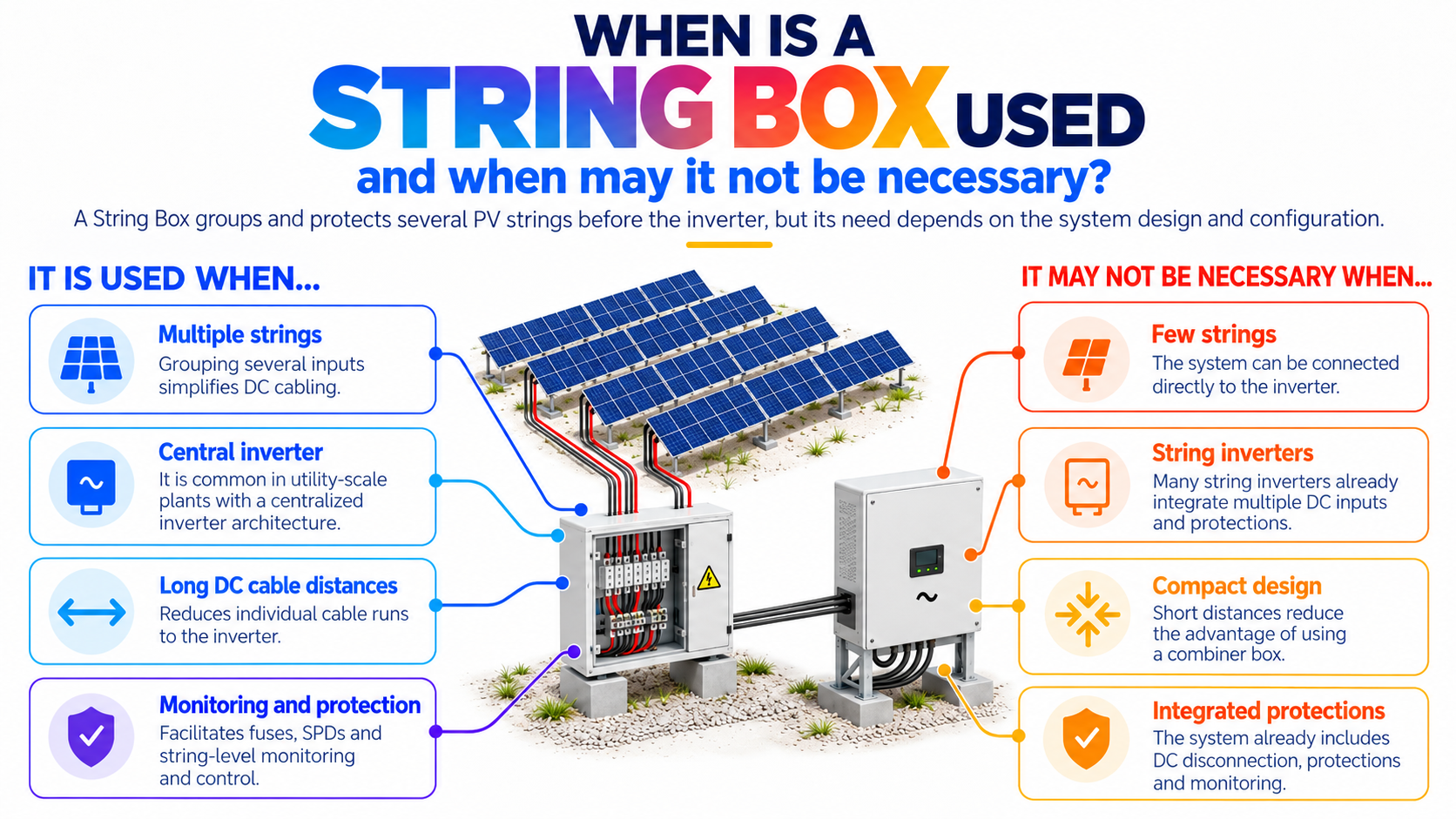
String Boxes are particularly common in photovoltaic plants with central inverters or architectures where many strings must be combined before reaching the conversion equipment. In these projects, they reduce the number of conductors running to the inverter area and improve the organisation of DC array protection.
They can also be found in industrial installations, large rooftop systems and plants with significant distances between modules and inverters. The greater the number of strings and the more spread out the solar array, the more valuable well-defined combining points become.
However, not every photovoltaic installation needs a separate String Box. Many modern string inverters incorporate numerous DC inputs, fuses, SPDs, switch-disconnectors and monitoring directly into the equipment. In those cases, strings can run to the inverter without passing through an external combiner box. The decision therefore depends on the architecture. It is incorrect to assume that a large plant always needs String Boxes or that a small installation never uses one. The number of inverter inputs, cable lengths, maximum current, integrated protection, maintenance, cost and monitoring strategy must be evaluated.
Which components does a String Box contain?
A String Box may look relatively simple from the outside, but its interior is designed to operate at high DC voltages and substantial combined currents. Typical components include input terminals, fuse holders, gPV fuses, busbars, SPDs, a DC switch-disconnector, a main output, sensors and communication modules.
The gPV fuses are used specifically for photovoltaic circuits. The IEC 60269-6 sets supplementary requirements for fuses intended to protect photovoltaic strings and arrays in circuits up to 1,500 V DC. Surge protective devices also require PV-specific equipment. The IEC 61643-31 covers SPDs intended for the DC side of photovoltaic installations up to 1,500 V DC.
In monitored String Boxes, Hall-effect sensors or shunts can measure the current of each input. Data are sent over industrial buses to the SCADA, enabling string comparison and alarm generation.
How a String Box is sized
Sizing starts with two basic variables: maximum DC voltage and current. The box must be rated for the maximum voltage the string can reach under the most adverse temperature conditions, while the busbars, conductors and switching devices must withstand the combined current of all connected strings. If N identical strings are connected in parallel, a simple approximation of the combined operating current is:
Ibox ≈ N × Istring
For example, if a String Box receives 16 strings and each operates at around 13 A, the combined current will be approximately:
16 × 13 A = 208 A
This does not mean that equipment rated at 208 A should automatically be selected. The actual design must consider safety factors, maximum short-circuit currents, environmental conditions, internal temperature, simultaneity, device ratings and regulatory requirements. The electrical compatibility of the combined strings must also be checked. Combining strings with very different orientations, shading, module counts or characteristics in the same circuit can cause losses and make MPPT tracking more difficult. The architecture must be coordinated with the inputs and MPPTs available in the inverter.
Why the String Box matters for safety and O&M
In a large-scale photovoltaic plant, a String Box brings many DC connection points together in a single enclosure. This makes it convenient for operation, but also creates a point where a poor connection can cause overheating, electrical arcing or loss of availability.
Common faults include blown fuses, loose terminals, moisture ingress, degraded SPDs, overheated connectors, corrosion, measurement errors and abnormal differences between strings. Some of these problems do not shut down the entire plant: they simply reduce production in part of the array and can remain hidden without adequate monitoring. As part of a strategy for O&M, String Boxes are usually checked through visual inspection, thermography, torque checks, SPD and fuse inspection, and analysis of individual string currents.
A persistent difference between comparable strings can be the first sign of soiling, shading, module failure, connector problems or an electrical fault. In this sense, a monitored String Box does more than combine energy: it also acts as a diagnostic point for the photovoltaic array.
String Box, Junction Box and inverter DC enclosure: they are not the same
The terminology can be confusing. The junction box of a photovoltaic module is the small box on the back of the panel where internal connections are made and bypass diodes are usually housed. It is not a String Box.
The String Box receives several complete strings and combines them in parallel. By contrast, some inverters internally incorporate the protection devices and functions traditionally housed in an external String Box, so there may be no separate visible enclosure.
Other terms used include combiner box, PV combiner box, array box or string combiner box. Although these terms are used interchangeably in many projects, the exact nomenclature depends on the manufacturer and on whether the box combines strings, outputs from other combiner boxes, or additional protection and monitoring functions.