
Front of the Meter (FTM): what it is and how it works in energy
Front of the Meter (FTM) describes energy assets located on the grid side of the consumer’s electricity meter. These are installations connected directly to the power system whose main function is not to reduce a single user’s bill, but to generate, store or manage energy for the grid and electricity markets.
Typical examples include solar and wind plants at Utility Scale, along with BESS systems connected directly to the grid, substations and certain flexibility assets. The European Commission explicitly uses the term front-of-the-meter to refer to utility-scale storage connected to the power system.
The key idea is simple: if the asset operates on the grid side, it is Front of the Meter; if it is installed behind a consumer’s meter, it is Behind the Meter (BTM). Size helps distinguish some projects, but it is not the fundamental criterion: what matters is the connection architecture and whom the asset serves.
In the context of the energy transition, FTM assets are becoming increasingly important because they enable more renewable generation to be integrated, shift energy between hours, provide balancing services and deliver flexibility to the power system.
How does a Front of the Meter asset work?
An FTM asset exchanges energy directly with the grid through its own connection point. There is no consumer end load “before” that point that uses the generated or stored energy as a priority. The asset operates directly with the power system, and its behaviour is metered, scheduled and remunerated according to the applicable connection, market or contractual rules.
Energy asset → Substation / Connection point → Electricity grid → Market and consumers
A 100 MW solar plant connected to a substation is a clear example. All the energy produced is delivered to the grid, apart from internal auxiliary consumption. The same applies to an FTM BESS that charges from the grid or an associated plant and later discharges when there is greater economic value or a system need.
In Europe, the European Commission highlights grid-connected storage as a key source of flexibility, stability and reliability, particularly as the penetration of variable renewable generation increases. European Commission.
Which types of assets can be Front of the Meter?
FTM is not a specific technology, but a form of connection and operation. It can apply to generation, storage and other resources integrated directly into the grid.
Common examples include utility-scale solar and wind plants, large-scale BESS, hybrid generation-plus-storage installations, hydropower plants, long-duration storage assets and certain types of grid support equipment. Smaller projects connected directly to the distribution grid can also be FTM if they are not behind a consumer’s meter.
In a hybrid project, for example, a photovoltaic plant and a BESS can share connection infrastructure. The system can charge the battery with renewable generation, with grid electricity where the design and regulations permit, or with both sources, and then optimise their combined delivery to the market.
Coordination is usually managed through systems such as EMS, Power Plant Controllers and SCADA, which manage setpoints, connection limits, availability and responses to external signals.
Front of the Meter vs Behind the Meter
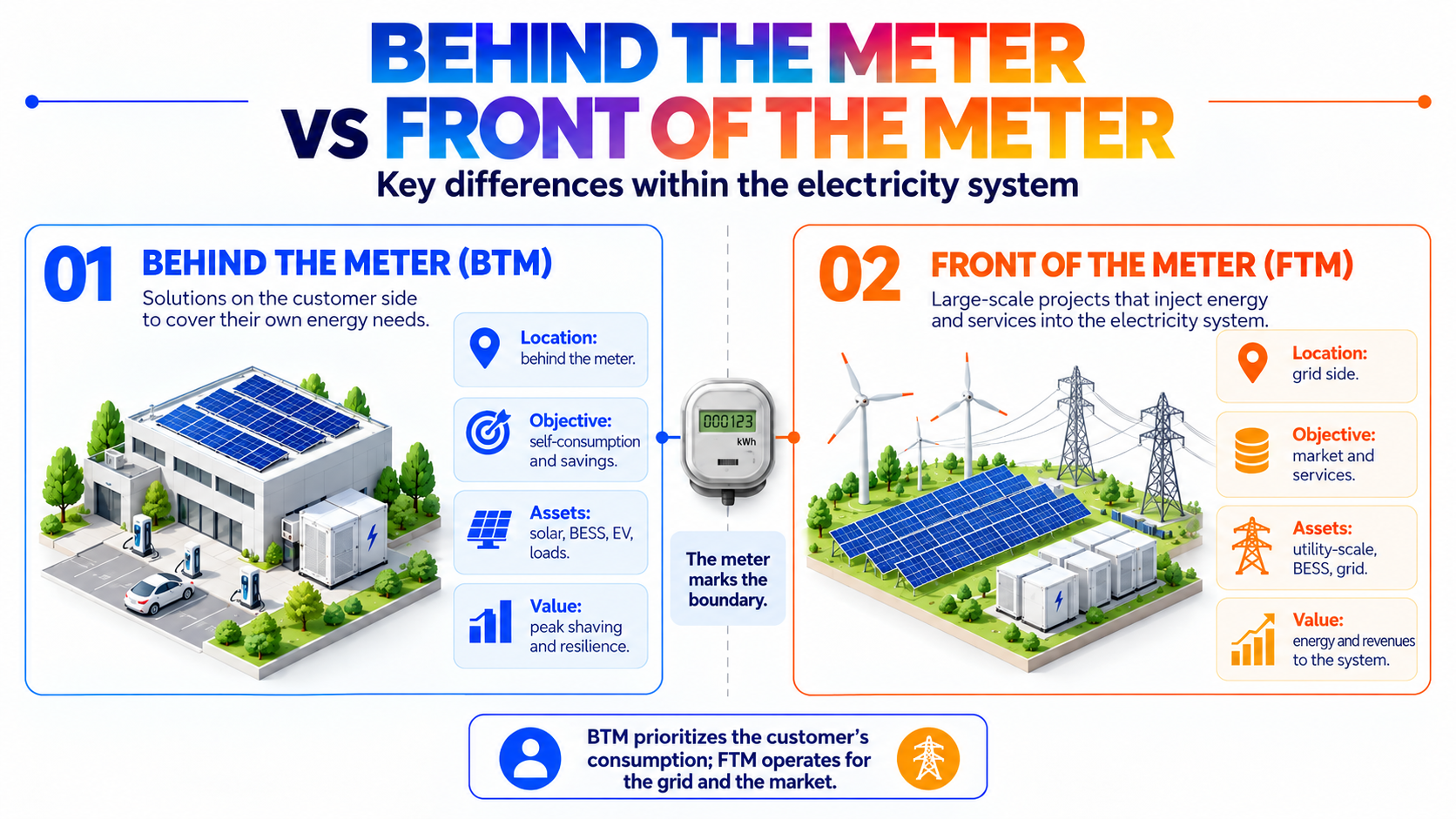
The difference between FTM and BTM is best understood by looking at what lies on either side of the meter and where the asset’s economic value comes from.
| Feature | Front of the Meter (FTM) | Behind the Meter (BTM) |
|---|---|---|
| Location | Grid side | Consumer side |
| Usual objective | Market, grid and electricity services | Savings, self-consumption and resilience |
| Solar example | Grid-connected utility-scale plant | Photovoltaics at an industrial facility |
| BESS example | BESS grid-scale | Battery for Peak Shaving |
| Source of value | Markets, contracts and grid services | Bill savings and supplementary revenue |
A 5 MW battery can be FTM or BTM depending on how it is connected. If it has its own connection point and provides services directly to the system, it is FTM. If it is inside a factory and affects the demand recorded at that facility’s meter, it is BTM.
What services does an FTM asset provide?
The value of a Front of the Meter asset depends on the technology and the market in which it operates. A renewable energy plant earns revenue mainly from the energy generated, through the market, a PPA or other mechanisms. A BESS can combine several revenue streams and change strategy throughout the day.
The most common uses of FTM storage include energy arbitrage, shifting energy from lower-price hours to higher-value hours; balancing and frequency services; congestion management; capacity; voltage and reactive power support; renewable energy integration; and curtailment reduction. Some architectures can also provide black start or advanced grid functions where the technology and technical framework permit.
ACER defines flexibility as the power system’s ability to adapt to changes in generation, consumption and grid availability, and identifies storage, flexible generation and demand response as essential resources for balancing the system and reducing congestion. ACER. In merchant projects, the challenge is deciding which service offers the most value at each moment. An EMS can therefore reserve part of the BESS power capacity for a balancing market while using the remaining capacity for arbitrage. This combination is commonly known as revenue stacking.
What does a Front of the Meter project need?
The first requirement is a technically viable connection point. Grid capacity, short-circuit levels, voltage limits, congestion, protection systems and operator requirements determine the power the asset can inject or absorb. Substations, transformers, protection, revenue metering, telecommunications and control then come into play. In an FTM BESS, the PCS, battery racks, HVAC, fire protection systems, energy capacity, degradation and operating strategy must also be properly sized or accounted for in the design. Digital integration is critical. An FTM project needs to exchange setpoints and data with operators, markets and internal platforms, so SCADA, EMS, remote metering and cybersecurity systems form part of the asset’s operational infrastructure.
Beyond engineering, access and connection, permits, contracts, the revenue model, financing and grid code compliance must be addressed. In large projects, connection risk and revenue visibility can be as important for bankability as the technical performance of the equipment.
When does Front of the Meter make sense?
FTM makes sense when the main objective is to provide value directly to the power system or the market. It is the natural model for large renewable energy plants, merchant BESS, storage for grid services and assets designed to operate in response to price signals or operator setpoints. For storage, profitability can be expressed in simplified terms as:
FTM value = energy + grid services + capacity + other revenue − CAPEX − OPEX − degradation − connection costs
An FTM BESS can be attractive in systems with high price volatility, flexibility needs, congestion or markets that remunerate fast-response services. However, a large spread between maximum and minimum prices does not by itself guarantee profitability: round-trip efficiency, degradation, cycling, availability, access costs and competition from other assets must be considered.
FTM and BTM are therefore not competing models. They address different needs. BTM primarily optimises the consumer’s energy use; FTM optimises the asset’s value in relation to the grid and the market.