
Energy arbitrage: what it is, how it works and when it is profitable
The energy arbitrage process is a strategy that exploits differences in electricity prices at different times to reduce costs or generate revenue. The basic logic is familiar: buy, consume or store energy when it is cheap and use or sell it when its value is higher. However, in a real project, arbitrage does not depend solely on the spread between prices: efficiency, losses, degradation, market costs and the asset's operating constraints also matter.
The term is often associated with batteries, although it is broader. It can apply to a BESS connected to the grid, behind-the-meter storage, pumped hydro, thermal storage, electric vehicles or even industrial loads capable of shifting consumption to cheaper hours.
In markets with variable prices, arbitrage turns flexibility over time into economic value: electricity is not worth the same at every hour, and a flexible asset can decide when to buy, consume, store and sell.
The opportunity is growing as renewable penetration increases. ACER notes that larger intraday price changes create opportunities for storage and demand response, while the IEA highlights that energy shifting has become one of the dominant applications of grid-scale batteries.
How energy arbitrage works
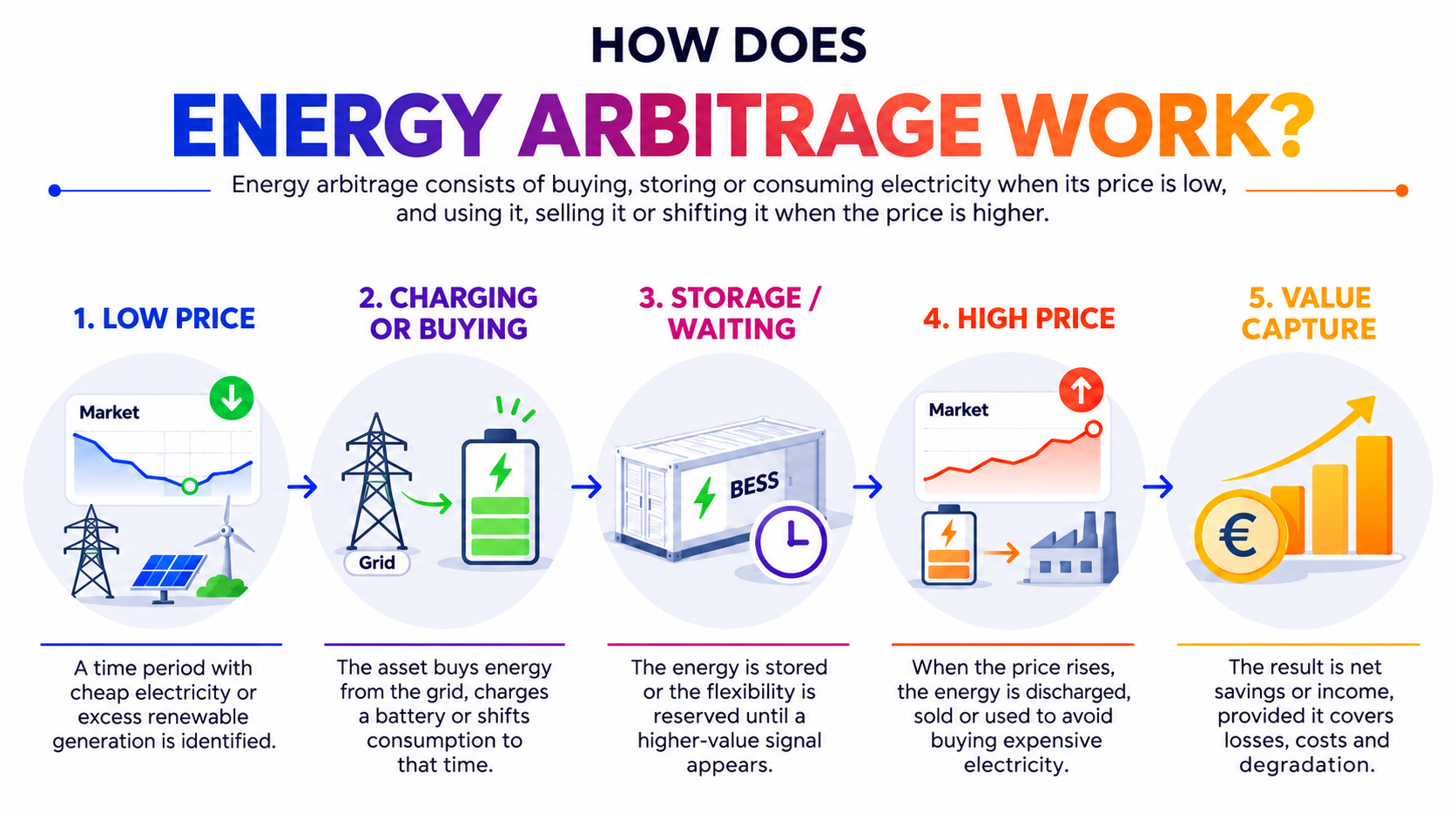
Energy arbitrage starts with a price signal. A control system analyses how much electricity costs now and what it could be worth in later hours. If the difference is sufficient to cover losses and costs, the asset shifts energy over time.
Low price → purchase / charging → storage or shifting → high price → discharge / avoided consumption / sale
In a utility-scale BESS, for example, the battery can charge during periods of abundant renewable generation and low prices, then discharge when demand and prices rise. In an industrial facility, the battery can do the same while avoiding expensive electricity purchases behind the meter. A flexible load can also perform arbitrage without a battery: it simply shifts some consumption to lower-cost periods. The ACER highlights that price fluctuations create arbitrage opportunities for storage and demand response: energy can be stored or consumption increased when prices are low, and consumption reduced or energy supplied when prices are high.
The spread is not the profit: how actual arbitrage is calculated
One of the most common mistakes is to assume that simply subtracting the purchase price from the sale price is enough. A battery loses some energy during the cycle and also incurs usage-related costs. A simple approximation of the margin is:
Net margin ≈ (Eoutput × Psale) − (Einput × Ppurchase) − degradation − market costs
If round-trip efficiency is 90%, storing 1 MWh does not allow a full 1 MWh to be sold later. Approximately 0.9 MWh becomes available again for discharge.
Example: a battery buys 1 MWh at €40/MWh. With 90% efficiency, it subsequently delivers 0.9 MWh when the price reaches €100/MWh. Revenue would be €90, compared with an energy cost of €40. The gross margin would be €50 before deducting degradation, tariffs, additional losses and operating or market costs. A spread of €60/MWh therefore does not automatically equate to €60 of profit. The lower the efficiency or the higher the degradation cost per cycle, the larger the price difference must be for the operation to make sense.
The role of the EMS in arbitrage
Manual arbitrage is possible in simple systems, but in modern assets the strategy is usually automated through an EMS. This system combines market prices, demand forecasts, renewable generation, battery SoC, technical limits and other signals to decide when to charge or discharge. An advanced EMS does not merely look for the day's minimum and maximum prices. It can calculate which opportunities are worth pursuing, reserve capacity for other services, avoid low-value cycles and update dispatch when forecasts change.
In merchant assets, optimisation can use day-ahead and intraday market prices and be combined with balancing services. In an industrial facility, the EMS can work with indexed tariffs, photovoltaic generation, contracted power and forecast consumption.
Types of energy arbitrage by asset
The economic mechanism is similar, but the way value is captured varies according to the asset's location and the flexibility it can offer.
Arbitrage with Front of the Meter BESS
A BESS connected directly to the grid buys energy when market prices are low and sells it when prices rise. This is the purest form of merchant arbitrage. Profitability depends on spreads, efficiency, cycles, degradation, market access and competition from other batteries.
These assets do not usually operate solely through arbitrage. It is common to combine it with balancing services, capacity or other revenue sources through revenue stacking. The IEA notes that large-scale batteries increasingly combine energy shifting with other system services.
Behind the Meter and industrial arbitrage
In a factory, logistics centre or commercial building, the aim may be to avoid buying electricity during expensive hours rather than to sell it. The battery charges when costs are lower and discharges to supply internal consumption during higher-price periods.
This model can be combined with solar self-consumption: surplus energy is stored when it has little value and used later when it displaces a more expensive grid purchase. Here, the benefit is primarily measured as bill savings rather than market revenue.
Hydro arbitrage and other storage technologies
Energy arbitrage existed long before the lithium boom. Pumped hydro uses lower-value electricity to pump water to an upper reservoir and generates electricity later when the system needs it and prices are higher.
Arbitrage is also possible with thermal storage, compressed air, hydrogen or other technologies. The choice depends on the time horizon: some solutions are suitable for shifting energy by a few hours, while others can operate over longer periods.
Arbitrage through flexible demand
Storing electricity is not always necessary. An industrial facility can shift non-critical processes to cheaper hours; an HVAC system can preheat or precool a building; and a fleet of electric vehicles can concentrate charging when prices are lower.
In this case, arbitrage concerns the timing of consumption. Value comes from shifting demand over time without harming the production process or the final service.
Benefits of energy arbitrage
The most obvious benefit is economic: reducing the average cost of electricity or capturing revenue from price differences. However, a well-designed strategy can deliver more value.
- Reduces exposure to expensive hours for consumers with dynamic or indexed prices.
- Generates merchant revenue for assets capable of buying and selling energy.
- Increases the value of storage by using the battery when the spread justifies the cycle.
- Supports renewable integration by shifting surplus energy to periods of greater demand.
- Provides system flexibility by absorbing energy during periods of abundance and returning it when it is most needed.
The European Commission specifically highlights that storage can reduce price fluctuations, ease peak periods and enable consumers to adapt consumption to prices and their needs.
When energy arbitrage is worthwhile and when it is not
Arbitrage is worthwhile when the difference between low and high prices is sufficient to cover all associated losses and costs. Volatility helps, but it is not the only factor. A project must analyse the actual distribution of spreads, not just exceptional days. It must also consider round-trip efficiency, degradation cost, available cycle count, power and energy limits, network tariffs, market access costs, availability and regulatory constraints.
It may become less attractive when spreads are small, the battery loses too much energy, the cost per cycle is high or other services offer more value for reserving capacity. In that case, forcing an arbitrage cycle may destroy more value through degradation than it generates in the market. Competition also matters. As more storage enters a market, more capacity is available to buy during cheap hours and sell during expensive hours, potentially compressing some of the spreads that created the opportunity.
Energy arbitrage vs Peak Shaving, self-consumption and revenue stacking
These concepts are related, but they are not equivalent.
| Strategy | Main objective | Trigger signal |
|---|---|---|
| Energy arbitrage | Exploit price differences over time | Electricity price |
| Peak Shaving | Reduce maximum demand | Power peak / demand charge |
| Self-consumption | Consume self-generated energy locally | Renewable generation and demand |
| Revenue stacking | Combine multiple sources of value | Available markets and services |
The same BESS can do all four at different times. For example, it can store surplus solar energy, reduce a power peak, perform arbitrage during a price window and reserve part of its capacity for grid services.
Energy arbitrage in a system with more renewables
With more solar and wind power, periods of abundant energy and low prices become more frequent, but hours of lower renewable generation and high prices can also occur. This separation in time is precisely what creates value for flexible assets. Arbitrage helps move energy from periods of lower value to periods of higher value. It does not by itself eliminate the need for grids, flexible generation or balancing markets, but it does turn storage and flexible demand into tools capable of responding economically to system signals.
For an energy project, the question is not only 'What is the maximum spread?' but how many profitable spreads actually remain after accounting for efficiency, degradation and costs, and how often the asset can capture them over its service life.