
Balance of System (BoS): what it is, what it includes and why it matters
The Balance of System (BoS) is the set of components, infrastructure and auxiliary systems required for the main equipment of an energy facility to function, connect, be protected and operate safely. The term is used particularly in solar photovoltaics, but can also apply more broadly to wind, storage, distributed generation and other energy assets.
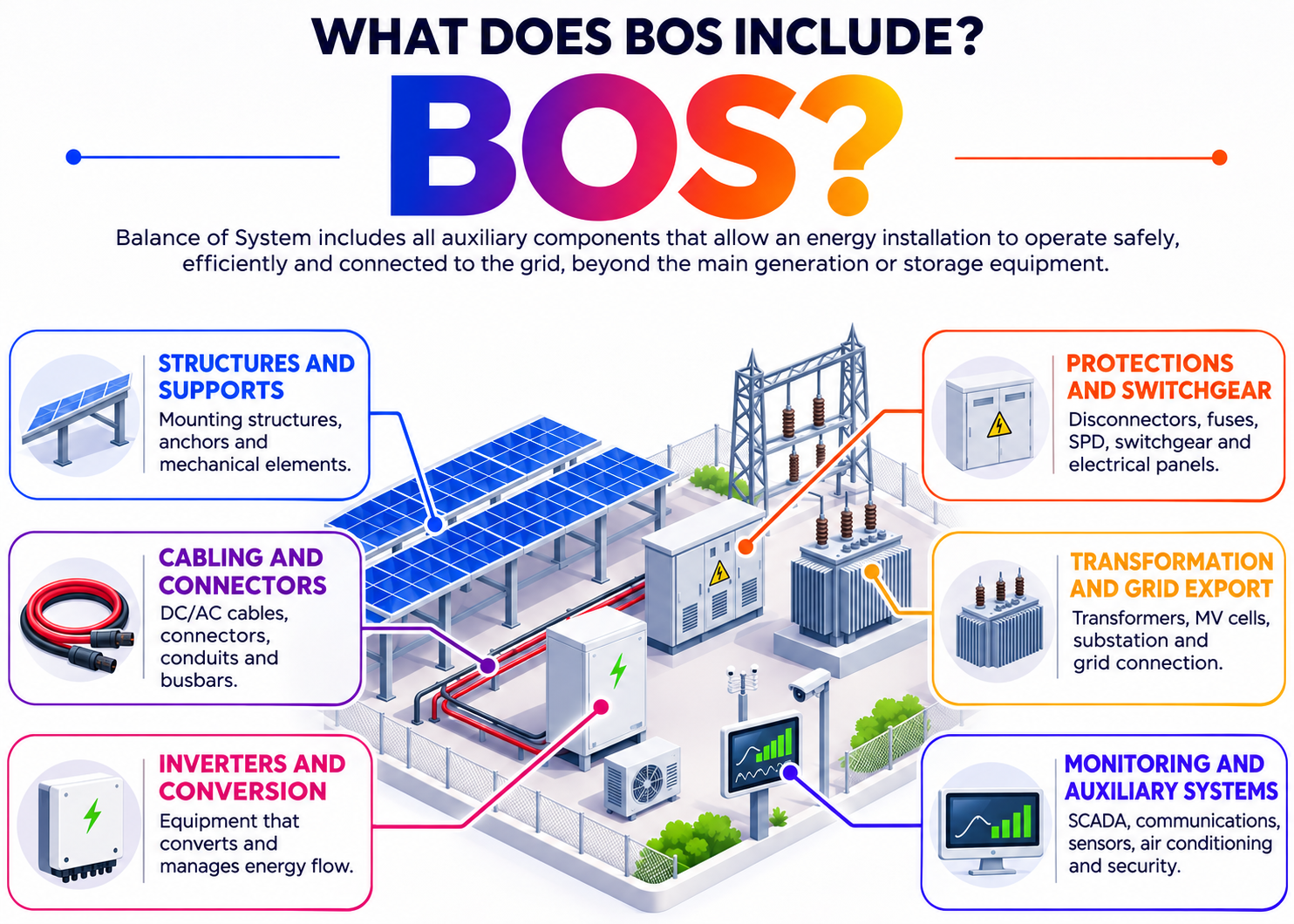
At a solar plant, for example, photovoltaic modules are the main generation equipment, while mounting structures, wiring, junction boxes, inverters, transformers, protection devices, communications, civil works and grid connection form part of the Balance of System to varying degrees, depending on the scope used.
BoS matters because a facility does not operate through its core technology alone. A module, wind turbine or battery needs a complete architecture that transports and converts energy, protects equipment, monitors the asset and connects it to the electricity system.
The Balance of System therefore directly affects CAPEX, performance, availability and reliability in virtually any energy project.
What does the Balance of System include?
The exact BoS scope varies with the technology and the project's contractual definition. In general, it can be grouped into four main areas: electrical, mechanical, civil works and control.
Electrical Balance of System
This includes the elements that collect, convert, distribute and protect electrical energy. They may include DC and AC wiring, electrical panels, protection devices, transformers, substations, earthing systems, generation export lines and grid connection equipment. In photovoltaics, the BoS may also include elements such as the String Box, fuses, disconnectors and surge protection devices.
Mechanical Balance of System
This covers the structures, supports and physical elements needed to install and keep the main equipment in its designed position. In solar, it may include fixed mounting structures or solar trackers; in wind, certain auxiliary tower and access systems; and in storage, racks, enclosures and integration structures.
Civil works and infrastructure
This includes roads, foundations, drainage, fencing, technical buildings, platforms, trenches, ducts and site preparation. Although these elements do not produce energy directly, they are essential for building, operating and maintaining the asset.
Control, communications and monitoring
SCADA, sensors, communications networks, control systems, metering and monitoring platforms may also form part of the BoS. Their role is to enable the different equipment to work together and give the operator real-time knowledge of the facility's condition.
BoS, CAPEX and OPEX: how they relate
The Balance of System directly affects both initial investment and subsequent operating costs. A cheaper design does not always make a project economically better. Reducing wiring, protection or redundancy may lower CAPEX, but can also increase losses, failures or repair times. Conversely, unnecessarily oversizing equipment can raise investment without providing an equivalent benefit.
Optimisation means finding the balance between upfront cost, efficiency, availability, safety and maintainability. This logic is reflected in the relationship between CAPEX and OPEX: a decision made during engineering can change costs throughout the asset's service life.
Balance of System within an EPC contract
Under an EPCcontract, the BoS usually represents a significant part of the engineering, procurement and construction scope. The contractor must integrate equipment from different manufacturers into a complete facility capable of meeting power, availability, safety and connection requirements. This involves coordinating interfaces. The main equipment manufacturer may guarantee its own product, but the EPC contractor must ensure that mounting structures, wiring, protection devices, transformers, control and connection work correctly as a system.
One of the main sources of risk lies precisely at those interfaces. If it is unclear who supplies, installs, configures or guarantees a BoS component, contractual gaps, delays or disputes may arise during commissioning.
What to review when designing the Balance of System
BoS must be designed around the asset's actual needs rather than as a simple collection of components. Key considerations include design power and voltage, environmental conditions, applicable standards, internal distances, losses, target availability, redundancy, accessibility and maintenance strategy. Interfaces with the grid and control systems must also be reviewed. In modern projects, communication between equipment is as important as the electrical connection. A poorly integrated system may limit power, hinder diagnostics or prevent the asset from properly participating in grid services.
In utility-scale projects, Balance of System is therefore an integration discipline. It does not generate energy itself, but determines how much energy can be harnessed, with what losses and reliability, and at what cost over the project's life.
Balance of System by asset type
The concept is particularly well known in photovoltaics, but its logic extends to many energy technologies.
BoS in a solar photovoltaic plant
In solar, the main equipment is normally the photovoltaic modules. BoS covers everything needed to convert that DC generation into usable electricity and export it: mounting structures, trackers, wiring, string boxes, inverters, transformers, protection devices, substation, communications, civil works and grid connection. In its cost analyses, IRENA usually separates module prices from other system costs, illustrating the economic importance of all the elements supporting the core technology. IRENA.
BoS in wind energy
At a wind farm, the wind turbine contains much of the technological value, but the project needs foundations, roads, a medium-voltage network, a substation, control systems, communications and grid connection. Offshore, BoS may carry even greater weight because of subsea cables, offshore substations, structures and logistics.
BoS in BESS
In a BESS, battery cells and modules are only part of the system. PCS, transformers, HVAC, fire protection systems, wiring, protection devices, EMS, communications, containers and civil works may be considered part of the BoS depending on the technical scope used.
BoS in other energy projects
An equivalent logic also applies in thermal generation, hydrogen, biomass and electrical infrastructure: a core technology needs auxiliary systems, balance of plant, electrical infrastructure and control to operate. In these sectors, the term Balance of Plant is more commonly used.
Balance of System vs Balance of Plant
Balance of System (BoS) and Balance of Plant (BoP) are sometimes used as synonyms, but their scope is not always exactly the same. BoS is particularly common in photovoltaics and modular systems. It usually refers to all components other than the main generation unit. BoP is more common in power stations, wind, storage and industrial projects, where it encompasses the auxiliary systems needed for the plant to operate.
| Concept | Typical use | Main idea |
|---|---|---|
| Balance of System | Solar, storage, modular systems | Components other than the main equipment |
| Balance of Plant | Power stations, wind, industry, major infrastructure | Auxiliary systems for the entire plant |
The boundary depends on the manufacturer, EPC contractor and contract. In a tender or financial model, it is therefore unwise to assume what BoS includes from the name alone: the technical and commercial scope must be reviewed.
Why the Balance of System matters
Good BoS engineering can make the difference between an asset that is simply built and one that operates efficiently for decades.
- Determines a significant share of CAPEX. As the cost of core technologies such as solar modules or batteries falls, structures, civil works, connection, transformation and other BoS components may represent an increasing share of total investment.
- Affects losses and performance. Cable cross-sections, transformers, inverters, electrical configuration and internal distances affect energy losses and net performance.
- Determines availability. A failure in a transformer, protection device, control system or auxiliary infrastructure can stop a plant even if the main equipment is in perfect condition.
- Affects maintenance. Accessibility, road layout, electrical panel organisation, redundancy and component quality influence O&M throughout the asset's life.