
BMS (Battery Management System): what it is, its functions and the risks it prevents
A BMS (Battery Management System) or Battery Management System is the electronic system responsible for monitoring, protecting and controlling a battery so that it operates within its electrical and thermal limits. In a BESS, the BMS is one of the most important control layers because it works directly with cells, modules and racks.
Its role is not simply to display a battery percentage. A BMS measures voltages, current and temperatures, estimates parameters such as State of Charge (SoC) and State of Health (SoH), manages contactors, controls cell balancing and can limit or stop charging and discharging when it detects a hazardous condition.
In other words, the BMS is the system that decides whether the battery can continue charging, continue discharging or needs protection. This decision is made continuously using thousands of data points and limits defined by the manufacturer.
In renewable energy and utility-scale storage, its importance increases because a management failure can affect not only one cell, but also the availability, safety and service life of an asset with several MWh of capacity.
What a BMS actually does: measure, estimate, decide and protect
A simple way to understand a Battery Management System is to divide its work into four steps. First, it measures what is happening inside the battery; then it estimates variables that cannot be measured directly; next, it decides which operation is permissible; and finally, it acts on contactors, current limits or alarms.
Measure → Estimate → Decide → Protect
Measured variables include individual cell voltages, module and rack voltages, current and temperatures. From these signals, the BMS calculates or estimates other fundamental parameters. SoC indicates approximately how much available charge remains in the battery. SoH expresses its state of health relative to its initial condition and may account for capacity loss, increased internal resistance or other indicators. These values do not come from a single sensor: they are obtained through models and algorithms that combine electrical measurements, operating history and the characteristics of the chemistry used.
In a Battery Rack, the BMS may be organised hierarchically. A module controller monitors groups of cells; a Rack BMS aggregates information from the rack; and a higher-level controller coordinates multiple racks and communicates limits to the PCS or EMS.
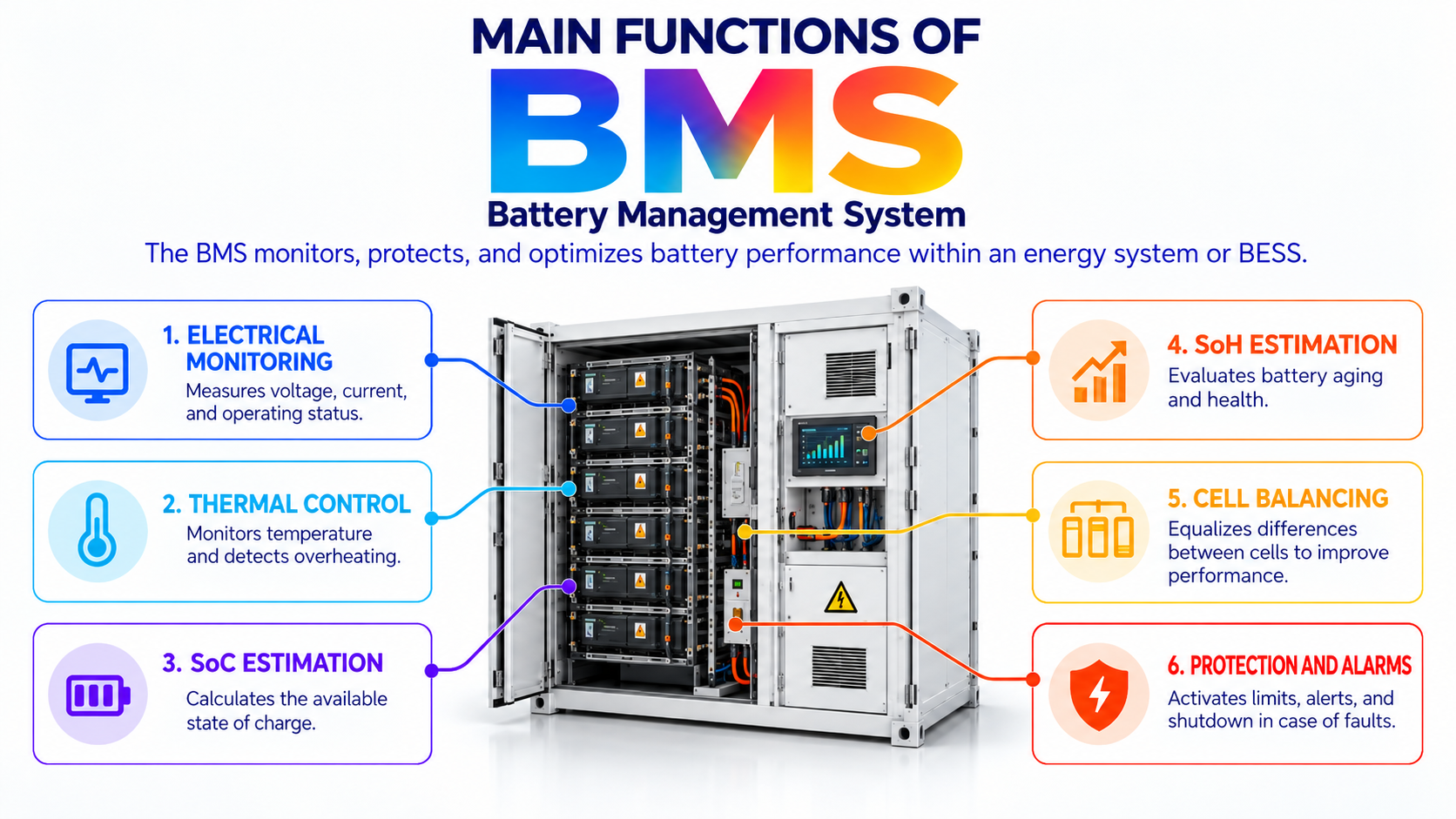
Main functions of a Battery Management System
The exact functions depend on the manufacturer and application, but a modern BMS usually brings together several critical responsibilities within a single electronic architecture.
- Electrical and thermal monitoring. It continuously checks voltages, current and temperature to detect deviations from the permitted limits.
- SoC and SoH estimation. It provides insight into the available energy and how the battery is ageing. This information influences operating decisions and performance guarantees.
- Charge and discharge control. The BMS can send maximum current or power limits to the PCS based on temperature, SoC, voltage and cell condition.
- Contactor and precharge management. It controls the rack's connection to and isolation from the DC bus and monitors sequences such as precharging before the circuit is fully closed.
- Cell balancing. It reduces differences between cells to prevent one of them from reaching its voltage limits first and restricting the capacity of the whole battery. Balancing can be passive or active, as explained in the article on the energy balancing process.
- Alarms, events and diagnostics. It records abnormal conditions and generates signals that can subsequently be integrated into SCADA, EMS or maintenance platforms.
Which risks a BMS prevents
The battery has a safe operating window. Repeatedly operating outside it can accelerate degradation and, under certain conditions, increase the risk of failure. The BMS acts as one of the main protective barriers against these situations.
1. Overcharge
If a cell exceeds its maximum permissible voltage, unwanted reactions, accelerated degradation and increased thermal risk can occur. The BMS detects which cell is approaching the limit and can reduce or stop charging even if the rest of the pack can still accept energy.
2. Overdischarge
Discharging a cell below its minimum voltage can also damage it. The BMS limits discharge when one of the cells reaches the lower threshold, preventing the system from continuing to draw energy from a battery that has already reached its operating limit.
3. Excessively high and low temperatures
Temperature affects performance, safety and the rate of ageing. The BMS can reduce current when an area of the pack gets too hot and block certain operations when the battery is outside its temperature range.
4. Overcurrent and short circuits
The BMS monitors current and can command contactors to open when certain thresholds are exceeded. However, it does not replace fuses, circuit breakers or dedicated protection devices: it acts as an additional layer within a coordinated safety architecture.
5. Cell imbalance
When one cell ages differently, it can become the limiting factor for the rack. The BMS identifies differences in voltage or SoC and uses balancing functions to reduce this variation and make better use of the available capacity.
6. Insulation faults or abnormal conditions
Depending on the architecture, the BMS can receive signals from insulation monitors, high-voltage sensors, thermal systems or other equipment. A serious anomaly can trigger power reduction, an alarm or rack disconnection.
Stationary battery safety is addressed internationally in standards such as IEC 62485-5, which covers electrical hazards, short circuits, fire and explosion in stationary lithium-ion batteries. For grid-integrated storage systems, IEC 62933-5-2:2025 addresses the safety of the BESS as a complete system and the interactions between its subsystems.
Where a BMS is used
A Battery Management System is found in virtually any modern battery where multiple cells must be controlled and safe operation ensured. Its complexity varies enormously according to the size and criticality of the application. In stationary BESS, the BMS can manage hundreds or thousands of cells distributed across modules and racks. In electric vehicles, it controls the traction battery pack and must adapt to highly dynamic power cycles. It is also found in industrial batteries, UPS, telecommunications systems, microgrids, residential storage, electric machinery and certain marine systems. In renewables, its role is particularly evident when solar or wind power is combined with storage. A hybrid plant may instruct the BESS to charge during periods of high generation and discharge later, but the EMS can only request that operation: the BMS determines what the battery can actually do at that moment.
BMS vs EMS vs SCADA vs PCS
These systems work together, but they do not perform the same function. Confusing them is one of the most common mistakes when describing the architecture of a BESS.
| System | Main function | What it controls |
|---|---|---|
| BMS | Protects and manages the battery | Cells, modules and racks |
| PCS | Converts energy DC ↔ AC | Electrical power |
| EMS | Optimises asset operation | Charge/discharge setpoints and strategy |
| SCADA | Monitors and records | Data, alarms and system states |
The EMS may decide that the asset should discharge at 5 MW because the price is high. The PCS carries out the power conversion. However, before accepting the setpoint, the BMS may indicate that only 3 MW is available from the battery because certain cells are close to their temperature or SoC limit. The SCADA system makes it possible to visualise that limitation and record the event, but it does not replace the BMS's protection logic.
What determines the quality of a BMS
Not all Battery Management Systems offer the same level of accuracy or sophistication. In storage projects, BMS quality directly affects the asset's usable energy, availability and degradation.
Measurement accuracy is fundamental. A small error in cell voltage can cause the system to leave too large a safety margin (reducing usable capacity) or approach an actual limit more closely than desirable. SoC and SoH algorithms, fault detection speed, communication robustness, balancing strategy and the ability to log historical data also matter. In utility-scale systems, there must also be clear coordination between the BMS, EMS, PCS and auxiliary systems.
A very conservative BMS can protect the battery well but unnecessarily limit its performance. An overly aggressive one can expose it to greater stress. Engineering is precisely about maintaining the balance between safety, performance, availability and service life.
Why the BMS is critical in a utility-scale BESS
In a large-scale BESS, small differences repeated thousands of times can lead to significant losses in capacity or availability. The BMS should therefore be assessed as more than just an electronic component: it is part of the asset's technical and economic strategy.
A system capable of accurately estimating SoC and SoH can make better use of available energy and help plan maintenance or capacity augmentation. Early detection of abnormal cells can prevent a local problem from developing into a module or rack failure. Reliable communication with the EMS and PCS enables the asset to respond precisely to grid services, arbitrage or renewable integration.
The IEC considers battery management and safety part of the technical ecosystem of electrical energy storage, together with the control, communication and protection systems needed to integrate BESS into modern electricity grids. IEC Smart Energy.