
SCADA: what it is and how it works in an energy asset
SCADA stands for Supervisory Control and Data Acquisition, a supervisory control and data acquisition system used to monitor and operate processes and infrastructure in real time or near real time. Although the concept is used in many sectors — industry, water, transport, oil and gas — in the energy sector it is central to operating solar and wind plants, battery energy storage systems ( BESS), substations, power plants, microgrids, and transmission and distribution networks.
The main function of a SCADA system is to collect field data, present it to the operator, record events and alarms, and enable certain remote control actions. This allows a control centre to understand what is happening at the asset without being physically beside every inverter, wind turbine, circuit breaker, transformer or battery.
SCADA should not be confused with a protection system or an economic optimiser. Fast-acting protection is usually implemented locally through relays, PLCs, controllers or systems such as the BMS, while an EMS (Energy Management System) can use SCADA data to decide how best to operate the asset from an energy or economic perspective.
In a modern project, SCADA therefore acts as a layer of visibility, supervision and operational control that connects field equipment with operators, higher-level management systems and maintenance platforms.
How does a SCADA system work?
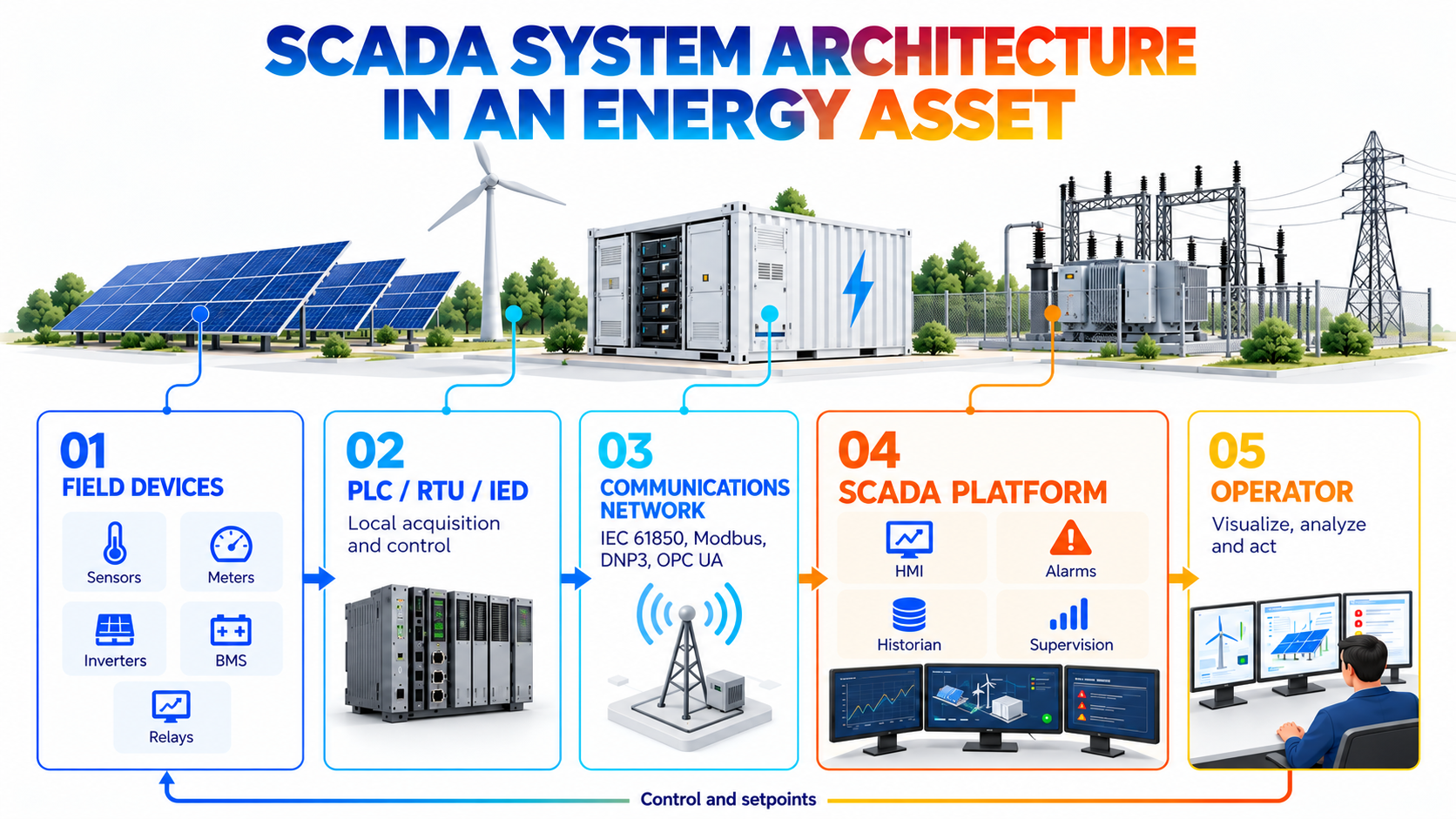
A SCADA system operates through a continuous flow of information between equipment installed in the field and a central supervisory platform. Sensors, meters, inverters, relays, RTUs, PLCs, plant controllers, BMS systems and other devices generate data that is transmitted through the communications network to the SCADA servers.
SCADA processes and organises this information for display through an HMI (Human-Machine Interface). From this interface, the operator can view statuses, trends, alarms, electrical measurements and single-line diagrams and, where the architecture allows, send control commands.
Field equipment → PLC / RTU / IED → Communications → SCADA → HMI / Historian / Alarms → Operator
SCADA control is normally supervisory: it coordinates and supervises, but does not replace local functions that require very fast response times. For example, in the event of a short circuit, tripping a protection device should not depend on a command travelling to a remote SCADA station and back. Critical functions are executed locally, while SCADA records the event, displays its status and facilitates operational recovery.
SCADA architecture in an energy asset
The exact architecture varies with the project's size and technology, but it is generally structured in several levels. At the lowest level are the field devices: sensors, meters, IEDs, protection relays, inverters, PCS, BMS, weather stations and auxiliary equipment. Above them, PLCs, RTUs or dedicated controllers aggregate signals and execute local logic.
The communications network carries data to SCADA servers, which manage visualisation, alarms, historical records and communications with higher-level systems. Larger projects generally include redundancy in servers, switches, power supplies, communications links and data storage to prevent a single failure from leaving the operator without visibility of the asset. In a plant operating at Utility Scale, SCADA can also integrate with a Power Plant Controller (PPC), an EMS, the owner's control centre and the interfaces required by the electricity system operator.
Which data does SCADA monitor?
An energy SCADA system can handle anywhere from hundreds to hundreds of thousands of data points. Not all have the same importance or update frequency. Some variables are used for operational supervision, while others support maintenance, performance analysis, contractual compliance or event reconstruction.
Typical signals include active and reactive power, voltage, current, frequency, cumulative energy, circuit-breaker status, power setpoints, equipment availability, temperatures, alarms, irradiance, wind speed and weather variables. In a BESS, these may also include SoC, SoH, rack status, PCS availability, charging and discharging limits, and the status of climate control or fire protection systems.
Data quality is critical. A signal with incorrect scaling, an unsynchronised timestamp or intermittent communications can lead to incorrect diagnoses, false alarms or wrong operational decisions. SCADA engineering therefore involves not only connecting equipment, but also defining point names, units, ranges, quality, alarm priorities and recording criteria.
SCADA in solar, wind, BESS and substations
SCADA adapts to the technology it supervises. In a photovoltaic plant, it displays production by inverter, availability, irradiance, temperatures, tracker status, meters and the substation. It also helps compare expected and actual performance and identify equipment that is limiting production.
- In a wind farm, SCADA receives data from wind turbines, the substation and auxiliary systems. It can display power, wind speed and direction, nacelle position, alarms, availability and operating states. Some of this data is subsequently used for performance analysis and predictive maintenance.
- In a BESS, SCADA integrates information from Battery Racks, BMS, PCS, transformers, HVAC, fire detection systems and meters. The system provides an operational view of storage, while the BMS keeps the batteries within their safety limits and the EMS can determine the charging and discharging strategy.
- In substations, SCADA integrates with IEDs, relays, controllers and switchgear. The IEC 61850 family provides communication models and mechanisms widely used in power system automation and has extended beyond substations to other energy resources.
SCADA vs EMS, BMS, PLC and PPC
One of the most common questions is where SCADA ends and other control systems begin. The answer depends on the manufacturer and architecture, but there are clear functional differences. SCADA supervises and records; an EMS optimises energy strategy; the BMS protects and manages the battery; a PLC or RTU executes local logic and acquires signals; and a PPC controls a plant's aggregate response at the point of connection.
| System | Main function | Example |
|---|---|---|
| SCADA | Supervision, alarms, historical records and remote control | Display the status of the entire plant and record events |
| EMS | Energy and economic optimisation | Decide when to charge or discharge a BESS |
| BMS | Battery management and protection | Limit operation based on temperature or cell voltage |
| PLC / RTU | Local logic and signal acquisition | Execute sequences and communicate with field equipment |
| PPC | Aggregate plant control | Maintain a MW, MVAr or power factor setpoint |
In real projects, these functions may be integrated into a single platform, but they should be distinguished conceptually. SCADA may allow the operator to change a setpoint, but that does not necessarily mean SCADA is the algorithm that calculates what that setpoint should be.
Communication protocols used in SCADA
SCADA is not a communication protocol. It is an architecture or platform that can use different protocols to exchange information with equipment and external systems. The choice depends on the technology, manufacturer, operator requirements and age of the installation.
| Protocol / standard | Typical use |
|---|---|
| IEC 61850 | Automation and communication in power systems, particularly substations and IEDs |
| IEC 60870-5-104 | Telecontrol between electrical installations and control centres |
| Modbus TCP | Communication with inverters, meters, PLCs and auxiliary equipment |
| DNP3 | Utility telecontrol and automation in certain markets |
| OPC UA | Interoperability and structured data exchange between platforms |
IEC highlights that IEC 61850 is much more than a protocol: it incorporates data models and automation functions that allow information to be described and exchanged meaningfully within the power system.
Alarms, Historian and performance analysis
SCADA does more than display instantaneous values. An essential part of its usefulness lies in preserving historical context. The Historian stores time series of relevant variables to reconstruct what happened before, during and after an incident, analyse trends and assess asset performance.
Alarm management also requires engineering. If a system generates thousands of alarms without prioritisation, the operator may lose visibility precisely when an important event occurs. Severity levels, delays, activation conditions, acknowledgement and alarm grouping are therefore defined to distinguish an operational warning from a critical condition. These data are particularly useful for O&M. Trends in temperature, availability, recurring faults, production losses or changes in behaviour can help identify problems before they cause an extended outage.
SCADA system cybersecurity
SCADA systems form part of the Operational Technology (OT) environment and can control physical infrastructure, so their cybersecurity must be designed differently from that of a conventional IT application. An intrusion can affect not only data, but also availability, control and operational safety. The IEC 62443 series establishes an international framework for the cybersecurity of industrial automation and control systems, including organisational and technical aspects throughout their life cycle. In the European energy sector, ENISA works specifically on cybersecurity risks and good practices applicable to energy infrastructure and ICS/SCADA.
Common measures include segmenting IT and OT networks, limiting privileges, controlling remote access, logging events, maintaining backups, managing patches, protecting credentials and designing redundancy. The connectivity required for remote operation must not unnecessarily expose the control system.
Why is SCADA important for operating an energy asset?
In an asset with hundreds or thousands of devices, operating without a centralised supervision platform would be inefficient and, in many cases, unfeasible. SCADA turns a large number of scattered signals into a coherent representation of the installation’s status, helping operators and maintenance teams prioritise actions and reduce diagnosis times.
It also provides traceability. When a disconnection, power limitation or loss of availability occurs, historical records help determine which device acted first, which alarms appeared and how the variables evolved. This information may be relevant to warranties, root cause analysis, contractual compliance and loss assessment.
SCADA quality therefore affects technical availability and the ability to manage an asset economically. A system that measures incorrectly, loses communications or generates inadequate alarms can conceal production losses and increase the time needed to correct faults, while a well-designed architecture improves operational visibility and decision-making.