
Permitting: what it is and how permits for an energy project work
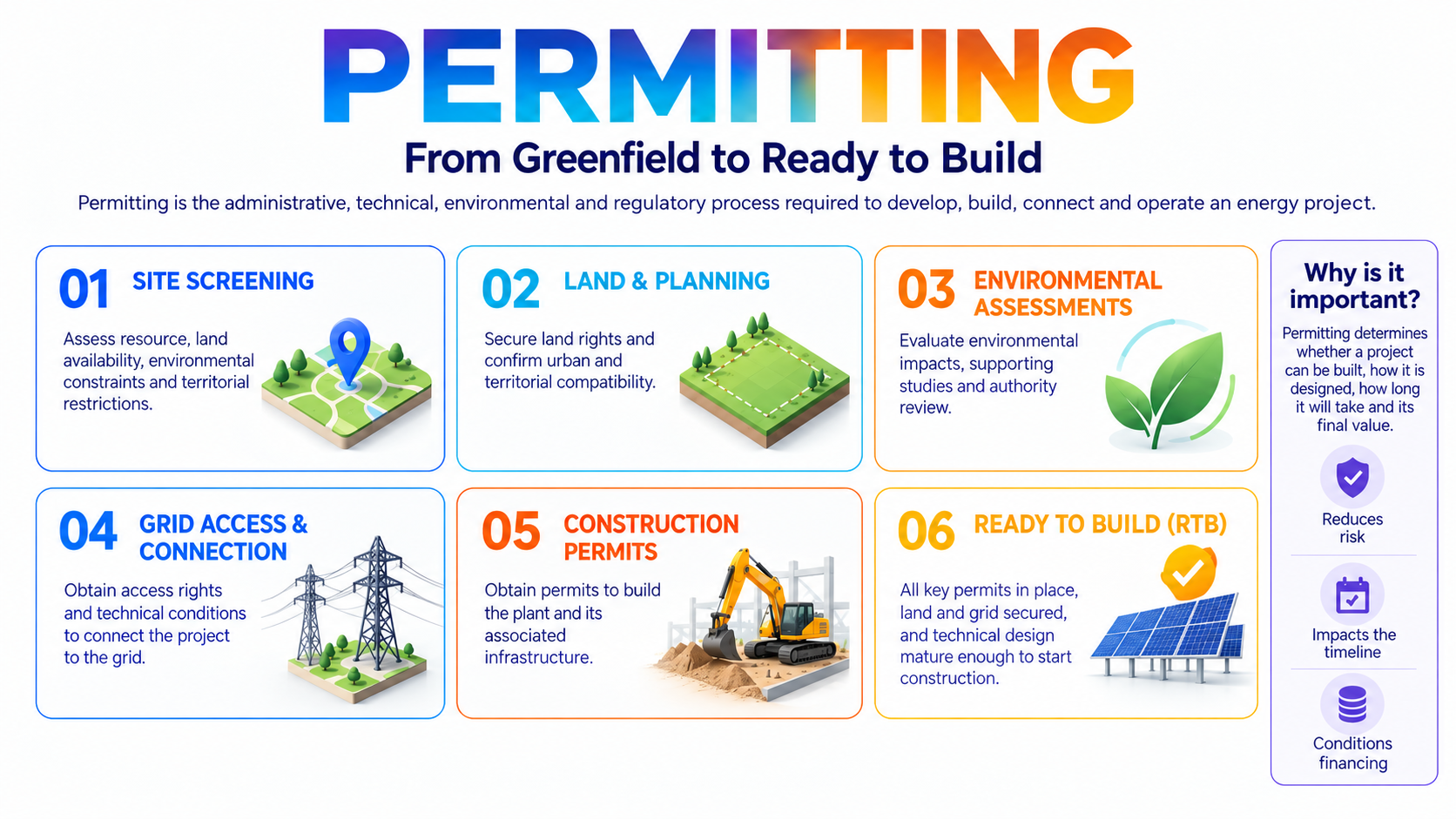
Permitting refers to the set of administrative, technical, environmental and regulatory procedures required to obtain the authorisations needed to develop, construct, connect and, ultimately, operate an energy project.
It is not a single permit. In a project Utility Scale, the permitting process may involve dozens of different authorisations, reports, consultations and rights relating to land, the environment, electricity supply, construction, water, heritage, roads, aviation or commissioning.
The term is used in virtually all energy infrastructure: solar photovoltaic plants, wind farms, facilities BESS, power lines, substations, power stations, hydrogen projects, grids, industrial facilities and offshore projects.
From a development and investment perspective, the permitting process is critical because a project may have access to excellent energy resources, land and technology, yet still be unfeasible if it does not obtain the necessary authorisations.
For this reason, investors, banks and developers analyse what is known as ‘permitting risk’ – that is, the risk that a permit may be delayed, subject to conditions, appealed against or even refused.
What does the permitting process for an energy project involve?
The exact scope of the permitting process depends on the technology, capacity, country, location and applicable legislation. There is no universal list of permits that applies to all projects. However, large-scale energy projects typically involve several categories of authorisations.
Environmental permits
Projects may require environmental assessment procedures designed to analyse their potential effects on the environment. These studies may cover aspects such as:
- Flora and fauna.
- Protected habitats.
- Birds and bats.
- Noise.
- Soil and water.
- Landscape.
- Archaeological heritage.
- Cumulative impacts.
- Preventive, corrective and compensatory measures.
In certain projects, the environmental assessment can become one of the factors that most influence the design. For example, the location of wind turbines may need to be adjusted to take account of bird flyways, whilst a solar power plant may need to exclude certain areas due to the presence of sensitive habitats.
Planning and land-use permissions
Before constructing a facility, it must be verified that the intended energy use is compatible with the site’s regional and town planning regulations. Depending on the jurisdiction, authorisations relating to land use, rezoning, town planning compatibility, planning permission or declarations of public interest may be required. Holding contracts relating to the land (for example, a lease option) does not necessarily mean that one has the administrative right to build on it.
Access to and connection to the electricity grid
Connection is one of the key elements in the development of any generation or storage project. The developer must determine where and under what conditions the asset can be connected to the electricity system. This may involve capacity studies, access applications, connection studies, technical requirements, financial guarantees and the construction of new infrastructure.
Although, from a legal perspective, access and connection are not always referred to simply as ‘permits’, from a development perspective they form an essential part of the permitting and grid connection process. In large-scale projects, the availability of land without a viable connection may be of very limited value. For this reason, grid capacity is one of the main constraints in the development of new energy assets.
Building and infrastructure permits
The project may also require specific permits to carry out the construction work on the plant and its associated infrastructure. These may include:
- Substations.
- Grid export lines.
- Roads and access routes.
- Infrastructure junctions.
- Watercourses and water management areas.
- Electrical installations.
- Foundations.
- Ancillary buildings.
In many cases, a power station may have obtained the main generation licences but still not be ready to start construction because it lacks a permit relating to a power line, a road or ancillary infrastructure.
Operating licence and commissioning
Nor does the permitting process necessarily end with construction. Before the asset reaches commercial operation, inspections, certificates, compliance tests, authorisations to energise the system and operating licences may be required. This phase relates to the commissioning of the asset and normally precedes the start of commercial operation.
What are the stages of the permitting process?
The permitting process usually runs in parallel with the engineering work, environmental studies, land negotiations, grid connection and the financial structuring of the project. In simple terms, it can be divided into the following stages:
1. Initial screening
Before investing significant amounts of capital, the developer assesses whether there are any obvious obstacles that would render the project unfeasible. This initial assessment may include:
- Availability of the energy resource.
- Distance to the connection point.
- Available network capacity.
- Soil classification.
- Environmental restrictions.
- Protected areas.
- Easements.
- Radar and aviation.
- Heritage.
- Topography.
- Accessibility.
2. Detailed studies and preliminary design
If the site passes the initial screening, a phase of more detailed studies begins. The layout may change many times as environmental, land, grid connection or construction constraints emerge. At a solar plant, for example, the initially available area may need to be reduced to respect watercourses, habitats, roads, existing lines, steep slopes or safety setbacks.
3. Submission of applications
Once a sufficient level of technical maturity has been reached, the developer submits the applications to the competent authorities. The quality of the application dossier is critical. Incomplete documentation may prompt requests for additional information, commonly known as RFIs (Requests for Information), which can significantly extend the timetable.
4. Assessment and consultation
The authorities review the documentation and may request opinions from different bodies. Depending on the project, there may also be public consultation procedures and consultations with public authorities, landowners, municipalities or other stakeholders.
5. Decision and conditions
Obtaining an authorisation does not always mean that the developer is free to implement the original design without restriction. Permits may include conditions precedent, environmental measures, construction constraints, works schedules, monitoring obligations or technical requirements that must subsequently be incorporated into the design and the contract for the EPC.
Permitting for solar, wind and BESS: is it the same for every technology?
No. Permitting varies considerably by technology and its potential impacts.
Permitting for a solar photovoltaic plant
In a utility-scale photovoltaic project, the following tend to be particularly important:
- Land use and occupation.
- Environmental assessment.
- Land-use planning compatibility.
- Grid access and connection.
- Grid export line.
- Substation.
- Construction permits.
- Heritage and archaeology.
- Watercourses, roads and other easements.
Permitting for a wind farm
Wind projects also involve specific issues related to the height and location of turbines. The aspects commonly assessed include birds, bats, noise, shadow flicker, landscape impact, radar, aviation and the transport of oversized components. In offshore wind, complexity increases because maritime authorisations, subsea cables, onshore connection, navigation and other uses of marine space must be coordinated.
Permitting for a BESS
The growth of energy storage has made BESS permitting an increasingly important area of energy project development. A battery project may require particular attention to:
- Fire safety.
- Separation distances between containers.
- Access for emergency services.
- Noise from HVAC, PCS and transformers.
- Thermal propagation risk management.
- Drainage.
- Grid connection.
- Building regulations.
In hybrid projects, such as solar plus BESS, some infrastructure can be shared, but adding storage may also change the scope of existing permits and the grid connection conditions.
Permitting, Ready to Build and the value of an energy project
One of the concepts most closely linked to permitting is Ready to Build (RTB). A project is generally considered RTB when it is sufficiently mature to begin construction: essential permits, land rights, grid connection and technical documentation are sufficiently advanced.
However, Ready to Build is not a universal legal definition. In a project sale and purchase agreement, the contract must specify exactly which permits, rights, guarantees and conditions must be in place for the asset to be considered RTB. This distinction is very important financially. A project may progress broadly through different levels of risk:
Greenfield → Early Stage → Advanced Development → Permitted → RTB → Construction → COD
As development risk falls, a project generally gains value because it is more likely to become an operating asset. Some developers therefore specialise in originating projects, securing land and grid connection, completing permitting and selling the projects before construction begins. For buyers, funds and financial institutions, permit due diligence is essential. It is not enough to establish that an authorisation exists: its validity, possible appeals, conditions, mandatory milestones and compatibility with the design that is actually intended to be built must also be assessed. All of this directly affects the project’s bankability
How does permitting affect profitability and CAPEX?
The main cost of permitting is not simply the amount of administrative fees. Delays can have a much greater economic impact because of the so-called cost of delay. A one-year delay may cause:
- Loss of expected revenue.
- Higher development costs.
- Extension of land agreements.
- Need to update studies.
- Changes in equipment prices.
- Changes in interest rates.
- Changes to financing terms.
- Risk to dates committed under a PPA.
- Expiry of certain permits or rights.
For this reason, two projects with the same capacity and technology can have very different valuations if one has advanced permitting and the other still faces substantial administrative risk. Progress in obtaining permits also affects the accuracy of the budget. In the early stages, CAPEX is based on numerous assumptions. As permitting is completed, the final layout, environmental measures, grid export infrastructure, additional works and conditions imposed by the authorities become clearer. This reduces uncertainty and improves the financial model before the FID (Final Investment Decision).
Renewable energy permitting in the European Union
The duration of authorisation procedures has become a strategic issue for European energy development. The European Commission recognises that lengthy administrative procedures can be a barrier to deploying new renewable capacity. The European Commission has promoted various measures to simplify and speed up permitting for renewables, grids and related infrastructure.
One of the main reforms is set out in Directive (EU) 2023/2413, known as RED III. Among other measures, the Directive establishes so-called renewables acceleration areas. For renewable projects in these areas, the permit-granting procedure should generally not exceed 12 months, while outside them the general limit is two years, subject to specific rules and exceptions depending on the type of project. Different time limits apply to offshore renewable projects.
RED III also introduces faster specific procedures for certain activities, including repowering, smaller installations, co-located storage and certain solar equipment. EU legislation does not remove environmental assessments or the obligation to meet applicable requirements. The aim is to make processes more predictable, coordinated and faster, particularly through advance planning, digitalisation, one-stop shops and areas selected in advance.
The same principle applies to certain strategic energy infrastructure. The European Commission provides for coordinated permitting procedures for Projects of Common Interest (PCI) and Projects of Mutual Interest (PMI), in which coordination between authorities, environmental studies and public participation is central to the process. Consequently, energy permitting should not be seen simply as bureaucracy before construction. It is a phase of engineering, risk assessment and development that determines what can be built, where, under what conditions, within what timeframe and with what degree of certainty the project can be financed.